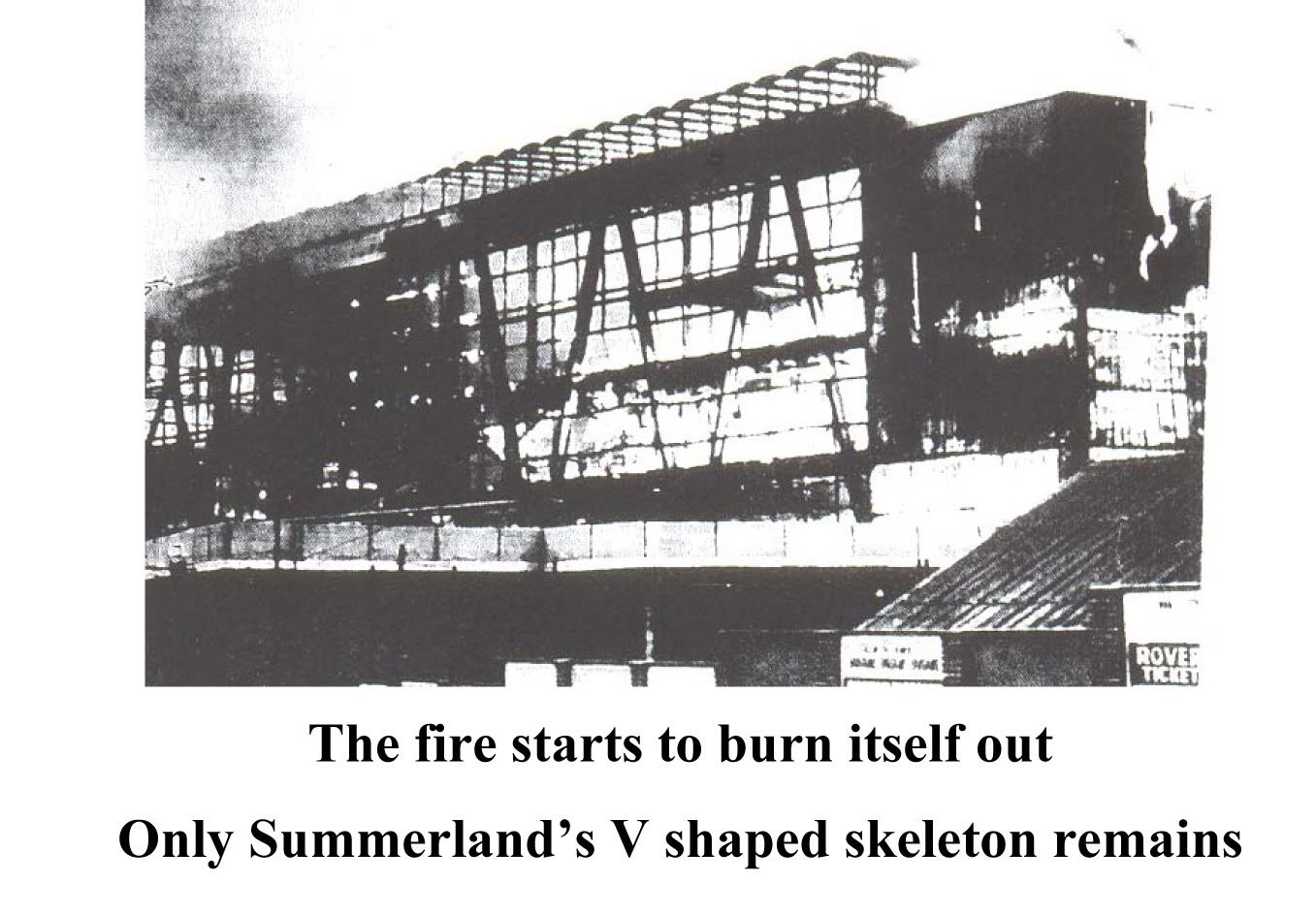
The word Summerland today conveys long pleasant golden days--the Lotus-Eaters' land in which it seemed always afternoon, a realm where the sun never set and the tiresome seasons never changed. This is because hardly anyone remembers what it meant to British holidaymakers in the dawn of the 1970s, or what it meant the morning of Friday, August the 3rd, 1973, when daylight revealed what was left of it.
It is interesting to compare the Summerland disaster to the King's Cross tube station fire. Fifty people died in Summerland, compared to thirty-one at King's Cross--but the King's Cross fire is mentioned far more often and gained far more media attention than did Summerland. Dr. Ian Phillips of the University of Birmingham has made what may be the most comprehensive and in-depth study of the Summerland disaster, which is well worth reading on its own; he muses that had a fire killed fifty holidaymakers in, say, Bournemouth, rather than on an obscure little island in the Irish Sea, it would have been a massive news story hailed as a national tragedy. He's right.
The Isle of Man is shaped roughly like a kipper. It is home to just over eighty thousand people, governed by the oldest parliament in the world, Tynwald; its flag shows a triskelion made of armored legs joined at the thigh. It has its own officially-recognised-as-a-legitimate-autochthonous-regional language, Manx Gaelic, and its indigenous Loaghtan sheep produce a particularly fine and much sought-after meat. And in 1971, it became home to a new concept in leisure: the first modern, completely climate-controlled, indoor holiday sports and entertainment center ever built in Britain.
Summerland in context
As the Sixties waned, the popularity of the British seaside holiday was fading in favour of cheap group tours to the Mediterranean. Spain in particular was attracting more and more lower-to-middle-class Britons who might otherwise have gone to Bournemouth or Minehead or even the Isle of Man for their summer hols. And honestly, anyone who's been to the British coastline in summer prior to, say, 2004 and the advent of summer temperatures regularly above eighty F would have to agree with them. British beaches are a) cold, b) windy, c) rainy, d) spiky or stony and e) all of the above at times, plus packed with hundreds of thousands of other determined holidaymakers and their porky children buying ice-creams and sticks of rock and cheap plastic pails and shovels to make sandcastles with. There's a certain dogged one-upsmanship associated with British holidaymaking: no matter how foully cold and rainy and disgusting it is, you are at the damn seaside and you are damn well going to paddle in the sea even if the sea is forty degrees fahrenheit and the colour of wet slate and everybody else is wrapped up in towels and anoraks and going "ooh isn't it cold." It is this mentality the planners of Summerland wished to exploit: instead of going off to Ibiza or Torremolinos or some other mucky foreign place where you were bound to get the runs, you could just nip off to the Isle of Man (a proper British holiday destination with regular ferries from places like Blackpool) and spend a fortnight in the endless tropical climate-controlled sunlight of Summerland.
The plot on which the Summerland/Aquadrome complex was constructed had long been used as a holiday/amusement park site. Located at one end of the promenade of Douglas, which became the Isle's capital in 1869, the site had first been developed in the 1790s for a structure called Derby Castle--at the time not even incorporated into Douglas, joined by a causeway. In the later 1800s the Castle property was bought by a gent who noticed the major uptick in tourist visits to the Isle and decided to capitalize on same by building what was in effect a prototype for Summerland: an entertainment center including a theater, ballroom, and restaurant/bar. There was even a roller-coaster and firework displays.
By the end of the 1800s the Derby Castle Company had merged with the other entertainment-venue companies vying with it for patrons. Through the World Wars, the entertainment center was used for various purposes such as factory work and storage for valuables from hotels used as internment-camps. It was said to be cursed; that anything built upon it would meet a sticky end.
After 1945 the Derby Castle property was bought by the "Douglas Corporation" in order to be redeveloped into a brand-new entertainment center designed to draw holidaymakers from the delights of the Mediterranean package holiday by replicating the attractions it theoretically offered. With the diminishing tourist trade and the lack of interesting and non-weather-dependent attractions in Douglas, the Isle wanted to create a center to entertain visitors even during truly awful weather. "The design presented," says a booklet produced by the Island's Development Company in 1972 (The Summerland Story, 1972, p.25), "is based on the idea of creating an environment where the sun always shines – an area in which the weather can be guaranteed and where every activity connected with a seaside holiday can be enjoyed by all ages. The scheme envisages, therefore, the maximum possible area enclosed by a structure designed to admit the maximum sunlight, implemented by artificial means, to create a permanent atmosphere of sub-tropical climate. Within this area it is aimed to produce a sense of being in the open air without the climatic hazards."
The arguments and agreements and parliamentary squabbling surrounding the development of what was to become Summerland are neither interesting nor uplifting. Suffice it to say that initially the swimming-baths (pool complex/Aquadrome) were definitely Wanted by the Isle government and money toward their construction was earmarked. At this point architects got involved--and at this point we start to see the inevitable confusion building. Perhaps Frank Gehry's architectural abortions aren't so bad after all: so far none of them has actively killed anybody.
The architects
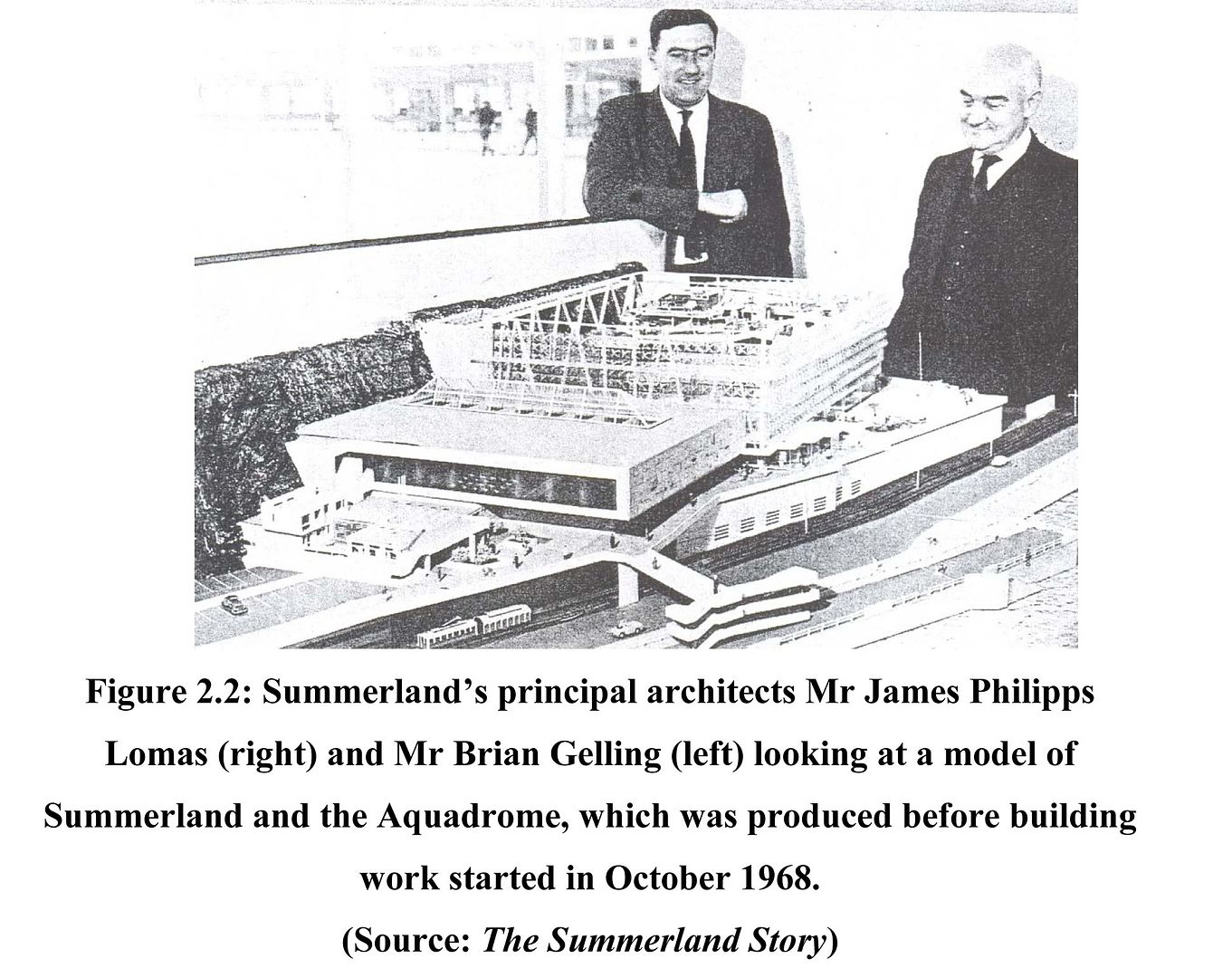
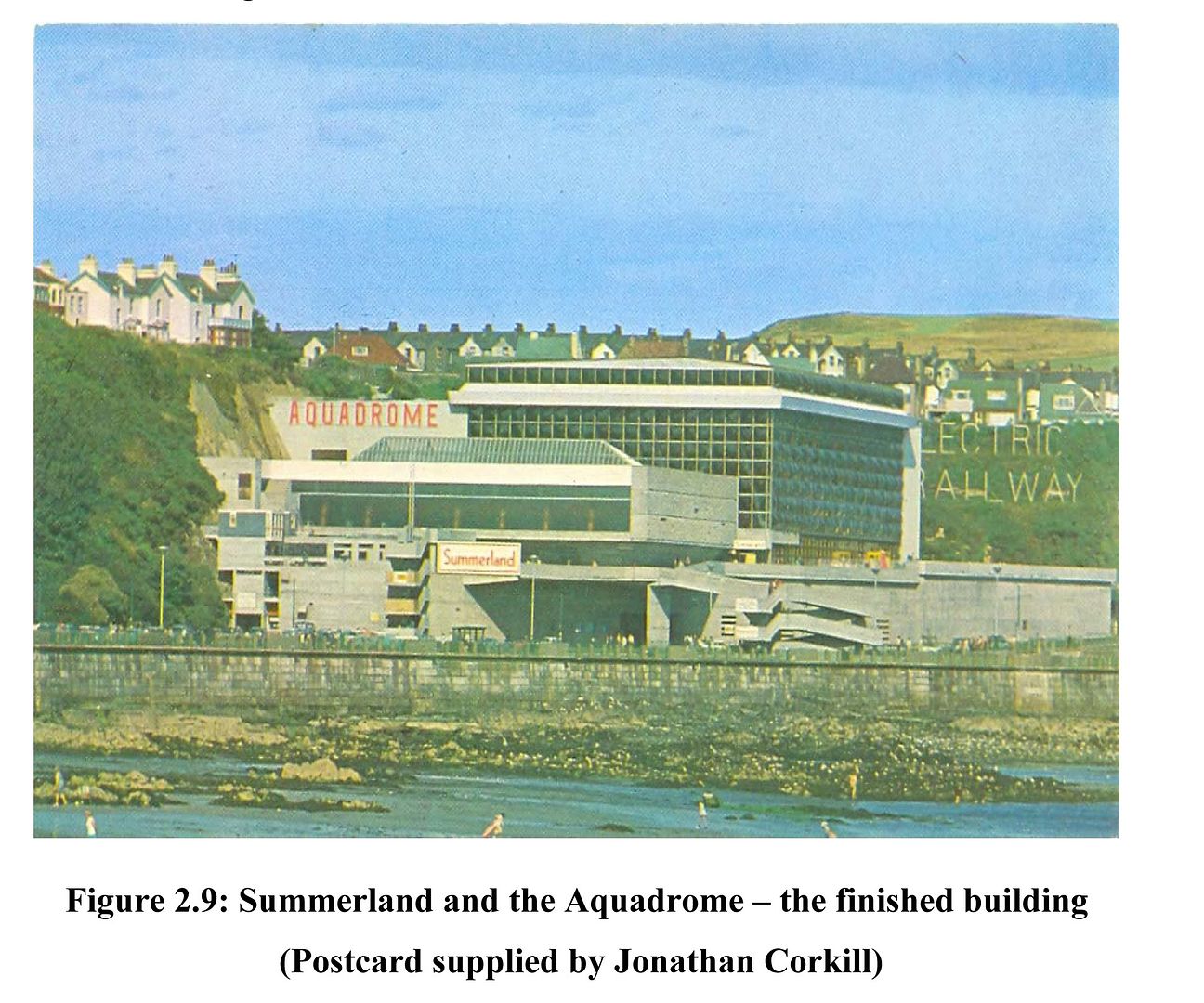
James Philipps Lomas, a Douglas architect with two lowercase Ps, won the contract for Summerland because his ideas were "rather more imaginative" than his competitors' (in the words of Douglas' Borough Engineer, Byrom, 1971, quoted in Phillips, s2 p58). Here is Lomas and his colleague Mr. Brian Gelling looking at a model of their creation. Notice that the Aquadrome, in the foreground, backs up directly against the cliff on one side. (Also notice that it's a horrible Brutalist disaster.) Lomas had never worked on anything outside the Isle of Man, whereas Gelling had been employed at a larger firm with experience designing leisure centers on mainland Britain; this firm, Gillinson, Barnett & Partners, was eventually to be appointed "associate architects" for the Summerland/Aquadrome project and do all the working drawings and all the research into materials needed for the work.
This last is significant. Summerland was to shake up the world of architecture with its unprecedented use of particular materials, the properties of which could have used a little more research.
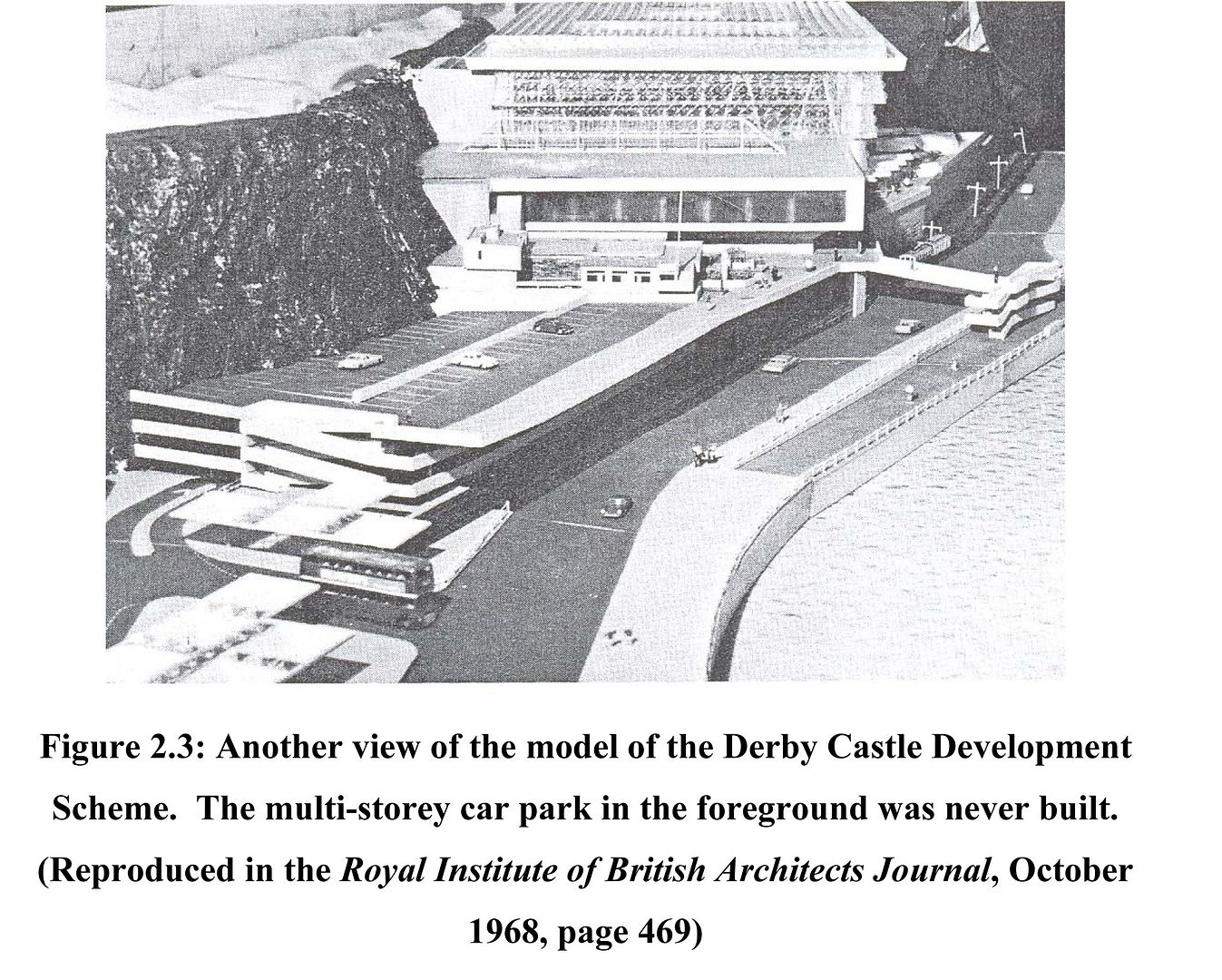
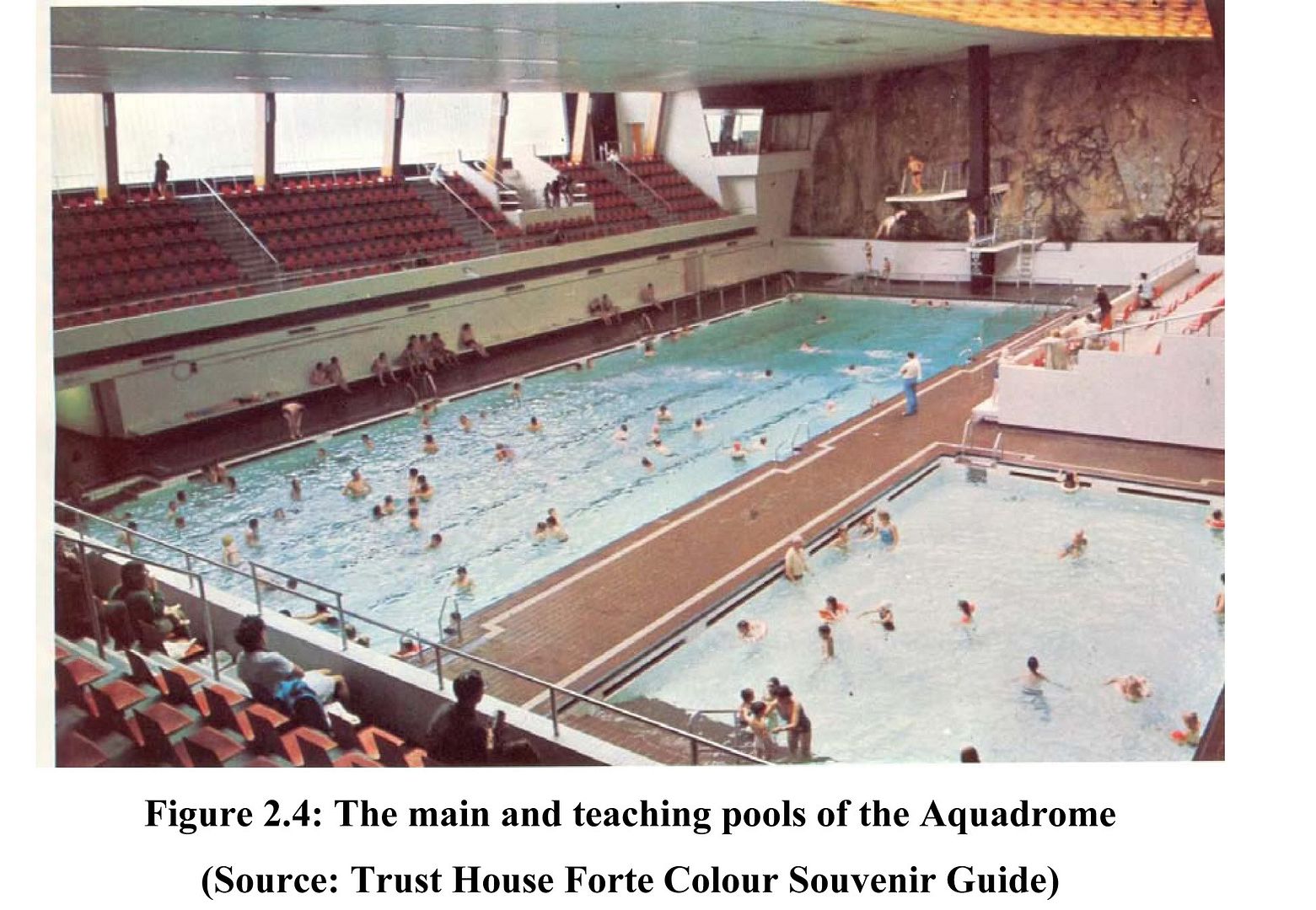
The construction of the Derby Castle Scheme had three components: the Aquadrome, Summerland itself, and a multistory car park which was never built. The Aquadrome featured two heated seawater pools with stadium seating, as well as a host of rather ominous-sounding other attractions including "aerotone, sauna, steam, hot, cold plunge, slipper, Vichy douche, massage, Russian vapour and Turkish baths." It opened in 1969 and was run by the Douglas Corporation (separate from Summerland). They had considerable difficulty sticking it to the cliff face that formed its fourth wall, and in fact had to bolt the cliff together to stabilize it, ending up with a messy and unbeautiful surface.
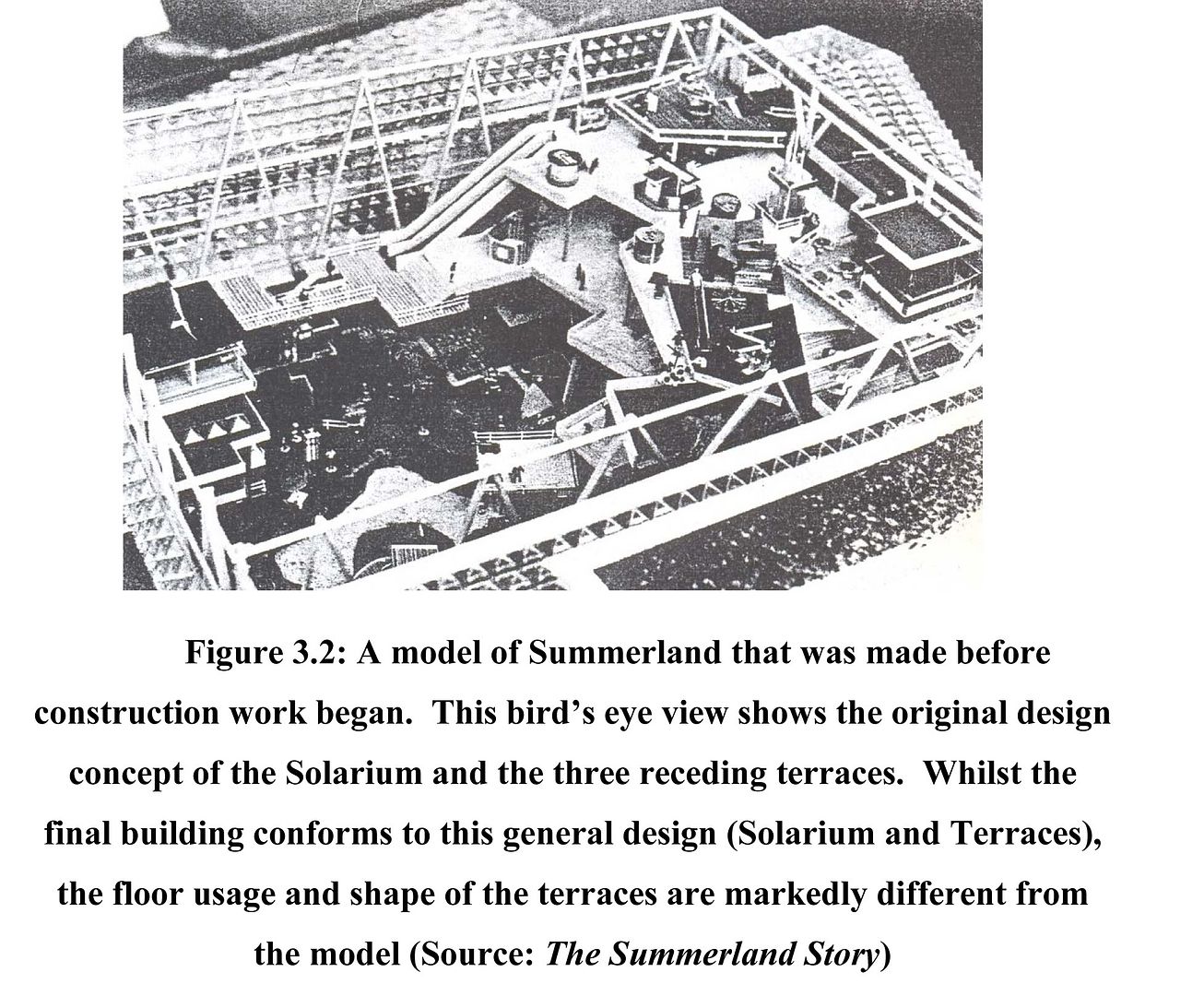
Summerland's plans had been drawn up in 1965. Construction didn't begin until 1968, and was disrupted in 1969 and 1970 by disagreements over the internal layout and what the probable tenant would end up doing with the building. An early model of the interior of the building shows a very different concept than what ended up being constructed. The Douglas Corporation waffled on a tenancy agreement for so long that in order to avoid expensive overruns the contract with the construction company was renegotiated to include just the building shell, rather than the internal structure. The shell was completed in December of 1970, just under the deadline. A new contract would have to be drawn up with the eventual tenant regarding the furnishings and fitting-out of the building. This is also significant, because the separation of internal and external structures involved a lot of fire code waivers and wriggling out of having to actually take structural precautions against disaster.
Douglas Corporation finally signed the UK hotel group Trust House Forte (THF) to a 21-year lease in December of 1970, which separated the managements of the Aquadrome and Summerland. Patrons would have to pay separate admission fees to the two attractions, and could not walk from one to the other without going outside, contrary to the original Scheme. The tenancy agreement did allow for work on the interior design and construction of Summerland to begin, and here is where the tragic flaws of the building begin to become manifest. The interior structure of Summerland was entirely done by the associate architects, Gillinson Bartnett & Partners, and not by Lomas and Gelling. Lomas's plans could not have taken into account design decisions made by Gillinson Barnett, and therefore could not have included an appropriate system of staircases and exits in the shell design to match the interior usage of the building.
After the fire, the investigation into Summerland's design unearthed this factor, which was used as an excuse by the architects: "The Commission was told that, during the long process of designing Summerland, the details of escape in case of fire could not be considered because the kind of occupancy, usage and activities were not decided, as no tenant had been nominated." (Summerland Fire Commission report, para 216, pg 21, quoted in Phillips, chapter 2.6, pg. 71.) The Commission wasn't having any of it, however, and concluded that Gillinson Barnett damn well could have made some educated guesses.
Materials
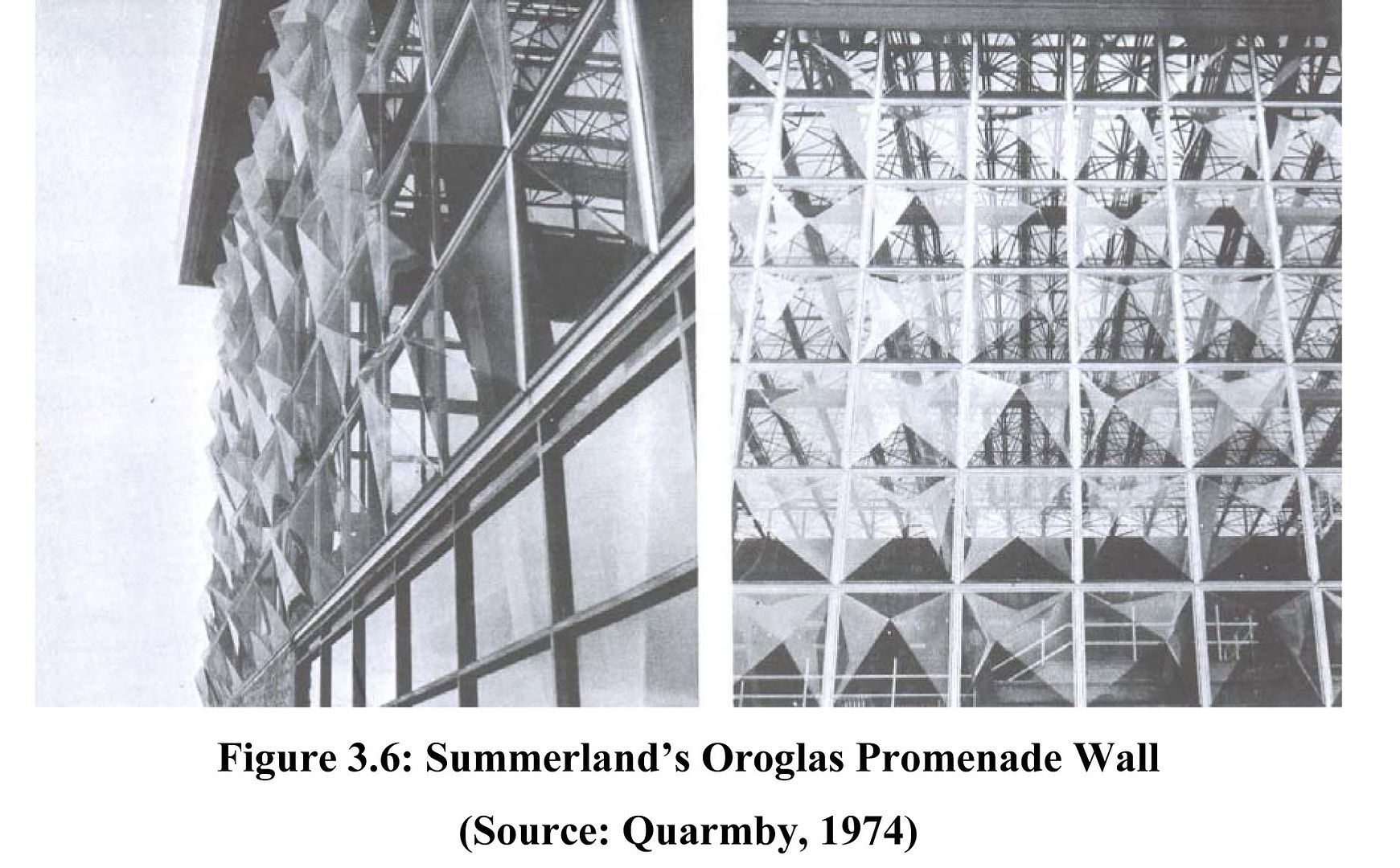
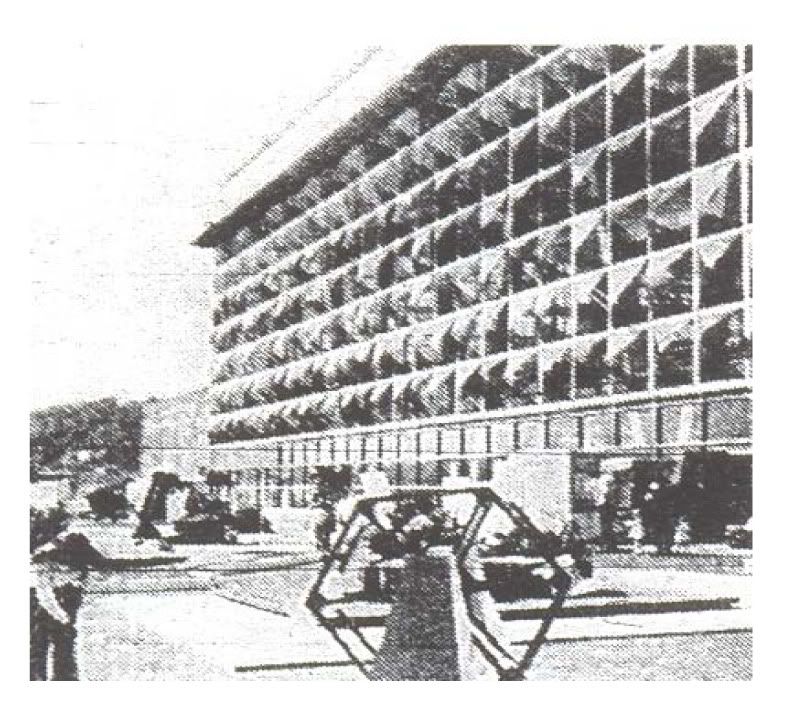
The revolutionary nature of Summerland as a concept was not so much based on its functioning as a leisure center but as a "weatherproof enveloping structure" within which visitors could enjoy the pleasures of a summer seaside holiday all year round. In order to create such a vast enclosed space, the associate architects turned to what was then a highly innovative building material, the polymethylmethacrylate sheeting sold as Oroglas. No one had ever used Oroglas on such a scale before: they created a whole roof and much of two walls of Summerland out of the stuff. This was not explicitly stated in minutes from the Tynwald discussions during the planning stages of the project: all the references to the construction used the words "glass" or "glass-like material," implying that the building would be constructed using largely traditional materials. Remember that it wasn't Lomas who was responsible for choosing materials, but the associate architects, Gillinson Barnett.
"The decision was taken to use Oroglas for Summerland by Mr Clifford Barnett at an early stage, and was confirmed amongst the architects before the Derby Castle Development Scheme brochure was presented to the Finance Committee of Douglas Corporation in August 1965 (chapter 2). Mr Barnett was not only insistent on an acrylic solution for Summerland; but a solution that involved the use of a particular type of acrylic sheeting manufactured by an American company that at the time had not been used on an extensive scale in Europe. His commitment to using Oroglas is picked up by the Summerland Fire Commission report (SFC Report, Paragraph 207, Page 69): “He [Mr Barnett] was clearly committed to it [Oroglas]”, the
report states....The architects wanted to create a building that was “unique and compelling” (The Summerland Story, 1972, Page 25). In the same brochure, the claim is made that Summerland would “set the architectural world alight for nothing had ever been designed to include so much of the transparent sheeting”." (Phillips, chapter 3, pg 98).
We don't need to point out the irony of the phrase "setting alight."
What did this marvelous material end up looking like in place? It looked like this. "Each panel catches the light to
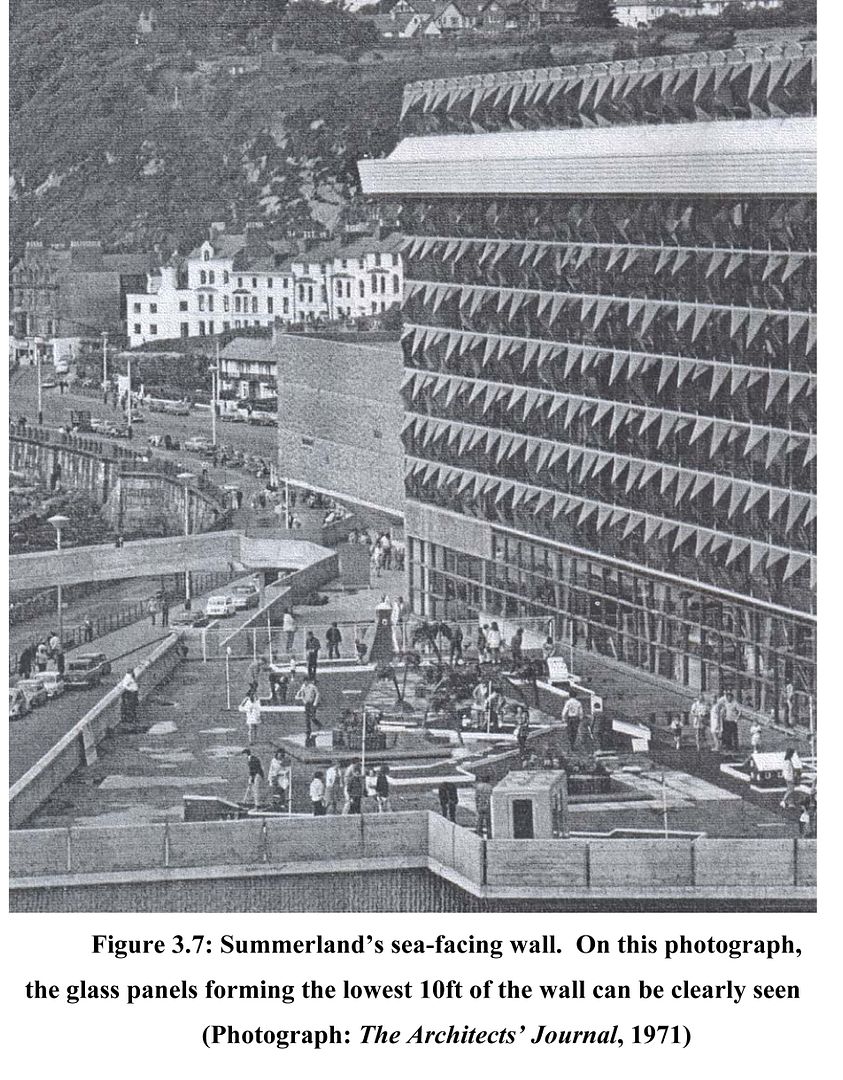
provide an interesting and varying pattern on the façade," says the brochure. To modern eyes, it looks perhaps less interesting and innovative than "spiky," but at the time I.M. Pei had not constructed the Louvre pyramids and the Early Seventies Awful school of architecture was firmly in power.
Rohm and Haas, the manufacturers of Oroglas, themselves state that “There is no building code in America which would allow it [Oroglas] to be used overall as it was at the Summerland
centre. A structure like that would just not have been allowed in America.” U.S. fire codes require a comprehensive sprinkler system to be installed wherever Oroglas was used on a large scale, and in fact the UK subsidiaries of Rohm and Haas were aware of these codes and requirements...but did not pass them on to the Isle of Man chief fire officer.
The manufacturers knew Oroglas was combustible. Phillips refers to an ad hoc experiment conducted in Warwickshire by a council considering the use of the material in a project, in which a sample of Oroglas was set alight with a cigarette lighter and burned like merry hell: “The sample did not have chance to smoulder, as it burst into flames with a ferocity that I had not seen since like all young boys do, [I] set light to a ping-pong ball. It spat and flared, and we got a bit panicked that it would cause problems with the stuffy staff either side of our office.” An internal Rohm and Haas UK memo admitted that Oroglas could burn “in quite a frightening manner”. The letter warned that the material might not even fall free from its frame in the event of a fire. “The ways in which Oroglas may behave if involved in fire are not easy to predict and you should be cautious in discussions on this problem. The method of installation, size of panel and, in some circumstances, even the colour of material can have some effect.” (Phillips, chapter 3, pg 104.) One of the properties touted by the proponents of Oroglas was that it would soften and fall out of its frame at temperatures far below its ignition point, which was apparently known not to be the case. Rohm and Haas admitted after the fire that this information should have been provided to Mr. Pearson, the island's chief fire officer, but was not.
After the fire there was much throwing about of brains regarding whose fault it was that Oroglas was used in such amounts without a sprinkler system and whether the use of Oroglas had in fact been the cause of the fifty deaths. As it turned out it wasn't "Horrorglass" at fault for the disaster after all: it was another building material entirely, a substance called "Colour Galbestos," rolled steel sheeting coated in bitumen and asbestos.
Waive this for me
Isle of Man by-law 39 "requires a building’s external walls to be non-combustible and have a fire resistance of two hours." Both of these requirements were waived during the construction of Summerland, which is precisely why the disaster happened. Use of Oroglas was permitted due to a waiver requested by Lomas and granted on the understanding that, while Oroglas did not have a fire resistance of two hours, in case of fire it would theoretically soften and fall out of its frames, allowing people to escape through the gridwork of the walls. The Borough Engineer who recommended the by-law be waived to allow the use of Oroglas did so believing it to be non-combustible, which is rubbish. It's repeatedly stated that Lomas and the other architects assured the Douglas Corporation of Oroglas's non-combustibility, and this inaccurate statement of the material's properties shows up in promotional literature for the building. Post-fire investigations of Lomas and Gillinson Barnett show rather predictable mutual attribution of blame: Mr. Barnett calls Mr. Lomas cavalier in his approach to regulations, and Mr. Lomas claims that Mr. Barnett and his partners should have done their research and he trusted them when they said that Oroglas was totally safe. Either the architects didn't know they were telling porky pies or they didn't care. I don't know which is more disturbing.
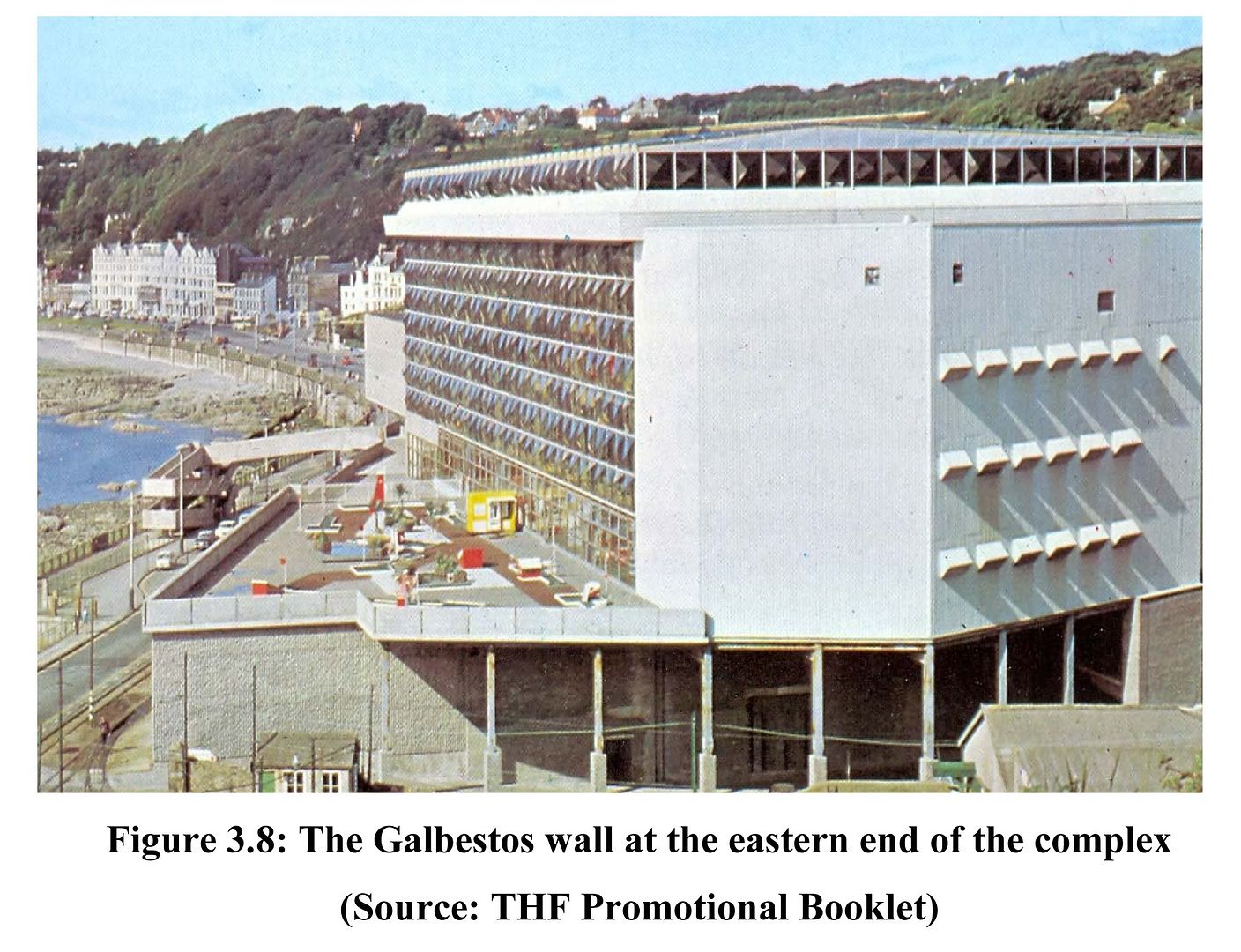
The use of Colour Galbestos on the building's east wall was even more of a violation of Law 39, as it is neither non-combustible or fire resistant. It was used in place of concrete or regular steel sheeting because it was cheaper, and permitted due to a truly astounding sequence of failures to communicate: the Borough Engineer suggested Law 39 be waived for it because "he considered it an adequate material in all the circumstances;" the Douglas Corporation meant to ask the Local Government Board for the waiver but never got around to it; the Local Government Board received plans including the use of Colour Galbestos without being notified that its use required further Law 39 waivers; the Chief Fire Officer was never consulted about the use of Galbestos because nobody twigged that it was, in fact, lethally inappropriate. Similarly, the decision to use combustible plastic-coated fiberboard Decalin for the interior wall of the amusement arcade was made off the cuff and never discussed amongst the architects and designers with regards to the fact that it caught fire like anything.
Opening
Reaction to Summerland when it finally opened in 1971 was mixed. The building's promoters, unsurprisingly, thought it was just wonderful: “[Summerland] stands as a pulsating memorial to the foresight of its planners and supporters. It can only confound the critics of the controversial scheme when they see for themselves what has been achieved…The result can only be a source of pride to the whole Island...It will undoubtedly attract the widest publicity – not only because it is unique in the western world, but because it caters so ideally for leisure and relaxation in the unreliable climate of the United Kingdom," according to a full-page advertisement appearing in the Isle of Man Examiner on 16th July, 1971. Others were not convinced. John Carter, the travel journalist and TV presenter (Holiday and Wish you were here?) commented in The Times (19th May, 1973):“The centre’s glossy brochure claims it has ‘Attractions for every taste’, but I must beg to be excused from that generalization. I do not like motorway restaurants, either, but that is another variation on the theme.” (Phillips, chapter 3, pp. 116-118.)
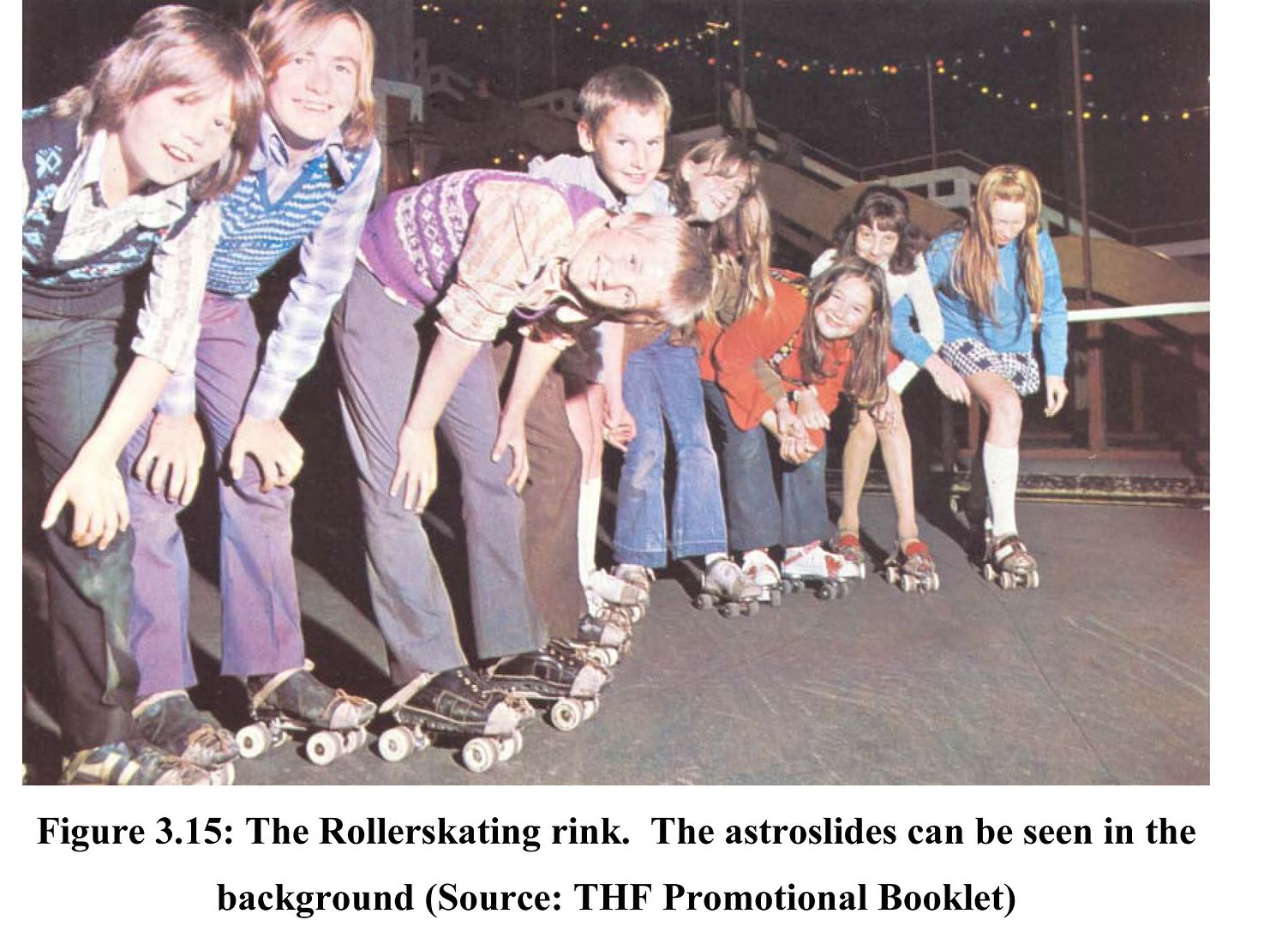
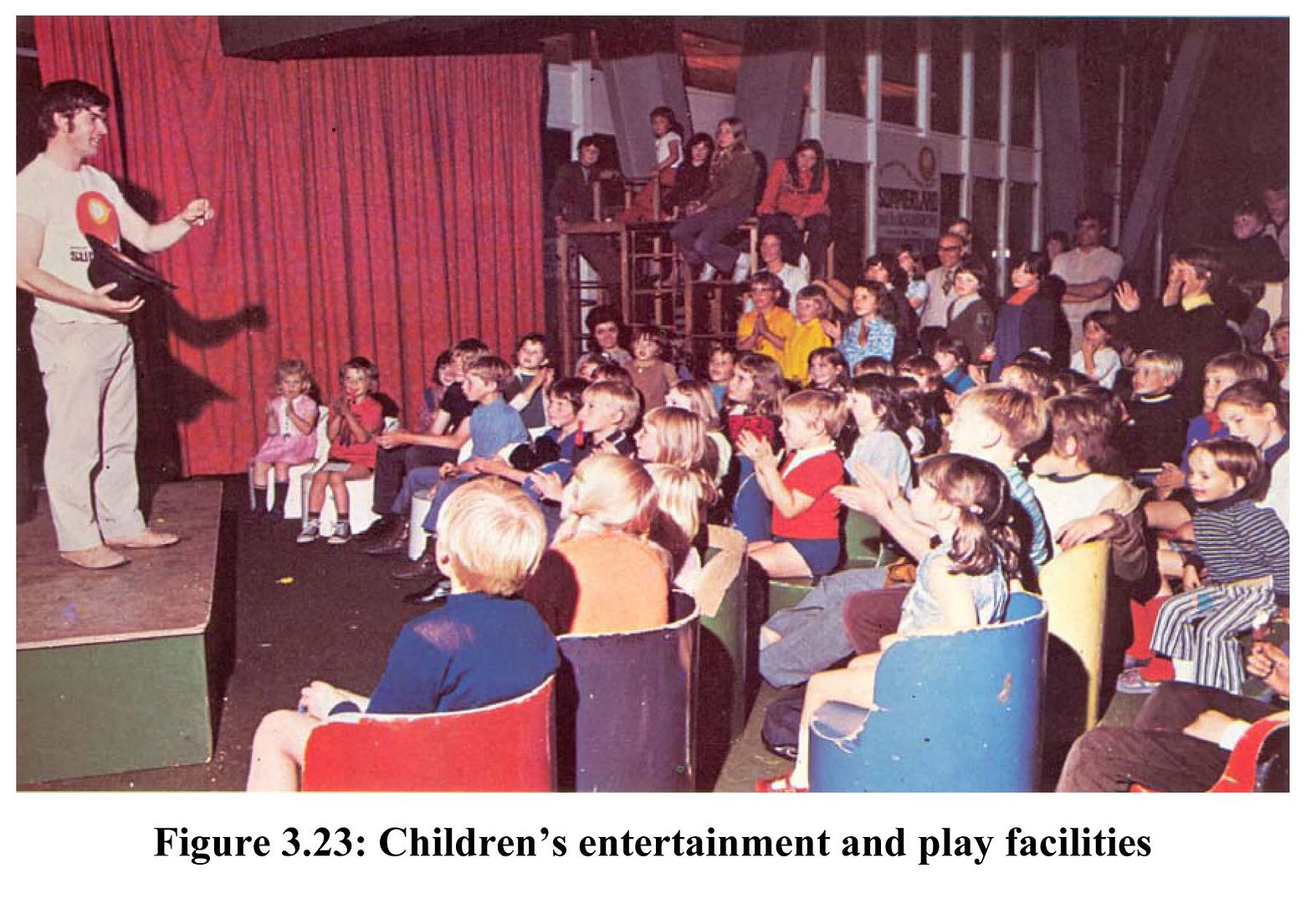
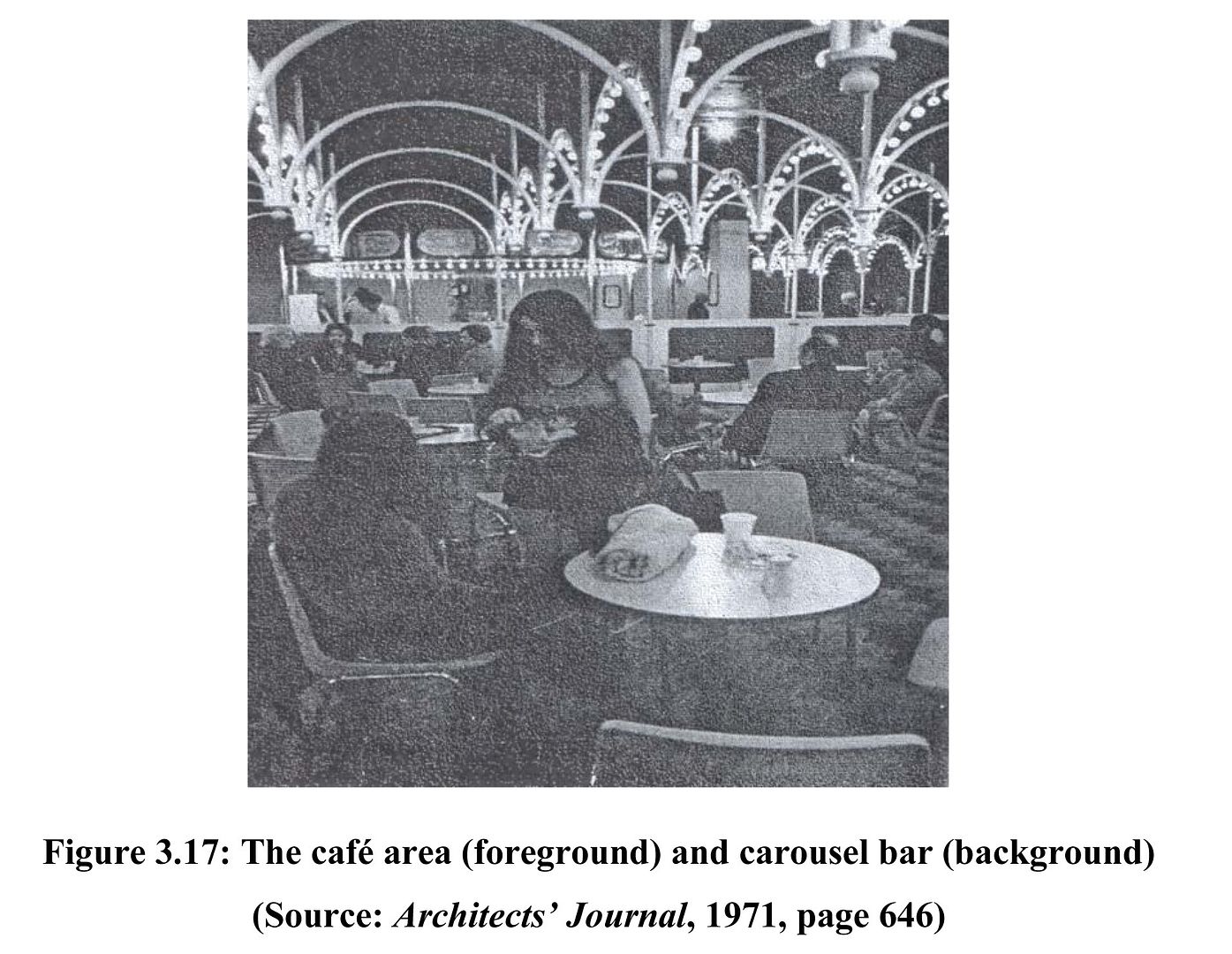
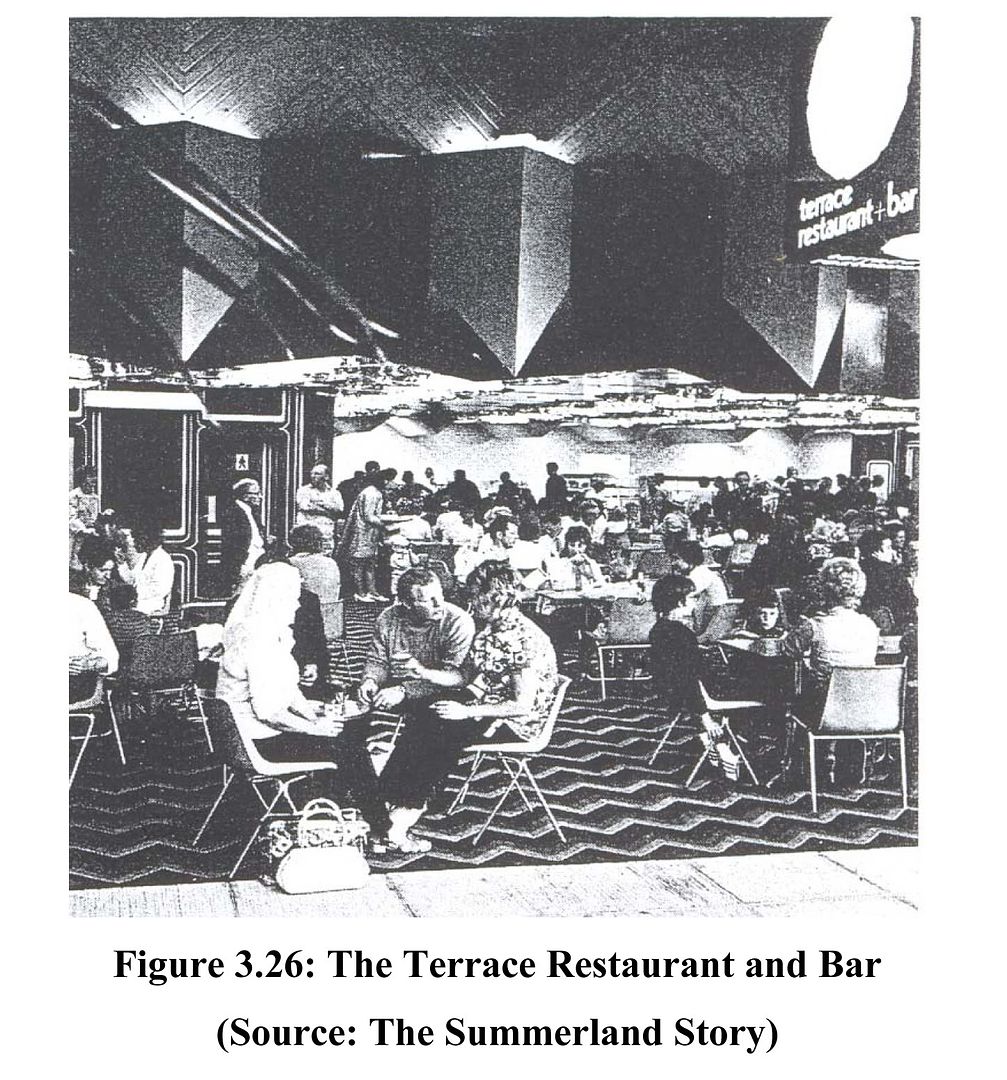
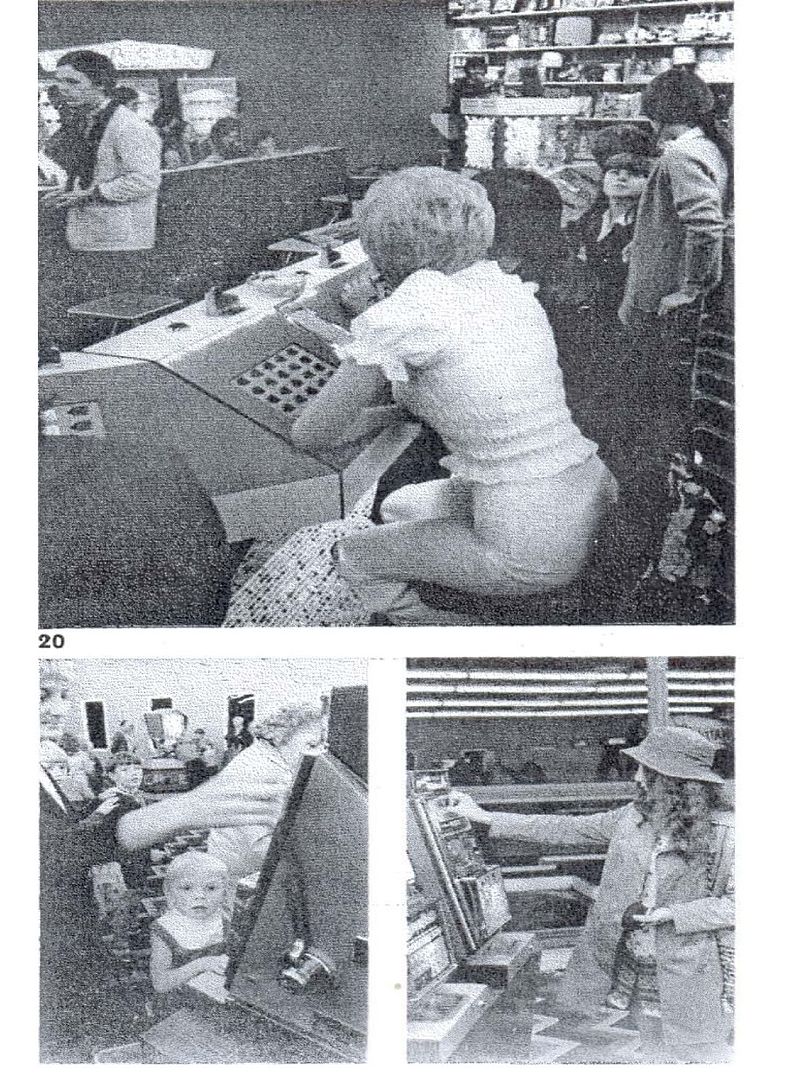
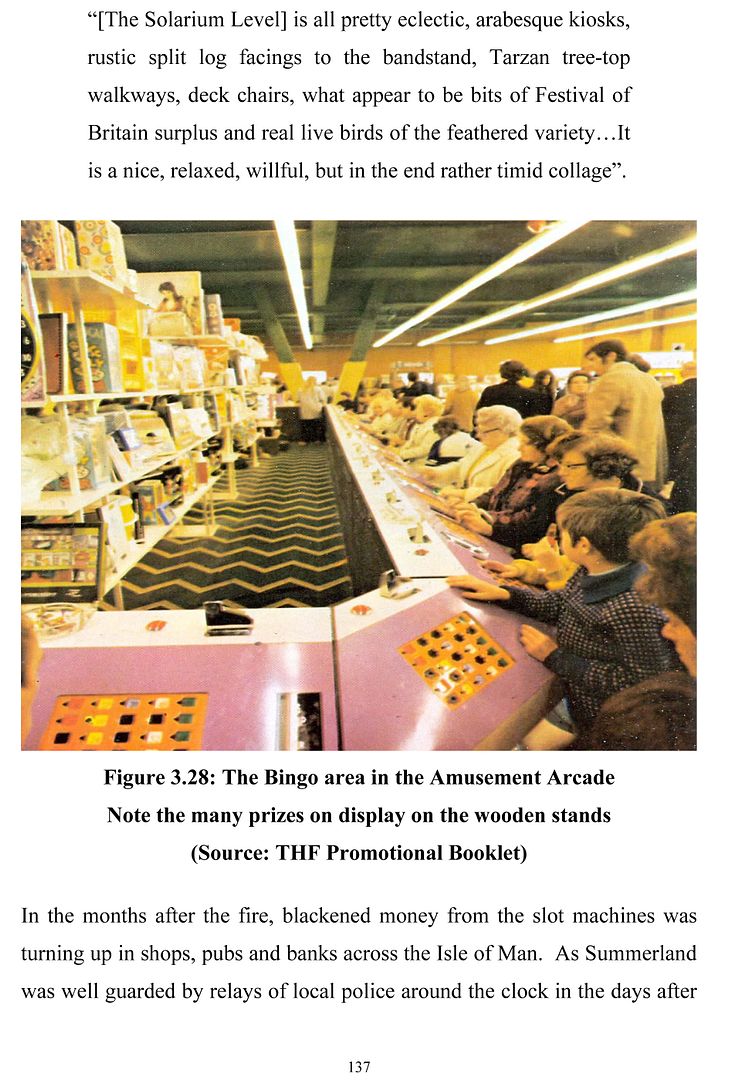
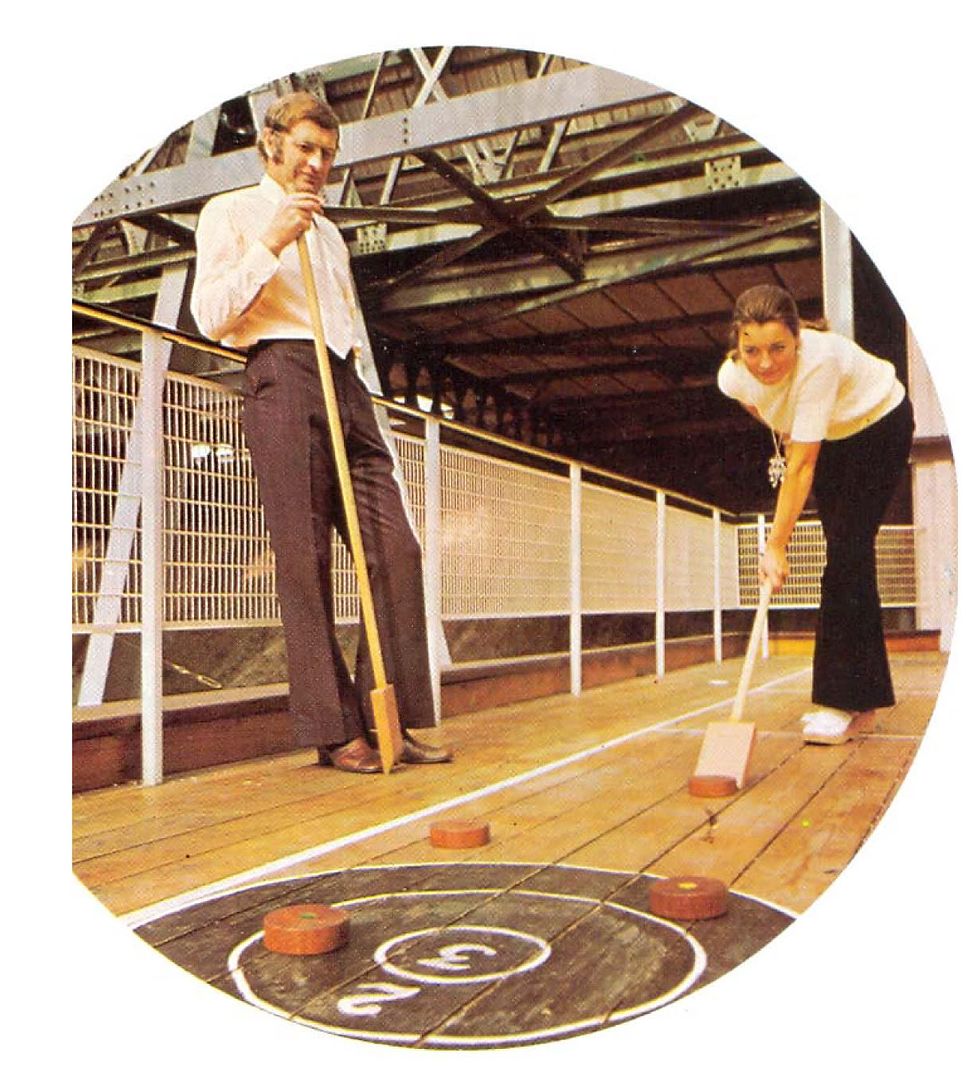
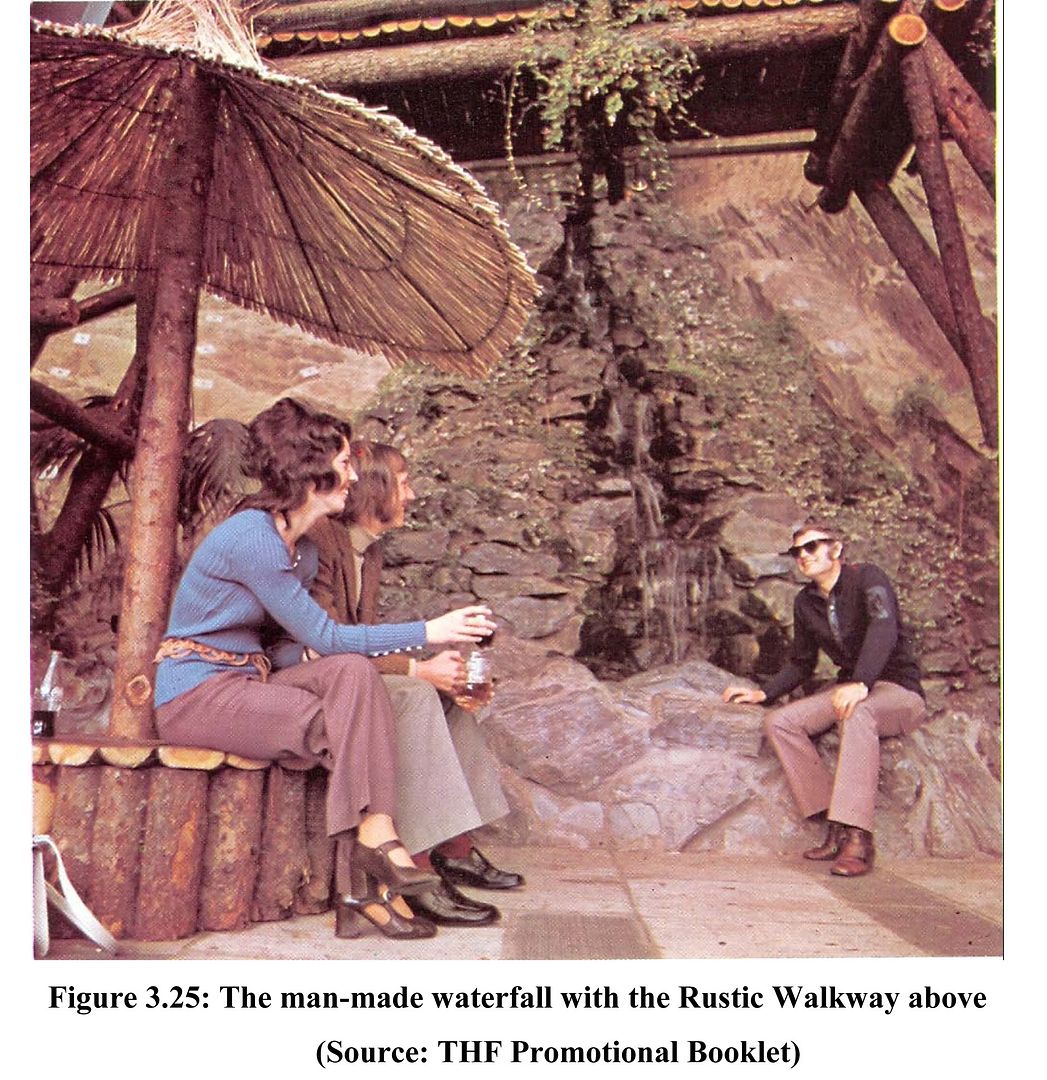
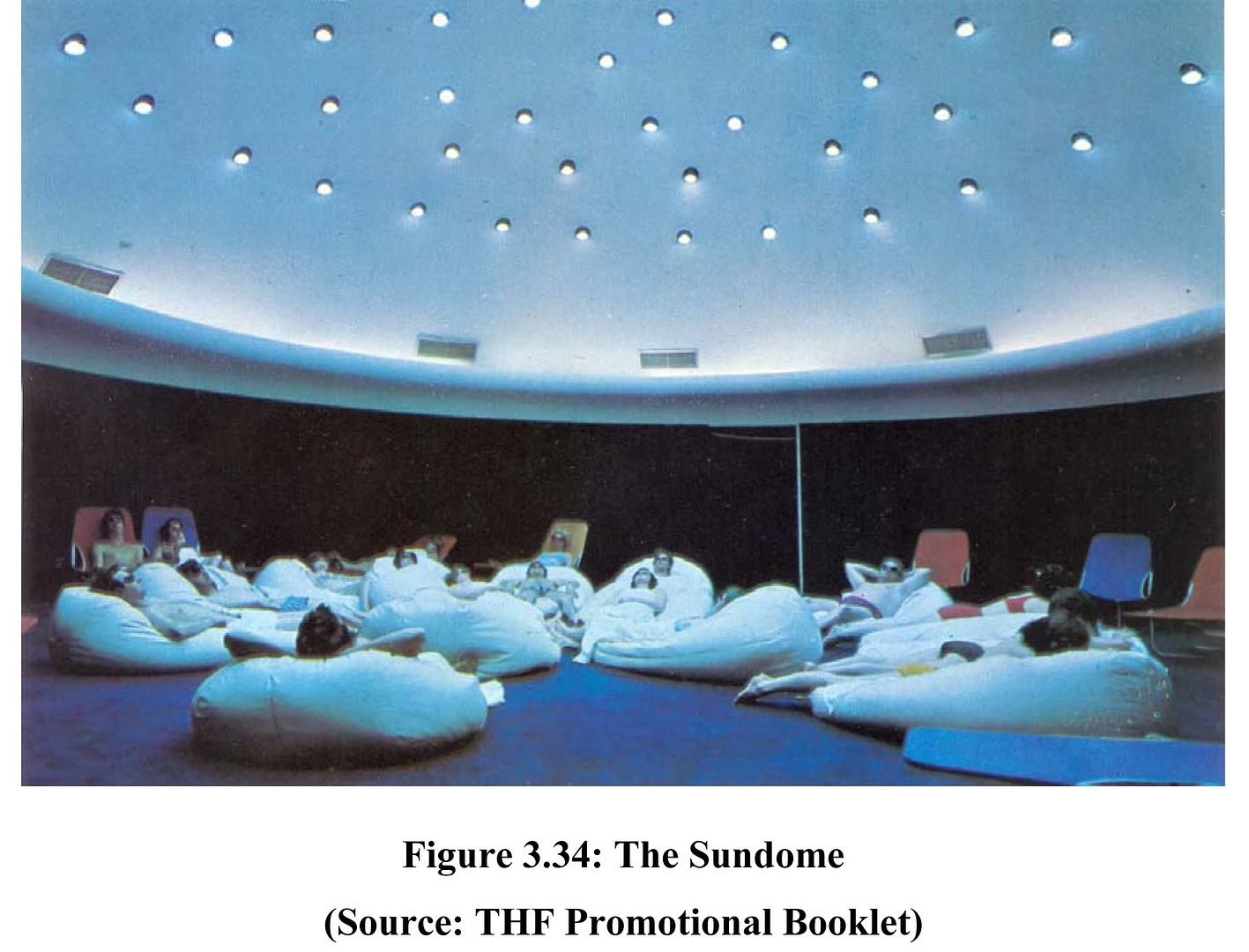
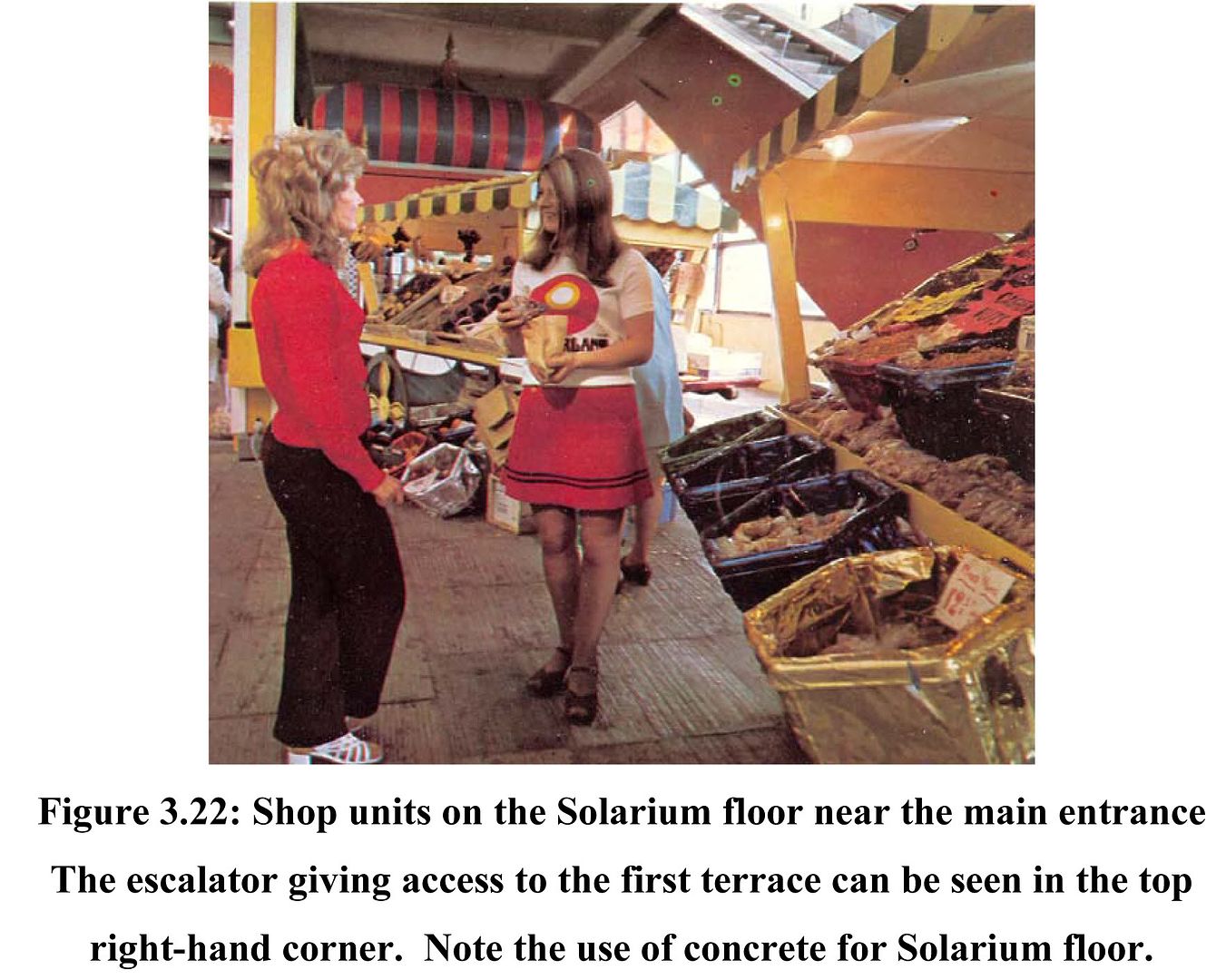
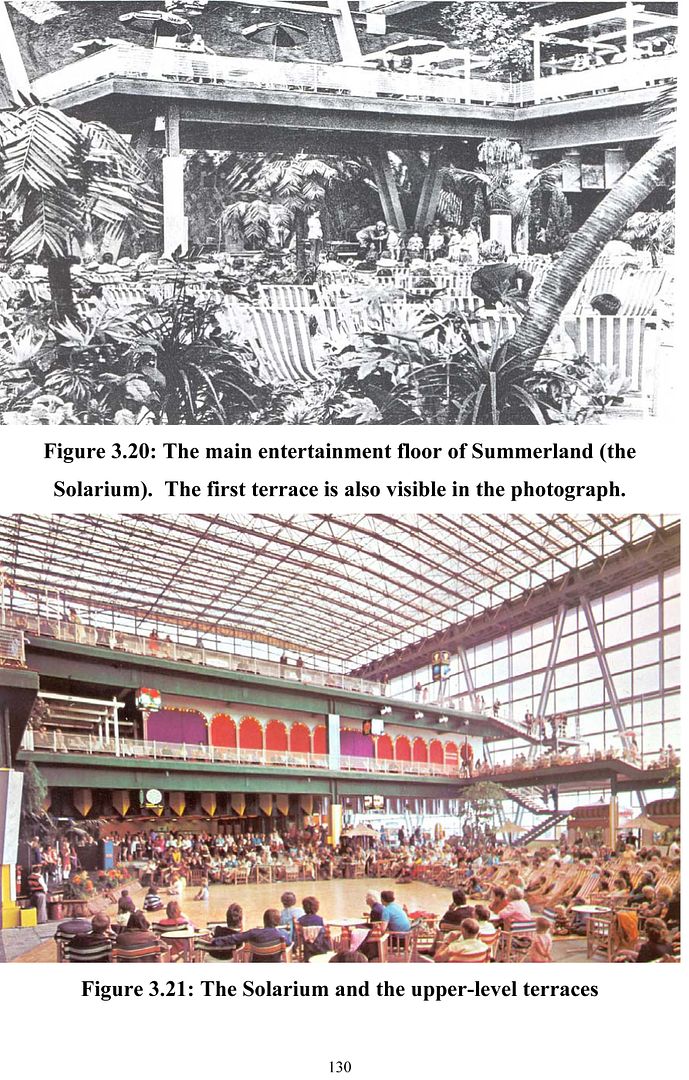
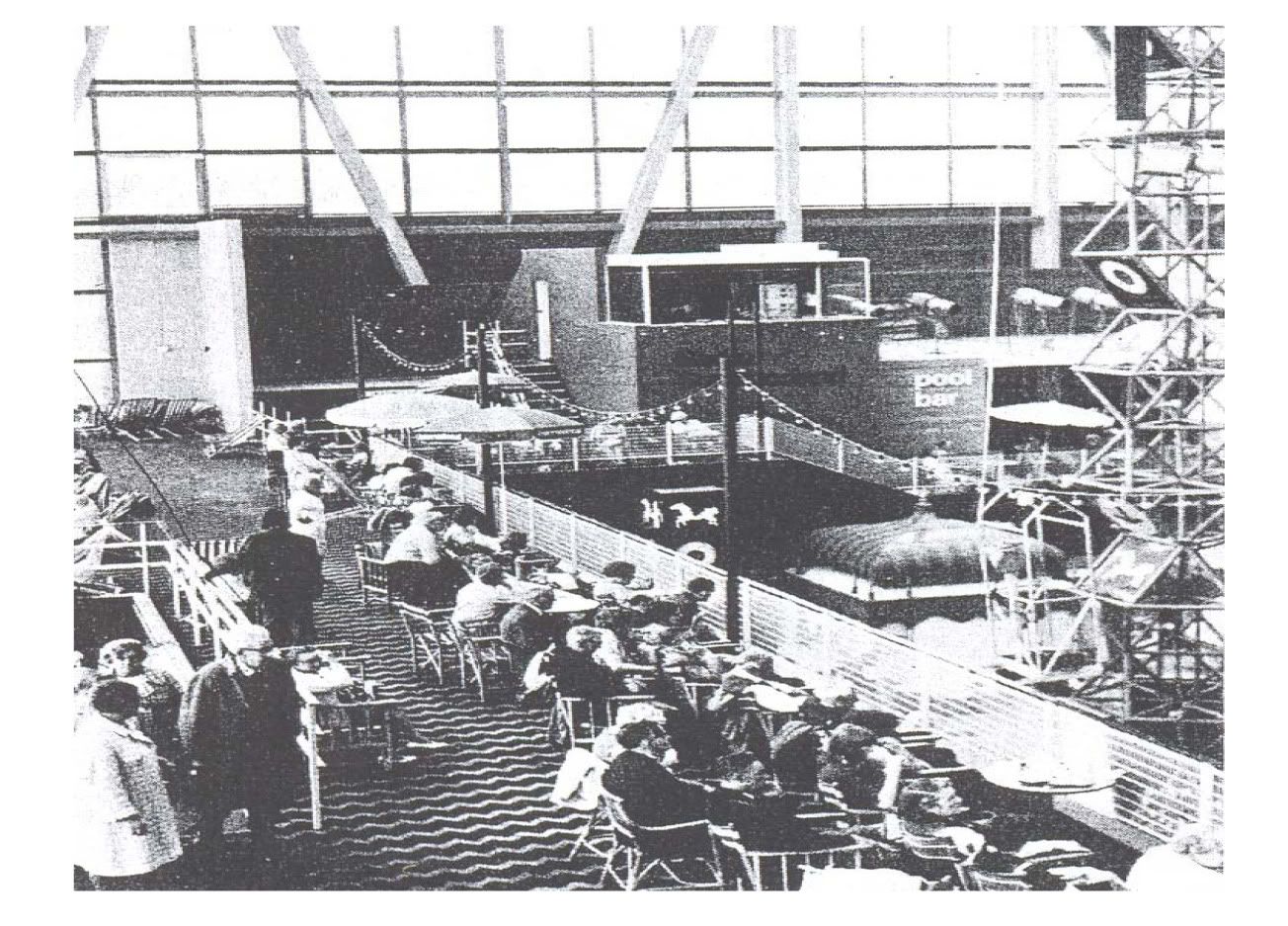
Inside, Summerland offered a wide range of attractions including children's entertainment and play facilities, cafes, restaurants, and bars, amusement arcades, bingo, shuffleboard and artificial waterfalls, a tanning room, shops, and of course the Solarium--which was used for mass performances.
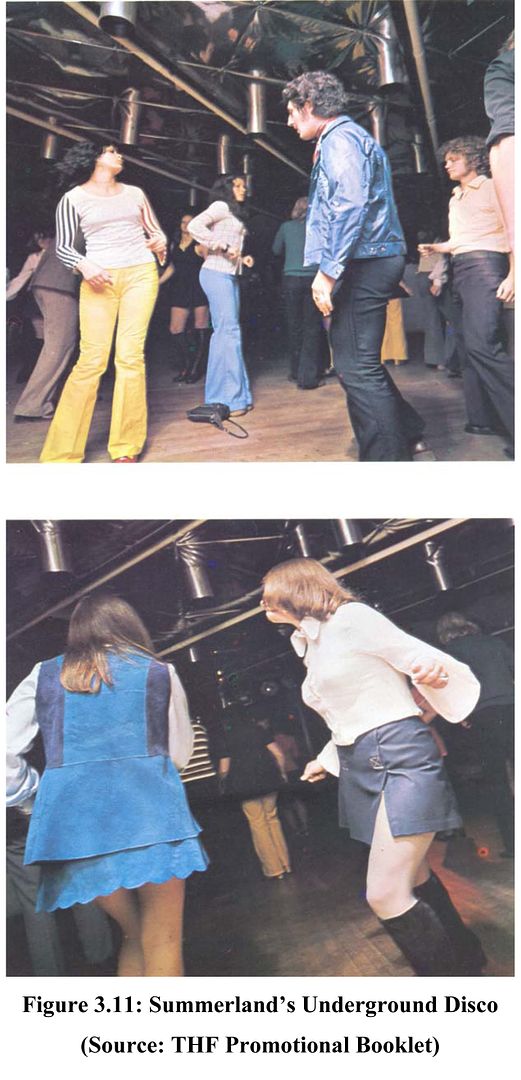
Despite the fact that its logo looks a bit like a gigantic pimple (or possibly the Eye of Sauron) the pictures convey a certain enthusiastic sort of gaiety. To modern eyes, Summerland drips with 1970s kitsch; James Lileks would have gone mad over the Marquee Showbar's purple and red awnings and plastic chestnut trees, or the bingo arcade's dental-appliance-pink and dog-diarrhea-yellow colour scheme. It's the apotheosis of Organized 1970s Fun, and not unlike one specific concept of Hell.
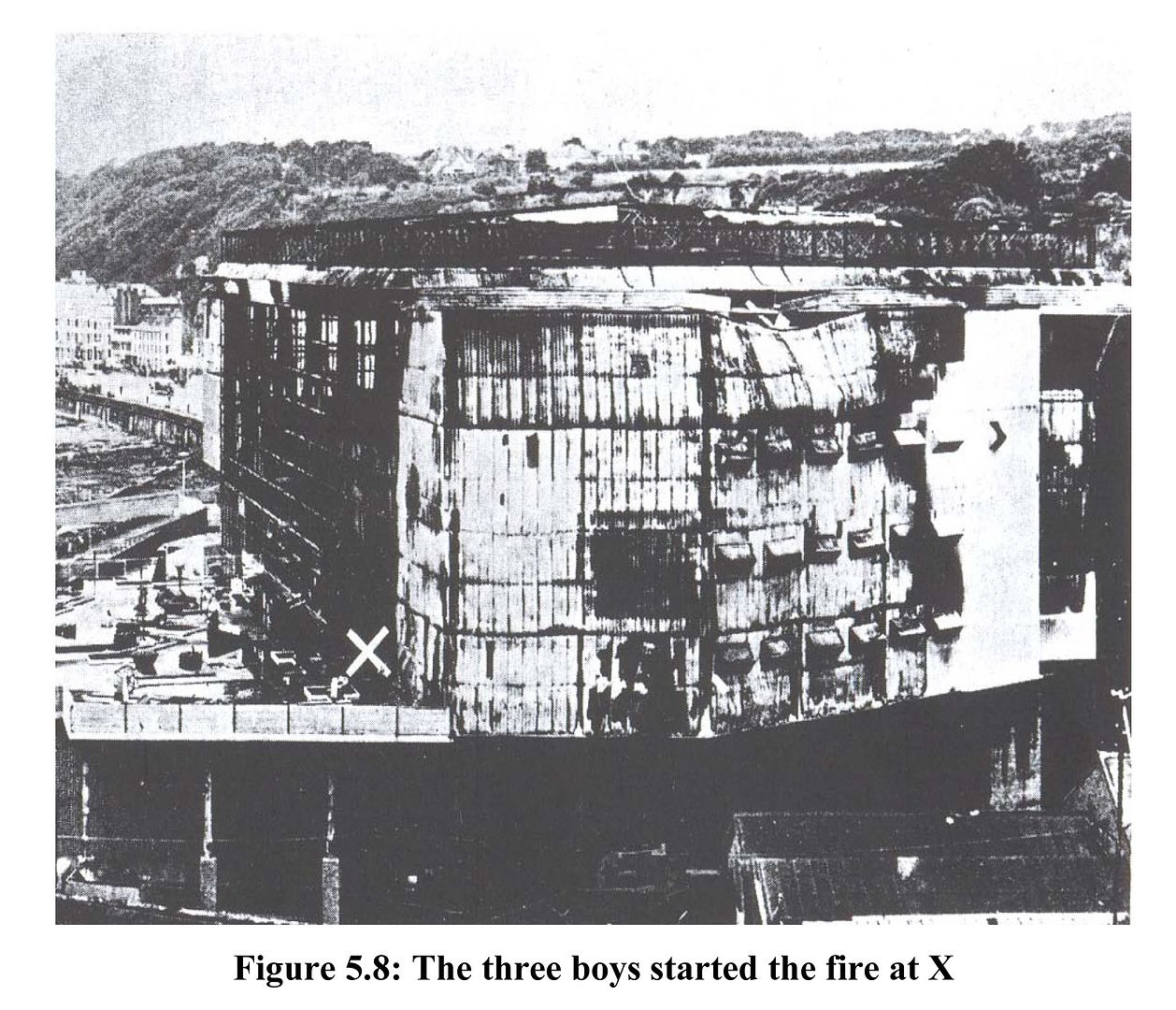
Now imagine all of this on a drizzly August evening in 1973, packed with around two thousand people listening to accordion music, dancing, drinking, roller-skating, tanning, eating, and generally spending money. It's still light outside as eight o'clock draws near. Outside on the terrace, where the mini-golf course is set up, three boys are hiding in a disassembled kiosk set up against the Galbestos part of the promenade wall, sharing an illicit cigarette.
The fire
The Summerland fire was started by a discarded match. While they were smoking, shortly before 7:40 pm, one of the boys lit a match which caught something inside the kiosk on fire. Apparently not realizing this or not thinking it would burn out of control, he joined his friends and some other boys on the terrace to talk about football. Soon afterward, they smelled something burning, and found that the floor of the kiosk was on fire. They tried to put it out, but the fire was beyond their control, and they ran away in fear.
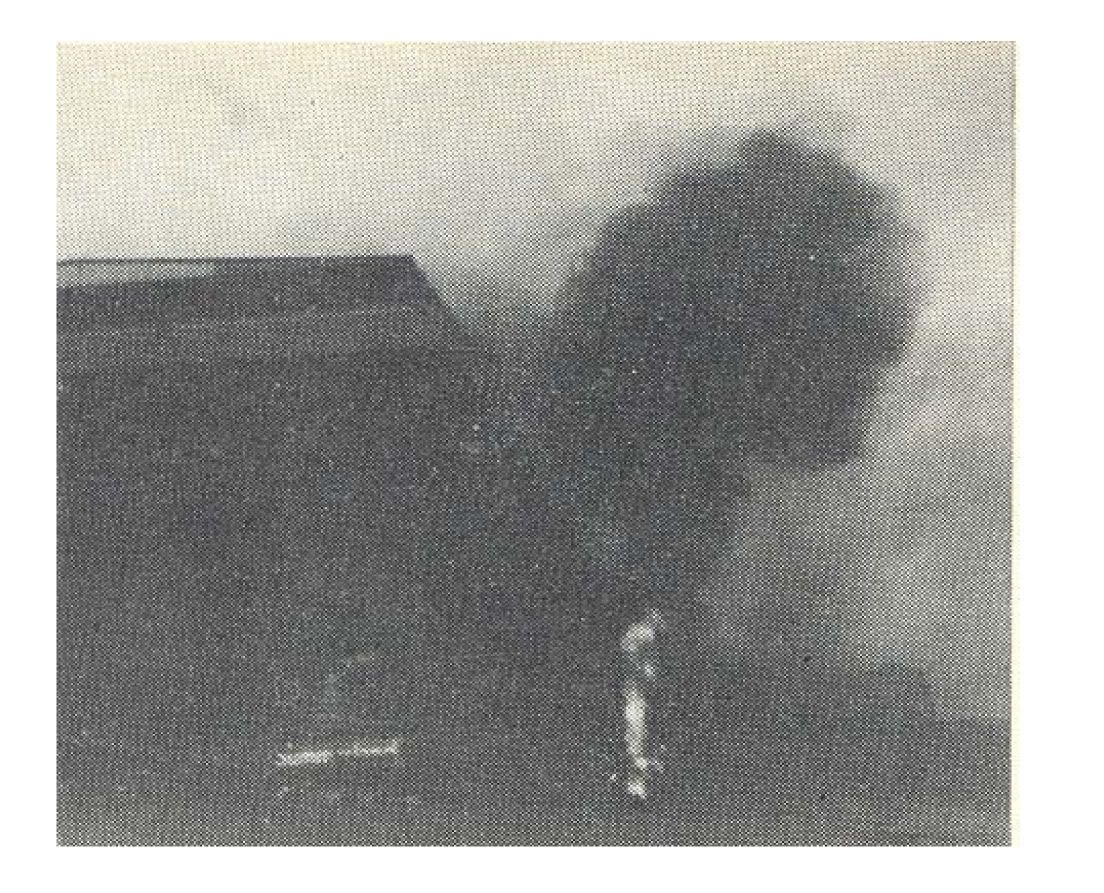
By itself the kiosk fire would not have caused the disaster had Summerland been constructed of materials adherent to by-law 39. The fact that the fire was located right up against a wall made of Colour Galbestos doomed the center and fifty people inside it. An extremely fuzzy photograph taken between the fire's ignition and the full involvement of Summerland itself shows smoke and flames rising from the kiosk on the outside of the promenade wall: nobody knew that in fact it had also started a concealed fire inside the wall of the building. Holidaymakers alerted the staff to the fire around 7:55 pm, and staff members joined at least one patron in trying to fight the fire with chemical extinguishers and the building's fire hoses.
Even the staff thought the external wall was regular steel sheeting and would prevent the fire entering the building. In fact, it was already inside:
"The Colour Galbestos used at Summerland consisted of a zinc coated steel core, which was “covered with asbestos felt saturated with bitumen and then faced with a polyester resin coating” (SFC Report, Paragraph 152, Page 53). When the burning kiosk collapsed against Summerland, the Galbestos wall rapidly became red hot and ignited the material’s combustible coating (polyester resin and bitumen) probably after around 80 seconds (Sam Webb, RIBA, Personal Communication). Since the core (steel and zinc) of the Colour Galbestos has a high thermal conductivity, fumes were soon given off on the inner side of the wall after two-and-a-quarter minutes. “Strong flames” were coming from the Galbestos one minute later." (Phillips, chapter 6, pp.268-269.) The damaged Galbestos wall shows how the stuff buckled and twisted in the heat.
The inner wall, made of a plastic-coated fiberboard called Decalin, was also combustible. When the fire breached the Galbestos wall and entered the void, it ignited the inner side of the Decalin wall and spread across the eastern end of the building between the two walls. Phillips offers some chilling data: "It is estimated that the fire in the void started around 4-6 minutes after the external fire had become established in the remains of the mini-golf course kiosk. This internal fire then gained intensity – but at all times being confined to the void – over the next ten minutes between about 7.45pm and 7.55pm (Time estimate by Professor Rasbash; see SFC Report Paragraph 106, Page 38). It is not known what temperatures were reached in the void, but they may have reached 1000 degrees C close to and after the Decalin wall gave way..." (Phillips, chapter 6, p.273.)
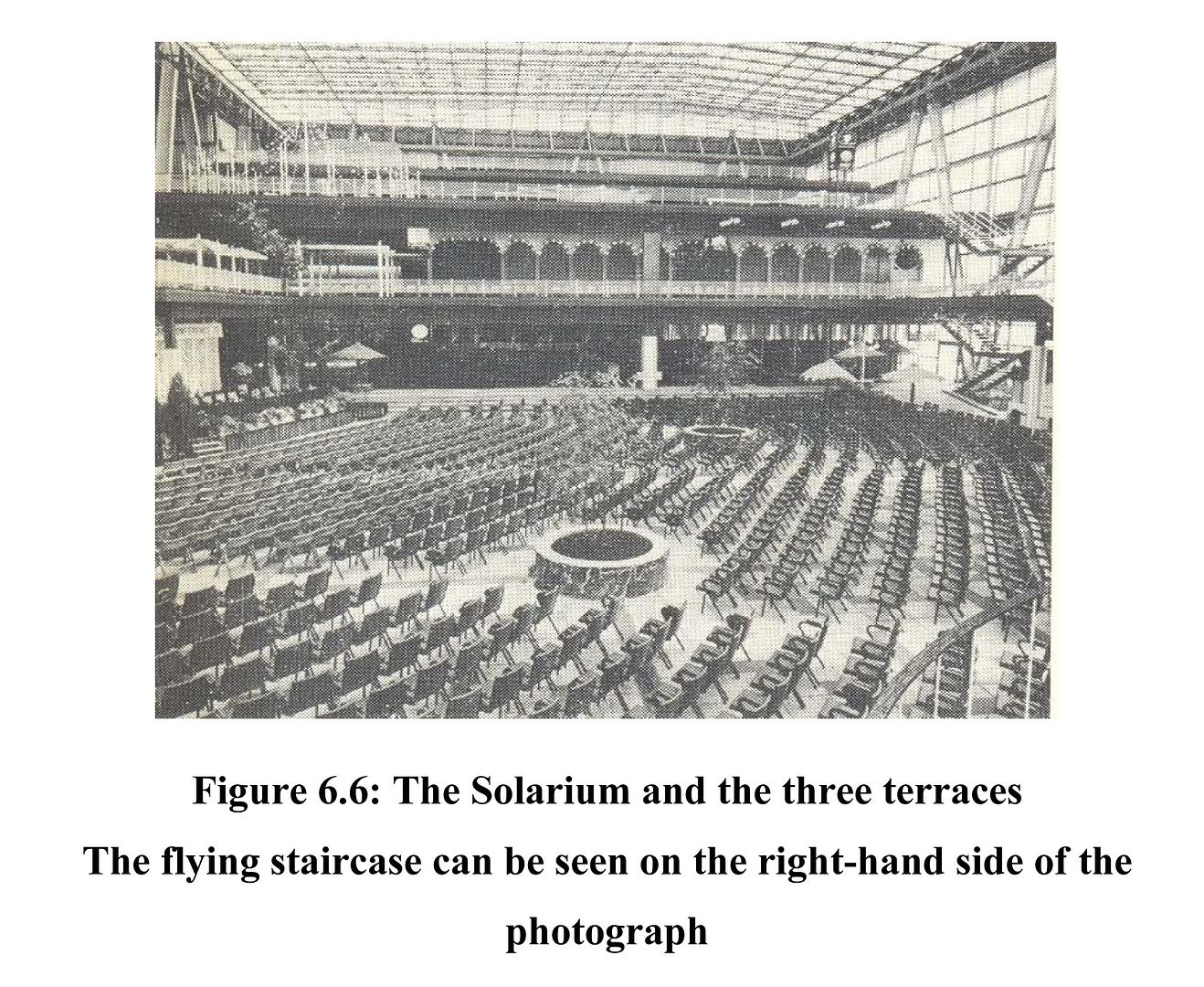
When the fire broke through into the interior of the building, it did so at the ceiling of the amusement arcade (directly beneath the Marquee Showbar level), probably because the only firestopping within the void was located at that level (asbestos sprayed on metal girder). The flames roared across the ceiling of the arcade like a blowlamp, spreading rapidly across flammable furnishings and decorations. By the time the first flames were seen within the building, a considerable portion of the wall had already been burning for some time: with the breach of the inner wall, air rushed in and rapidly fed the fire. From the amusement arcade the fire spread, igniting the Oroglas promenade wall alongside the flying staircase, which caught fire after being exposed to flame for less than two minutes. Burning plastic dribbled to the Solarium below.
Eyewitness accounts agree that the fire spread incredibly rapidly--"as if the place had been doused with petrol," "like a bomb," "worse than the Blitz," "within ten seconds the whole place was on fire," "like wildfire," "the building went up like paper and was wrecked in no time at all." There was no warning, no fire alarm bell was sounded, and no official call was made to evacuate the building other than a terrified compere's shout over a microphone. People on the Marquee Showbar level and above had few escape routes from the building, all of which rapidly became jammed with struggling people. And the Oroglas--far from softening and dropping harmlessly out of its frames--was burning. Molten blobs of burning plastic rained on the screaming people struggling to get out, spreading fire across the Solarium floor. The gap between the terraces and the Oroglas wall acted as a chimney, sucking fire upward to the roof, which burnt out in perhaps ten minutes after ignition. The plastic panels had no time to soften and drop harmlessly from their frames: the temperature of the hot gases and of the flames themselves brought it up to ignition point in seconds. Recall the ad hoc experiment done in Warwickshire on a sample of Oroglas: once alight, it burned fiercely.
Of the vastly insufficient number of exits from the building, several were locked, including two of the main entrance doors and one fire exit immediately adjacent: some of these could be battered open, as the doors into the Aquadrome were, and some could not. People lost their way in the toxic black smoke and were overcome. Parents relaxing on the upper terraces were separated from their children playing in the lower-level skating rinks and the amusement arcade, some of them permanently. At 8:11 the lights went out as the manager shut off the power in the mistaken belief that it would improve safety by preventing electrical fires: the only light left was that thrown by the fire itself, obscured by billows of smoke. The emergency lighting, designed to come on in the event of a power failure, failed--either because the generators wouldn't start or because the switch to them was set in the "off" position. A supposedly safe enclosed exit stairway (the northeast service staircase) was not only not designed for use as an emergency exit but was also now pitch black and full of smoke.
The first alarm was called in to the Douglas fire station at 8:01 by a passing taxi driver; the second was from a boat offshore. Only after those did anyone in Summerland call for the fire brigade. No automatic fire alarm had been rung from the burning building whatsoever: this was investigated as having been either due to the setup of the alarm system or to fire destroying alarm wires. Once the fire engines arrived, however, there was little they could do: the fire had taken too great a hold and had too much fuel for them to hope to extinguish it. The main focus was then shifted to trying to prevent the Aquadrome from a similar fate.
By ten past nine--only an hour and a half after it began--the fire was under control, and by eleven the firemen were beginning to bring out the bodies.
The inquiry into the disaster published its report in May of 1974. Prior to the report's publication, most of the theories about the factors responsible for the deaths focused on the rapid fire spread due to the extensive use of Oroglas, the locked exit doors, and the delayed and disorganized evacuation of the building. In fact the Oroglas theory was still being cited as late as 2006 (Phillips mentions an article in the Isle of Man Examiner in March of 06 containing the line “Summerland was rebuilt without the lethal plastic dome, which had been responsible for so many deaths”). The Summerland Fire Commission report, however, scotches this theory, revealing the catastrophic combination of Galbestos and Decalin that had played a major role in the early development and spread of the fire. The combination of inappropriate material use, open plan design, insufficient staircases and exits, and delayed evacuation is what really caused the deaths of fifty people in Summerland.
The first three of these causes can be attributed to poor or nonexistent communication and research on the part of the architects and planners; the fourth could not be avoided, as there was no sign of the fire inside the building until twenty minutes after it had begun. People were still paying to enter Summerland for that twenty minutes after the boys' accidental ignition of the disassembled kiosk on the terrace. Nobody had any idea that the fire had penetrated the Galbestos and was burning fiercely inside the wall; the staff had had no reason to suspect that evacuation was necessary until after it was already far too late to save everyone inside.
Summerland's fire alarm system, like the Noronic's, had two stages. Public break-glass alarm points around the building would show up on an indicator panel in the "Control Room" when smashed, but would not sound the public alarm. A staff member monitoring the indicator panel would then be responsible for verifying the fire and sounding the alarms if necessary (by either smashing a staff fire alarm glass outside the control room or pushing a "test" button, not the Sound Alarm switch, on the console). The built-in delay was meant to allow for investigation of false alarms, but the fire station should automatically have been alerted when the public trigger was smashed. The fact that it wasn't indicates that the alarm panel itself had been taken apart and physically modified to extend the built-in delay to the automatic fire brigade alert, which Summerland had had done after prior false alarms without notifying the Chief Fire Officer. Which is a lethal version of "it's easier to ask forgiveness than permission."
As if the handy pre-sabotaged alarm system wasn't bad enough, the power supply to run it wasn't up to code, it turned out during the investigation. If the mains wiring was destroyed by fire, the backup generators were supposed to be able to provide power to run the alarm, but when these were examined after the fire they appeared to have been inoperable. Furthermore, the operator in the Control Room had had no training on the fire alarm system, did not know how to use the system, and was not aware that running the system was part of her duties.
The Control Room was set on the first terrace level facing the Solarium and the three terraces against the east wall, allowing the operator a continuous view of most of the interior. It was used in actual practice as the sound and light/announcer's booth for the Solarium, and in fact the operator on duty at the time of the fire reported not to the Fire Officer but to the Entertainments Manager, which gives you an idea of the room's role in the running of the building. There was in effect no fire and safety oversight from the Control Room, nor had there been under the management in place at the time of the fire. (It is worth pointing out that the first manager to run Summerland did take the Control Room seriously and its operators under his oversight were trained in emergency responses.)
When the fire started, the 19-year-old operator in the control room was not bothered because it appeared to be outside the building and no fire alarm station had buzzed on her panel as having been smashed. Even after the first public alarm glass had been smashed, no indicators were received in the Control Room, suggesting that the alarm system was already dead due to fire in the wall burning through the wiring. The operator could have sounded the actual alarm and sent a signal to the fire station, but did not do so. According to the report, "she felt that it was pointless to make an announcement because the fire was so evident in the building by this stage" (SFC report, paragraph 167, p 58, quoted in Phillips chapter 6 p. 278.)
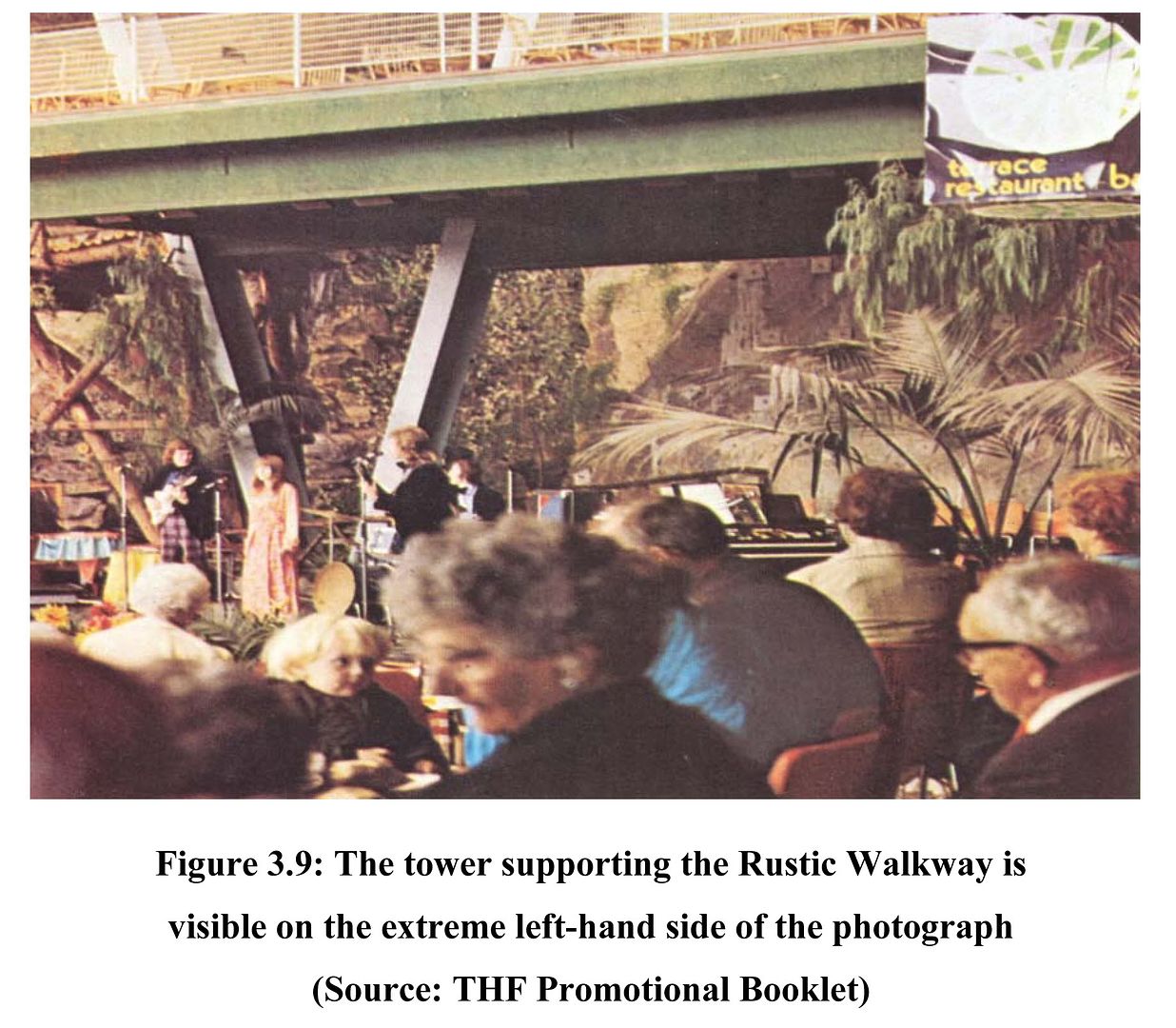
The locked exit doors turned out, on analysis, not to have been as desperately fatal a factor as might be thought. Most of the deaths occurred on the terraces or the (few) staircases leading down from them to the Solarium floor or directly out of the building. From the third ("Cruise Deck", the highest point in the building) to the second terrace (Leisure Level) there was only one exit (the flying staircase); on the Leisure Level there was access to the flying staircase as well as the northeast service staircase which descended to the ground level and opened directly to the outside. From the first terrace one had a choice of the service staircase, the flying staircase, or the "rustic walkway" (an afterthought, not in the original plans). People struggling to escape from the terraces joined the throng on the Solarium floor running for the exits if they were lucky: if they weren't, they were stuck either on the terraces as the fire spread or on the staircases jammed with panicked people screaming in terror. The flying staircase--for many people the only exit of which they were aware--became enveloped in flames, killing at least 13 as they were overcome by fire and fumes or leapt to their deaths in the blaze below.
No villains
The official report's conclusion that the disaster was an accident attributable to human error and not to any specific "villain" surprised many. Here's what they said:
“In all the above inadequacies and failings, it seems to the Commission that there were no villains. Within a certain climate of euphoria at the development of this interesting concept, there were many human errors and failures and it was the accumulation of these, too much reliance upon an‘old boy’ network and some very ill-defined and poor communications which led to the disaster. It would be unjust not to acknowledge that not every failure which is obvious now would be obvious before the disaster put structure and people to the test."
Death by misadventure was the coroner's verdict--times fifty--and this, too, infuriated those who had lost loved ones in the disaster. If the architects and planners, the companies who sold them the materials, and the management in place at the time of the fire could not be held responsible, who could? God? Bad luck? The "curse" of the Derby Castle site?
There are no answers, but the Corporate Manslaughter Act of 2007--a result of unsuccessful prosecutions in cases of disaster--means that if anything like Summerland ever happens again, it would be possible to find the management of the building liable. As with almost every disaster, Summerland spurred the creation of new and more stringent safety codes and regulations, meant to address the various elements of the situation that had led to the appalling death toll. This comes as cold comfort to the families of the victims.
We should remember Summerland not for its kitsch and its desperately misguided concept. We should remember it because it is still the deadliest building fire to have occurred in Britain since the end of World War Two. We should remember it because the decisions that led to disaster are individually small and perhaps understandable: decisions that are likely to have occurred over and over since 1973. We should remember it because new is not always better, and because regulations are not always there to be waived.
Summerland was rebuilt in a vastly subdued version after the fire, but struggled to break even: in 2006 it and the Aquadrome, which had survived the fire, were demolished. After forty years the Derby Castle site has rid itself of a lingering scar, and Douglas--and the Isle of Man--can move on.
Information in this post is from Dr. Ian Phillips's book detailing the results of his research into the Summerland disaster. The book is available on the Web at Dr. Phillips's Birmingham University page. All images in this post are from Dr. Phillips's book (complete with original caption and citations where possible) and moved to my own hosting for purposes of illustration. No copyright infringement is intended and no money is being made: the research was done by Dr. Phillips, not myself, and this post is intended merely to present in summary the conclusions detailed in his work.
Wiki's article on the disaster states variously that 50 and 51 people were killed: there is controversy over the above-50 death toll figure, but Dr. Phillips states that he was unable to find any evidence to support the notion that more than fifty died.
Showing posts with label fire. Show all posts
Showing posts with label fire. Show all posts
Thursday, July 30, 2009


![[Summerland]](http://img.photobucket.com/albums/v104/ceruleancynic/summerland/summerlandbrochurecover.jpg)



Tuesday, June 16, 2009
“No, I cannot say that I have:” a clueless crew and a firetrap ship, the SS Noronic
Nothing can beat the Apollo 1 launchpad fire in terms of flame propagation speed, but the cataclysmic fire that destroyed the SS Noronic in 1949 as she sat beside the docks of Toronto’s Pier 9 was impressively rapid nonetheless. The focus of investigations into the Noronic fire was not the point of origin--that was fairly obvious from eyewitness accounts--or the actual source of ignition: it was the rather horrifyingly laissez-faire attitude of the crew members regarding what to do in the case of a fire in dock.
The official "Report of Court of Investigation into the Circumstances Attending the Loss of the S.S. Noronic" contains quite a lot of direct quotes from examination of the various officers, included into the narrative to make the point abundantly clear: there was no official instruction given to crew members regarding their duties in case of fire in dock, and no attempts made to develop or distribute same, because “the ship had been running from 1913 without mishap.”
The Noronic, built (as mentioned) in 1913, was a cruise and package freight ship plying the Great Lakes. She had two sister ships, the Huronic and the Hamonic; this last, suffering under an even sillier name than Noronic, burned out in 1945. No apparent lessons were learned from the loss of the Hamonic, as demonstrated very clearly in the behaviour of the Noronic’s crew prior to and during the disaster.
She was vast for the time, capable of carrying six hundred passengers and two hundred crew on her five decks, and considered one of the most beautiful and luxurious cruise liners in Canada. Part of her luxury came from the fact that her interior walls were paneled in beautifully polished wood, into which thirty years of lovingly applied lemon-oil varnish had soaked. Some of the wood (the passenger accommodations on D deck) was painted rather than varnished, but the majority of the walls in the upper decks and communal areas were treated with this highly flammable oil.
She was also, being built prior to regulations passed in 1939, lacking the requisite fire-resistant bulkheads the regulations called for. The Chairman of the Board of Steamship Inspection was allowed to exempt existing ships from compliance with the regulations where it was “impracticable or unreasonable” to retrofit the ship to comply. In this case it was rather obviously “expensive” to do so, and Noronic remained a totally period-accurate vessel.
The series of legal loopholes through which the Noronic sailed to escape the installation of vital safety systems is impressive. Not only was she allowed to go around without fire-resistant bulkheads, she also did not have to comply with Regulation 3 of section 405 (1) c of the Canada Shipping Act, requiring “every ship…which is engaged on an international voyage, [to be provided with] an approved fire alarm or fire-detecting system which will automatically register at one or more points or stations in the ship, where it can be most quickly observed by officers and crew, the presence or indication of fire in any part of the ship…not accessible to a fire patrol system.”
Fire patrol meant that the crew was detailed to regularly make exhaustive rounds of the ship throughout the day and night to catch any hint of fire on board; the regulations stated that “all spaces in a passenger ship, except such spaces as cargo spaces, baggage and store rooms, may as a general rule be regarded as accessible to the patrol,” thereby exempting them from the requirement that an automatic alarm or detection system be fitted. Noronic was not considered international, as she only puttered around on the Great Lakes—an “inland voyage.” Even had she been considered “international” due to her route between Canada and the States and thus required to comply with Regulation 3, the Board of Steamship Inspection ruled in 1938 that Regulation 3 only applied to ships making international voyages on the ocean. Either it didn’t apply, or it didn’t apply.
Noronic did in fact have a manual fire alarm system that ran off batteries, of the in-case-of-fire-break-glass type. This alarm rang bells located a) in the officers’ quarters, b) on the port side of D deck, and c) in the engine room on E deck, registering the location of the pulled alarm. It did not activate the klaxons located around the ship which would alert passengers and crew to an emergency: in order to sound those someone would have to go up to the pilot house above A deck to manually flip the klaxon switch. The first and second officers informed investigators that it was “the duty of the officer on watch, upon hearing the bell alarm, to proceed to the locality from which the alarm had been given for the purpose of investigating whether the fire was serious enough to require the sounding of the klaxon alarm and, if he so concluded, then to return to the pilot hours above A deck where he would throw the switch which sounded the klaxon horns. If the officer on duty was away from the pilot house, the wheelsman who should be there was expected to find the officer on duty and report to him as to the locality at which the alarm had been sounded. To obtain this information he would first have to go to the bath-room in the mates’ quarters where the indicator was located.”
I quote the report again directly: It is, of course, obvious from the above that considerable time might be lost between the giving of the alarm at the point where the fire was first discovered and the giving of the klaxon alarm which could only be sounded from the pilot house.
No shit.
It goes on like that. There were supposed to be hydrants located all around the ship so that “at least two powerful jets of water can be rapidly and simultaneously brought to bear upon any part of each deck or space occupied by passengers or crew,” but the inspectors thought, eh, it’d be good enough if you could just run a hose down from the deck above if there weren’t enough hydrants on any given deck (even though the actual wording of the regulations states that “the hydrant shall be so placed on each deck that the fire hoses may be easily coupled to them").
It's apparent that nobody in a position to enforce safety regulations ever actually thought a fire could break out on the Noronic. Certainly they made every effort to weasel out of providing even the most basic of safety systems, taking advantage of the fact that as Noronic was merely sailing on a lake and not the ocean she did not strictly fall under the regulations requiring fire patrol. Whether this is due to some unknown dangerous quality in salt water as opposed to fresh is not explained. The report mentions tartly that in the judge’s opinion the regulations requiring ships to be equipped with working hydrants and extinguishers imply that there also should be crew members provided by the ship’s owner to use the aforementioned apparatus. Without an automatic fire detection system or a sprinkler system on board, Noronic really could’ve used a fire patrol. What they got was this:
Two crew members designated “Special Officers” switched off at 6-hour intervals to walk around the ship with a time clock and punch a series of keys located at various points on board “on the hour.”
Yeah. In 1942 Canada Steamship Lines issued a list of duties to be completed by the Special Officers, including:
“Each night from 9:00 PM until 6:00 AM the watchman clock shall be punched punctually on the hour. The dials are carefully checked by the Purser and the reason for not punching or the dials not being marked must be explained satisfactorily by the officer. During the round of punching, it is your duty to stop any excessive noise by passengers that are boisterous…Upon completion of your round and all passengers are quiet [sic], return to the rotunda where you are easily found should you be needed…”
The round of time-clock punching took about 15 minutes, which meant that for 45 minutes out of every hour there was pretty much zero fire patrol going on. One of Noronic’s Special Officers said that he thought he wasn’t supposed to do the patrol at all when the ship was in port, but remain instead at the gangplank; the other one understood his duty to be completing the rounds each hour and then returning to the gangplank. In fact neither of them were on board the night of the fire: both Special Officers’ rounds were conducted by a pair of wheelsmen who took the shortest possible routes between the time clocks.
This lack of clarity amongst officers and crew comes up over and over again throughout the investigation. This officer understood that this other officer was supposed to do something, but didn't check with anyone to see if this was in fact the case; that officer thought he was supposed to do this other thing but in point of fact was supposed to be somewhere else entirely and had no idea what to do in case of emergency. The card in the passengers' accommodations regarding fire stated confidently that the ship was equipped with "modern fire prevention apparatus" and patrolled "day and night by experienced watchmen." Or inexperienced wheelsmen doing the watchmen's jobs for them, either way.
Fire and lifeboat drills were regularly held on board the Noronic when she was moored in Duluth. Every Tuesday at ten in the morning, the signal was given for fire drill and the crew members assigned to "fire stations" (hydrants) gathered at their posts. The objective of the drill was to get to the hydrant, get the hose down from its rack, and couple the hose to the hydrant. Sometimes on the outside fire stations they'd squirt the hoses overboard, but obviously not indoors. A few crew members were expected to get the extinguishers down and wave them about, maybe discharge one or two. That was it for fire training of the crew.
In 1945, the General Manager at Canada Steamship Lines was apparently made aware of the fact that his ships were practicing a thoroughly useless excuse for a fire drill, and sent out a memo with an updated list of rules. The memo stated that the enclosed Lifeboat and Fire Drill Regulations were (I quote) serious business, and that masters of all passenger steamers must study them carefully and instruct all crew members accordingly. Let's see how the Norons did:
1) MUSTER STATIONS: The Master will designate locations of muster stations throughout the ship to which members of the crew will report for lifeboat and fire drills (and make sure all crew members know where these stations are and which signals call for them to muster).
1) a ALARM SIGNALS: General or Fire Alarm is indicated by one long, three short, one long blasts on whistle or alarm. Proceed at once to fire drill assigned station. Man Boats Alarm is indicated by General Alarm followed by two short blasts on whistle or alarm. Proceed at once to boat drill assigned station.
The Noronic's crew members each carried a blue card on which was printed his crew number, his fire station number, and his boat number. It clearly states the types of alarm and what one should do upon hearing them. However, in practice, the fire drill signal was a continuous blast on the klaxon horns, while the lifeboat drill signal was identical to the official "general or fire alarm" signal. Crew members had to learn to ignore the info on the blue card.
Passengers did not take part in either drill. The only information they received on what to do in case of fire was on the instruction cards in their rooms. The crew were the only ones who had any idea of emergency procedures, and their grasp on same was tenuous at best.
2) MUSTER LISTS: The Master will have a muster list prepared including the information of all crew members and their muster stations, as well as "full particulars" of the signals required to call members of the crew to muster. This list shall be posted in conspicuous places throughout the ship including the crew's quarters and every officer's room.
There was no such thing as a "muster list" on board the Noronic, nothing signed by the Master, and nothing hung in any officer's room. A "chart" of crew members apparently hung in the maids' quarters, in the crew's stairway aft, on either B or C decks, and in the crew's rec room. The first officer, Gerald Wood, used this chart to prepare a list of crew members and their blue card numbers, boat numbers, and hydrant numbers, and gave a copy to the chief steward. The captain was completely ignorant of all of this and only knew about the typed list because he looked over Wood's shoulder as he was filling it out. Who's on board? Whose job is it to do what? Who knows?
3) MUSTER CARDS: A card indicating the muster station for each crew member must be placed in his berth in such position that it cannot be obscured by baggage or clothing.
The only thing remotely similar to this in use on the Noronic was the blue card, which was kept wherever the crew felt like keeping it.
There was also a rule stating that the Master had to appoint Senior Officers to various parts of the ship in order to help direct passengers to their muster stations if necessary. Here is where the testimony really gets interesting: Captain Taylor said that he'd allocated the first officer to C deck, second officer to A deck, third officer to B deck, and chief steward and purser to D deck. Wood, the first officer, denies any allocation was made, and then proceeds to flip-flop like a gaffed pike (unsurprisingly, he stated that he had never seen or heard of the Serious Business memo):
Q: Was there any allocation that you know of of senior officers allocated to certain locations for the purpose of mustering passengers?
A: No there was not.
Q: Did you make any allocation?
A: No.
Q: Did anyone else to your knowledge?
A: Not that I know of.
Q (really trying here): Now I want to be fair with you. I thought the Captain did say to us that he had allocated certain senior officers in accordance with this and he said the allocation was the chief officer to C deck....do you know anything about that?
A: Well yes, I would be in charge of C deck.
Q: (wondering what he's smoking): Well that is what he told us, that you were in charge of C deck--then must that not mean that you were allocated in some way to C deck?
A: Yes, I would be allocated.
Q: How would you be allocated and what instructions did you have with regard to C deck?
A: I think by this chart [which indicated his duty was free to move about the ship].
(some back and forth about whether or not this allocation is the same as on other ships)
Q: Now what do you say as to whether or not any station was allocated to you as the first officer under this regulation?
A: Well he may have told me to go to my allocation on C deck.
Q: (between clenched teeth) Well he may and then I suppose he may not, but I am trying to get from you whether he did.
A: Well I have been there a number of years.
Q: Then is your statement to me that you do not know whether the Captain in the case of fire had told you that you were to go to C deck?
A: I am pretty sure--I might say that the captain did not tell me this year. He could have back in 1944 or 1945.
Q: Did you always go to C deck on fire drill?
A: No, I go all over the ship.
Q: Then you were really not allocated to C deck?
A: Not to stay there.
Q: Well was anybody allocated to C deck?
A: Well I think the officers were free--wherever we could be the most help.
This confusion is heightened by "the chart," which states that Wood was in fact in charge of deck A. Balancing out various testimonies against one another it becomes abundantly clear that this "chart" had become so obsolete by 1949 that it had nothing to do with any organization or lack thereof on board the ship and in fact the captain had no idea it existed at all. We are dealing with governmental levels of confusion here. The captain and first officer, when asked about duties to be performed by the officers and men at the fire hydrant stations, contradicted one another and made up answers to explain what the rest of the crew not assigned to hydrants would be doing (running away, is my guess).
The slipperiness of officials when faced with questions about the Noronic extends way up the ladder. General Manager of the line Captain Reoch had to admit under examination that in fact when he wrote the Serious Business memo he did not take into consideration the fact that, if a fire occurred while the ship was tied up to a dock, directing all the passengers to the muster stations on C deck would not do them a blind bit of good as the only gangplanks to the dock were on E deck three floors below. "Was it your intention under these rules when you drew them up, that in the event of a fire at a dock, the passengers from D deck would go up or be directed to C deck and then go back down to D [and then E] deck to get off onto the dock?" he was asked. After some squirming and repeated requests to answer the question, Reoch finally admitted that he didn't think that the rules he'd indicated would be followed in case of a dockside fire--or, more accurately, he'd not bothered to consider the possibility.
The really damning bit is when they are asked why they didn't increase the number of crewmen on fire patrol while the ship was tied up. "If there had of [sic] been any signs of an emergency, yes, but there was no reason why they would have. I can't see any reason why they would."
Maybe because you're in a floating firetrap lacking rudimentary safety systems, steeped in decades' worth of flammable varnish, and inhabited by people who are coming back from Toronto bars drunk off their tits and probably waving around lit cigars?
There was no way of knowing which crew members were on or off the ship while she was in port, as they were free to go ashore at any time they were not on duty. If there had been any organization amongst the crew for dealing with emergencies, it went directly out of the porthole as soon as crew members began to go ashore unremarked.
So we have the perfect setup for disaster. On the night of September 17, 1949, something in a linen closet on C deck aft caught fire. The closet contained bed linen, towels, and cleaning materials, as well as a box for rubbish and wastepaper collected from the cabins, and a switchbox controlling some of the stateroom lights. The presence of the box is controversial: a maid stated that the rubbish box was never placed in the linen closet; the chief steward said it might have been there, and an eyewitness stated that it was there. If the fire was due to a smouldering cigarette butt, this box would have represented a perfect point of origin. Passengers mentioned seeing maids smoking cigarettes in the linen closet during the voyage; in the absence of a major electrical fault it seems likely although not certain that a carelessly discarded butt was responsible for killing somewhere between 118 and 139 people.
A passenger, Don Church, noticed a haze in the starboard corridor around 2:30 a.m. and followed it to the linen closet, where he saw smoke coming from the sides and top of the locked closet door. He heard a faint crackling, rustling noise, and assumed someone was inside; this would have been the fire talking to itself. Church, unable to open the door, ran forward yelling that the boat was on fire and encountered the head bellboy, Earnest O'Neill. O'Neill ran back with him to the locker, whereupon their stories diverge: O'Neill stated that he ran back to the steward's officers to fetch the closet key, then went to fetch a fire extinguisher before unlocking the door. Church stated that he just unlocked the door as they arrived.
They opened the door and saw that the wall was in flames and a hanging sheet was beginning to burn. The extinguisher barely slowed it down: almost as soon as the door was opened, flames poured out along the ceiling, feeding on the beautifully polished wooden paneling. Church and O'Neill went for a fire hose, but when Church opened the valve nothing came out. At this point he thought sod this for a game of soldiers and went off to fetch his family and got the hell out of it.
O'Neill only now broke the glass on the fire alarm and ran down to E deck to find a wheelsman and inform him of the fire. It's uncertain how much time really elapsed between the discovery of the fire and the sounding of the alarm, but time was definitely lost in trying to put out the fire with ineffective means. If O'Neill had sounded the alarm at once instead of messing about with extinguishers, several senior officers could have responded at once and taken charge of the fire equipment: C deck was the most well-staffed in terms of hydrant stations. He didn't. The fire raged out of control.
The wheelman O'Neill had woken in turn woke Wood, who quickly sounded the klaxon alarm and pulled the whistle, which stuck open and drowned out the klaxons. By now the starboard side of the boat was "full of fire," and he could not go aft farther than the first three cabins on the port side, where he "banged on the windows" and shouted.
Just before Wood sounded the whistle, a night watchman on the pier was appalled to see flames breaking through a window on the ship's starboard side. He ran inside and called the fire department and gave the alarm, then called the police; someone else standing at the door told him to call for ambulances as well. After he'd told the police to send all the doctors and ambulances they could, the watchman--a Mr. Harper--went back outside to find a mass of flame engulfing the starboard side of the ship. Now the whistle was blowing--Wood had sounded the alarm--and the fire department was arriving. By now it was 2:41 a.m., eleven minutes since Church first saw the smoke, and half the ship's decks were on fire.
The man who had told Harper to call for ambulances was one of the first to escape the burning ship. He had seen people badly burned--a woman with her hair burned away, people with faces and arms scorched and bubbling. It was still only minutes after the fire had begun, and already it was lethal.
The captain was informed of the fire some time between 2:30 and 2:35, according to his testimony, but the times don't match up; he claims to have gone out to yell for help from the outside deck and observed people on the pier, but Harper the watchman had seen the fire begin to erupt and made the alarm call when there had been no other people on the dock.
There is considerable flip-flopping from Wood regarding the instructions he had given to the crew members as to what they ought to do in case of fire: should they notify the officer on watch or just any officer, should they use a hose or an extinguisher first, did he actually tell them anything at all. "Would this be fair," he was asked, "and now correct me if I do not say it correctly--that so far as the education of the crew in the event of fire was concerned, all they had was what they saw on the printed chart in the crew's quarters, which took them to their various stations in the event of hearing the alarm--is that all they had--apart from what you have just said as to what you might have told any particular member of the crew--does that cover the whole field?"
"Yes, that covers it."
There was no organization, and therefore there was no clear and evident list of duties for each member of the crew to perform. Some of the fifteen men on duty tried harder than others to waken passengers and shepherd them over the side on ropes and Jacob's-ladders; by now the fire department was there en masse and trying to reach the ship with aerial ladders, but so many people leapt on the first of these--Aerial No. 5--that it snapped and spilled the lot of them into the harbour. Other passengers leapt straight into the water, some of them screaming as they burned, some of them in eerie silence. Many people were asleep when the fire broke out, and woke only to find their cabins ablaze and the only way out blocked by a window-screen they could not break; some were pulled from burning cabins from the outside by crew members or fellow passengers who had broken the screens away.
GenDisasters offers a collection of quotes from eyewitnesses. Mildred Briggs of Detroit, one of the survivors, said the flames spread as if in a matchbox. "The fire just welled up along the corridors and spread faster than any fire I've ever seen," she said.
"There was a mob of men and women surging back and forth," said another survivor, Alberta Agia of Detroit. "Men were pushing women around, and many were knocked to the floor. The screaming filled the air. There was so much panic that I don't know how these people found anyway to safety. I slid down a rope."
Men rushed out in their nightclothes. One man got ashore naked.
Henry Maurer and his wife were sound asleep when someone pounded the door. When they reached the outside rail, his wife started down a rope ladder, "but it became horribly twisted from so many trying to get on it. She got tangled and trapped. I swung down on a rope to her side and got her free, and we both managed to get to the dock."
Sylvia Carpenter of Detroit said she screamed and headed for the outside rail when she saw smoke and flame billowing along the passageways.
"A rope was tossed over the rail and I put a hitch knot on it to hold it to a stanchion," she said. "As I did so, three men pushed in front of me and shoved some screaming women out of the way. They went down the rope."
The fire burned intensely enough to heat the steel hull white-hot. Glass melted from portholes; metal slumped and warped. Enough water was poured in by the firefighting equipment to list the burning ship toward the dock; operations had to be halted until the list righted itself, as the Noronic settled to the bottom of the harbour with only her top decks above the surface. By five in the morning the fire was out, but they had to let the hull cool before venturing inside to find the bodies.
Everything that could be consumed inside the hull was consumed. Luxurious fittings were reduced to ash, ceilings and columns melted and warped. All the stairways in the boat save one were utterly destroyed.
The fire stripped away identities, turning human bodies to calcined bone fragments; some victims were nothing but a skull or spine. There are touchingly gruesome tales of searchers entering the ship to find embracing skeletons in the hallways and the remains of the cabins. The remains had to be removed by shoveling them onto tarpaulins, as they crumbled when picked up. New advances in forensic odontology (including the use of X-rays) had to be made to identify Noronic victims; articles on the techniques developed as a result of this disaster are still being published today in forensic journals.
Newspaper articles covering the disaster began, as newspaper articles of this sort tend to do, with horrified pronoun-deficient headlines: 200 DIE ON FIERY SHIP. GREAT LAKES QUEEN BURNS. HOLOCAUST SINKS PLEASURE CRUISER AT TORONTO DOCK. 400 HOLIDAYERS ESCAPE FLAMING DEATH AMID SCENES OF HORROR.
The final conclusion of the Court report into the disaster placed the blame on the failure of the owners and captain in:
a) Holding a continuous fire patrol of the ship, instead of a cursory time-clock round every 45 minutes
b) Maintaining any organized system while the ship was in dock with passengers aboard by which “information as to the outbreak of fire could be promptly dispatched to some point from which men trained in the methods of dealing with fire could be immediately dispatched to the locality,” or “effective fire alarm and fire procedure”
c) Taking the threat of fire at a dock seriously and allowing all but fifteen of the crew to go play on shore and be potentially unavailable in the case of emergency
d) Developing and practicing any plan for waking and evacuating passengers in the case of a fire while in dock
e) Training the crew on what to do in case of fire or how to operate the extinguishers and hoses.
Or, to put it more baldly, being about as prepared for a dockside fire as a jumbo prawn would be to handle a credit-default swap. The scope of the failure to prepare for or anticipate anything of the sort is breathtaking. The owners knew perfectly well that there was no functional plan in place for dealing with this kind of disaster, and so did the captain–and there was nothing stopping him from taking any steps to remedy the situation. It’s the equivalent of driving a car with half the lug nuts loose and just sort of hoping the damn wheels won’t come off.
The Noronic fire may not have been preventable, but the loss of life associated with it was. Nobody ever did determine what started it, but my money’s on an indifferently butted cigarette tossed into the refuse box in the linen closet, which then spread rapidly throughout a ship lacking in regulation fire-resistant bulkheads, a ship lined with highly inflammable varnished wood, a ship without automatic fire-detection or sprinkler systems, a ship whose fire alarm system was Goldbergian in its unnecessary complexity and multiple stages, and a ship manned by a totally insufficient and untrained skeleton staff. The bellboy O’Neill could possibly have saved the ship had he sounded the alarm before attempting to put the fire out himself–but he didn’t. The story of the Noronic is a litany of “I didn’t,” “I don’t know,” “I cannot say that I have,” and “I can’t see any reason why they would.”
Captain Taylor lost his license for a year; an unknown number of people lost their lives. The steamship company paid out something like $3 million to the families of the victims. Rather horribly, another Canadian passenger ship, the SS Quebec, experienced a similar fire a year later: the Quebec fire was ultimately determined to be the result of arson and started in a linen locker. None of the safety regulations written after Noronic were put in place aboard Quebec, and the crew were just about as useless in trying to fight the fire and evacuate passengers. That was it for Canada Steamship Lines’ passenger cruises on the Great Lakes.
It’s too easy to make fun of the Noronic’s name, which I will now reveal is most likely in reference to Lake Noron, Quebec. It’s too easy to point out that “no we didn’t” and “moronic” overlap quite efficiently, so I will just leave you with First Officer Wood’s deathless turn of phrase:
“I think in cases of emergency, the officer goes where he can be the best help.”
In this case, over the side.
Information in this article is taken from the following sources:
CanadianHistory.suite101.com
www.centrenaufrages.ca, Courage Tales 5, accessed June 16, 2009
GenDisasters.com
Lost Liners
Report of Court of Investigation into the Circumstances Attending the Loss of the S.S. "Noronic" (1949), located at Tales of Tragedy and Triumph: Canadian Shipwrecks, a virtual museum exhibition at Library and Archives Canada
The Walkerville Times
Wiki
The official "Report of Court of Investigation into the Circumstances Attending the Loss of the S.S. Noronic" contains quite a lot of direct quotes from examination of the various officers, included into the narrative to make the point abundantly clear: there was no official instruction given to crew members regarding their duties in case of fire in dock, and no attempts made to develop or distribute same, because “the ship had been running from 1913 without mishap.”
The Noronic, built (as mentioned) in 1913, was a cruise and package freight ship plying the Great Lakes. She had two sister ships, the Huronic and the Hamonic; this last, suffering under an even sillier name than Noronic, burned out in 1945. No apparent lessons were learned from the loss of the Hamonic, as demonstrated very clearly in the behaviour of the Noronic’s crew prior to and during the disaster.
She was vast for the time, capable of carrying six hundred passengers and two hundred crew on her five decks, and considered one of the most beautiful and luxurious cruise liners in Canada. Part of her luxury came from the fact that her interior walls were paneled in beautifully polished wood, into which thirty years of lovingly applied lemon-oil varnish had soaked. Some of the wood (the passenger accommodations on D deck) was painted rather than varnished, but the majority of the walls in the upper decks and communal areas were treated with this highly flammable oil.
She was also, being built prior to regulations passed in 1939, lacking the requisite fire-resistant bulkheads the regulations called for. The Chairman of the Board of Steamship Inspection was allowed to exempt existing ships from compliance with the regulations where it was “impracticable or unreasonable” to retrofit the ship to comply. In this case it was rather obviously “expensive” to do so, and Noronic remained a totally period-accurate vessel.
The series of legal loopholes through which the Noronic sailed to escape the installation of vital safety systems is impressive. Not only was she allowed to go around without fire-resistant bulkheads, she also did not have to comply with Regulation 3 of section 405 (1) c of the Canada Shipping Act, requiring “every ship…which is engaged on an international voyage, [to be provided with] an approved fire alarm or fire-detecting system which will automatically register at one or more points or stations in the ship, where it can be most quickly observed by officers and crew, the presence or indication of fire in any part of the ship…not accessible to a fire patrol system.”
Fire patrol meant that the crew was detailed to regularly make exhaustive rounds of the ship throughout the day and night to catch any hint of fire on board; the regulations stated that “all spaces in a passenger ship, except such spaces as cargo spaces, baggage and store rooms, may as a general rule be regarded as accessible to the patrol,” thereby exempting them from the requirement that an automatic alarm or detection system be fitted. Noronic was not considered international, as she only puttered around on the Great Lakes—an “inland voyage.” Even had she been considered “international” due to her route between Canada and the States and thus required to comply with Regulation 3, the Board of Steamship Inspection ruled in 1938 that Regulation 3 only applied to ships making international voyages on the ocean. Either it didn’t apply, or it didn’t apply.
Noronic did in fact have a manual fire alarm system that ran off batteries, of the in-case-of-fire-break-glass type. This alarm rang bells located a) in the officers’ quarters, b) on the port side of D deck, and c) in the engine room on E deck, registering the location of the pulled alarm. It did not activate the klaxons located around the ship which would alert passengers and crew to an emergency: in order to sound those someone would have to go up to the pilot house above A deck to manually flip the klaxon switch. The first and second officers informed investigators that it was “the duty of the officer on watch, upon hearing the bell alarm, to proceed to the locality from which the alarm had been given for the purpose of investigating whether the fire was serious enough to require the sounding of the klaxon alarm and, if he so concluded, then to return to the pilot hours above A deck where he would throw the switch which sounded the klaxon horns. If the officer on duty was away from the pilot house, the wheelsman who should be there was expected to find the officer on duty and report to him as to the locality at which the alarm had been sounded. To obtain this information he would first have to go to the bath-room in the mates’ quarters where the indicator was located.”
I quote the report again directly: It is, of course, obvious from the above that considerable time might be lost between the giving of the alarm at the point where the fire was first discovered and the giving of the klaxon alarm which could only be sounded from the pilot house.
No shit.
It goes on like that. There were supposed to be hydrants located all around the ship so that “at least two powerful jets of water can be rapidly and simultaneously brought to bear upon any part of each deck or space occupied by passengers or crew,” but the inspectors thought, eh, it’d be good enough if you could just run a hose down from the deck above if there weren’t enough hydrants on any given deck (even though the actual wording of the regulations states that “the hydrant shall be so placed on each deck that the fire hoses may be easily coupled to them").
It's apparent that nobody in a position to enforce safety regulations ever actually thought a fire could break out on the Noronic. Certainly they made every effort to weasel out of providing even the most basic of safety systems, taking advantage of the fact that as Noronic was merely sailing on a lake and not the ocean she did not strictly fall under the regulations requiring fire patrol. Whether this is due to some unknown dangerous quality in salt water as opposed to fresh is not explained. The report mentions tartly that in the judge’s opinion the regulations requiring ships to be equipped with working hydrants and extinguishers imply that there also should be crew members provided by the ship’s owner to use the aforementioned apparatus. Without an automatic fire detection system or a sprinkler system on board, Noronic really could’ve used a fire patrol. What they got was this:
Two crew members designated “Special Officers” switched off at 6-hour intervals to walk around the ship with a time clock and punch a series of keys located at various points on board “on the hour.”
Yeah. In 1942 Canada Steamship Lines issued a list of duties to be completed by the Special Officers, including:
“Each night from 9:00 PM until 6:00 AM the watchman clock shall be punched punctually on the hour. The dials are carefully checked by the Purser and the reason for not punching or the dials not being marked must be explained satisfactorily by the officer. During the round of punching, it is your duty to stop any excessive noise by passengers that are boisterous…Upon completion of your round and all passengers are quiet [sic], return to the rotunda where you are easily found should you be needed…”
The round of time-clock punching took about 15 minutes, which meant that for 45 minutes out of every hour there was pretty much zero fire patrol going on. One of Noronic’s Special Officers said that he thought he wasn’t supposed to do the patrol at all when the ship was in port, but remain instead at the gangplank; the other one understood his duty to be completing the rounds each hour and then returning to the gangplank. In fact neither of them were on board the night of the fire: both Special Officers’ rounds were conducted by a pair of wheelsmen who took the shortest possible routes between the time clocks.
This lack of clarity amongst officers and crew comes up over and over again throughout the investigation. This officer understood that this other officer was supposed to do something, but didn't check with anyone to see if this was in fact the case; that officer thought he was supposed to do this other thing but in point of fact was supposed to be somewhere else entirely and had no idea what to do in case of emergency. The card in the passengers' accommodations regarding fire stated confidently that the ship was equipped with "modern fire prevention apparatus" and patrolled "day and night by experienced watchmen." Or inexperienced wheelsmen doing the watchmen's jobs for them, either way.
Fire and lifeboat drills were regularly held on board the Noronic when she was moored in Duluth. Every Tuesday at ten in the morning, the signal was given for fire drill and the crew members assigned to "fire stations" (hydrants) gathered at their posts. The objective of the drill was to get to the hydrant, get the hose down from its rack, and couple the hose to the hydrant. Sometimes on the outside fire stations they'd squirt the hoses overboard, but obviously not indoors. A few crew members were expected to get the extinguishers down and wave them about, maybe discharge one or two. That was it for fire training of the crew.
In 1945, the General Manager at Canada Steamship Lines was apparently made aware of the fact that his ships were practicing a thoroughly useless excuse for a fire drill, and sent out a memo with an updated list of rules. The memo stated that the enclosed Lifeboat and Fire Drill Regulations were (I quote) serious business, and that masters of all passenger steamers must study them carefully and instruct all crew members accordingly. Let's see how the Norons did:
1) MUSTER STATIONS: The Master will designate locations of muster stations throughout the ship to which members of the crew will report for lifeboat and fire drills (and make sure all crew members know where these stations are and which signals call for them to muster).
1) a ALARM SIGNALS: General or Fire Alarm is indicated by one long, three short, one long blasts on whistle or alarm. Proceed at once to fire drill assigned station. Man Boats Alarm is indicated by General Alarm followed by two short blasts on whistle or alarm. Proceed at once to boat drill assigned station.
The Noronic's crew members each carried a blue card on which was printed his crew number, his fire station number, and his boat number. It clearly states the types of alarm and what one should do upon hearing them. However, in practice, the fire drill signal was a continuous blast on the klaxon horns, while the lifeboat drill signal was identical to the official "general or fire alarm" signal. Crew members had to learn to ignore the info on the blue card.
Passengers did not take part in either drill. The only information they received on what to do in case of fire was on the instruction cards in their rooms. The crew were the only ones who had any idea of emergency procedures, and their grasp on same was tenuous at best.
2) MUSTER LISTS: The Master will have a muster list prepared including the information of all crew members and their muster stations, as well as "full particulars" of the signals required to call members of the crew to muster. This list shall be posted in conspicuous places throughout the ship including the crew's quarters and every officer's room.
There was no such thing as a "muster list" on board the Noronic, nothing signed by the Master, and nothing hung in any officer's room. A "chart" of crew members apparently hung in the maids' quarters, in the crew's stairway aft, on either B or C decks, and in the crew's rec room. The first officer, Gerald Wood, used this chart to prepare a list of crew members and their blue card numbers, boat numbers, and hydrant numbers, and gave a copy to the chief steward. The captain was completely ignorant of all of this and only knew about the typed list because he looked over Wood's shoulder as he was filling it out. Who's on board? Whose job is it to do what? Who knows?
3) MUSTER CARDS: A card indicating the muster station for each crew member must be placed in his berth in such position that it cannot be obscured by baggage or clothing.
The only thing remotely similar to this in use on the Noronic was the blue card, which was kept wherever the crew felt like keeping it.
There was also a rule stating that the Master had to appoint Senior Officers to various parts of the ship in order to help direct passengers to their muster stations if necessary. Here is where the testimony really gets interesting: Captain Taylor said that he'd allocated the first officer to C deck, second officer to A deck, third officer to B deck, and chief steward and purser to D deck. Wood, the first officer, denies any allocation was made, and then proceeds to flip-flop like a gaffed pike (unsurprisingly, he stated that he had never seen or heard of the Serious Business memo):
Q: Was there any allocation that you know of of senior officers allocated to certain locations for the purpose of mustering passengers?
A: No there was not.
Q: Did you make any allocation?
A: No.
Q: Did anyone else to your knowledge?
A: Not that I know of.
Q (really trying here): Now I want to be fair with you. I thought the Captain did say to us that he had allocated certain senior officers in accordance with this and he said the allocation was the chief officer to C deck....do you know anything about that?
A: Well yes, I would be in charge of C deck.
Q: (wondering what he's smoking): Well that is what he told us, that you were in charge of C deck--then must that not mean that you were allocated in some way to C deck?
A: Yes, I would be allocated.
Q: How would you be allocated and what instructions did you have with regard to C deck?
A: I think by this chart [which indicated his duty was free to move about the ship].
(some back and forth about whether or not this allocation is the same as on other ships)
Q: Now what do you say as to whether or not any station was allocated to you as the first officer under this regulation?
A: Well he may have told me to go to my allocation on C deck.
Q: (between clenched teeth) Well he may and then I suppose he may not, but I am trying to get from you whether he did.
A: Well I have been there a number of years.
Q: Then is your statement to me that you do not know whether the Captain in the case of fire had told you that you were to go to C deck?
A: I am pretty sure--I might say that the captain did not tell me this year. He could have back in 1944 or 1945.
Q: Did you always go to C deck on fire drill?
A: No, I go all over the ship.
Q: Then you were really not allocated to C deck?
A: Not to stay there.
Q: Well was anybody allocated to C deck?
A: Well I think the officers were free--wherever we could be the most help.
This confusion is heightened by "the chart," which states that Wood was in fact in charge of deck A. Balancing out various testimonies against one another it becomes abundantly clear that this "chart" had become so obsolete by 1949 that it had nothing to do with any organization or lack thereof on board the ship and in fact the captain had no idea it existed at all. We are dealing with governmental levels of confusion here. The captain and first officer, when asked about duties to be performed by the officers and men at the fire hydrant stations, contradicted one another and made up answers to explain what the rest of the crew not assigned to hydrants would be doing (running away, is my guess).
The slipperiness of officials when faced with questions about the Noronic extends way up the ladder. General Manager of the line Captain Reoch had to admit under examination that in fact when he wrote the Serious Business memo he did not take into consideration the fact that, if a fire occurred while the ship was tied up to a dock, directing all the passengers to the muster stations on C deck would not do them a blind bit of good as the only gangplanks to the dock were on E deck three floors below. "Was it your intention under these rules when you drew them up, that in the event of a fire at a dock, the passengers from D deck would go up or be directed to C deck and then go back down to D [and then E] deck to get off onto the dock?" he was asked. After some squirming and repeated requests to answer the question, Reoch finally admitted that he didn't think that the rules he'd indicated would be followed in case of a dockside fire--or, more accurately, he'd not bothered to consider the possibility.
The really damning bit is when they are asked why they didn't increase the number of crewmen on fire patrol while the ship was tied up. "If there had of [sic] been any signs of an emergency, yes, but there was no reason why they would have. I can't see any reason why they would."
Maybe because you're in a floating firetrap lacking rudimentary safety systems, steeped in decades' worth of flammable varnish, and inhabited by people who are coming back from Toronto bars drunk off their tits and probably waving around lit cigars?
There was no way of knowing which crew members were on or off the ship while she was in port, as they were free to go ashore at any time they were not on duty. If there had been any organization amongst the crew for dealing with emergencies, it went directly out of the porthole as soon as crew members began to go ashore unremarked.
So we have the perfect setup for disaster. On the night of September 17, 1949, something in a linen closet on C deck aft caught fire. The closet contained bed linen, towels, and cleaning materials, as well as a box for rubbish and wastepaper collected from the cabins, and a switchbox controlling some of the stateroom lights. The presence of the box is controversial: a maid stated that the rubbish box was never placed in the linen closet; the chief steward said it might have been there, and an eyewitness stated that it was there. If the fire was due to a smouldering cigarette butt, this box would have represented a perfect point of origin. Passengers mentioned seeing maids smoking cigarettes in the linen closet during the voyage; in the absence of a major electrical fault it seems likely although not certain that a carelessly discarded butt was responsible for killing somewhere between 118 and 139 people.
A passenger, Don Church, noticed a haze in the starboard corridor around 2:30 a.m. and followed it to the linen closet, where he saw smoke coming from the sides and top of the locked closet door. He heard a faint crackling, rustling noise, and assumed someone was inside; this would have been the fire talking to itself. Church, unable to open the door, ran forward yelling that the boat was on fire and encountered the head bellboy, Earnest O'Neill. O'Neill ran back with him to the locker, whereupon their stories diverge: O'Neill stated that he ran back to the steward's officers to fetch the closet key, then went to fetch a fire extinguisher before unlocking the door. Church stated that he just unlocked the door as they arrived.
They opened the door and saw that the wall was in flames and a hanging sheet was beginning to burn. The extinguisher barely slowed it down: almost as soon as the door was opened, flames poured out along the ceiling, feeding on the beautifully polished wooden paneling. Church and O'Neill went for a fire hose, but when Church opened the valve nothing came out. At this point he thought sod this for a game of soldiers and went off to fetch his family and got the hell out of it.
O'Neill only now broke the glass on the fire alarm and ran down to E deck to find a wheelsman and inform him of the fire. It's uncertain how much time really elapsed between the discovery of the fire and the sounding of the alarm, but time was definitely lost in trying to put out the fire with ineffective means. If O'Neill had sounded the alarm at once instead of messing about with extinguishers, several senior officers could have responded at once and taken charge of the fire equipment: C deck was the most well-staffed in terms of hydrant stations. He didn't. The fire raged out of control.
The wheelman O'Neill had woken in turn woke Wood, who quickly sounded the klaxon alarm and pulled the whistle, which stuck open and drowned out the klaxons. By now the starboard side of the boat was "full of fire," and he could not go aft farther than the first three cabins on the port side, where he "banged on the windows" and shouted.
Just before Wood sounded the whistle, a night watchman on the pier was appalled to see flames breaking through a window on the ship's starboard side. He ran inside and called the fire department and gave the alarm, then called the police; someone else standing at the door told him to call for ambulances as well. After he'd told the police to send all the doctors and ambulances they could, the watchman--a Mr. Harper--went back outside to find a mass of flame engulfing the starboard side of the ship. Now the whistle was blowing--Wood had sounded the alarm--and the fire department was arriving. By now it was 2:41 a.m., eleven minutes since Church first saw the smoke, and half the ship's decks were on fire.
The man who had told Harper to call for ambulances was one of the first to escape the burning ship. He had seen people badly burned--a woman with her hair burned away, people with faces and arms scorched and bubbling. It was still only minutes after the fire had begun, and already it was lethal.
The captain was informed of the fire some time between 2:30 and 2:35, according to his testimony, but the times don't match up; he claims to have gone out to yell for help from the outside deck and observed people on the pier, but Harper the watchman had seen the fire begin to erupt and made the alarm call when there had been no other people on the dock.
There is considerable flip-flopping from Wood regarding the instructions he had given to the crew members as to what they ought to do in case of fire: should they notify the officer on watch or just any officer, should they use a hose or an extinguisher first, did he actually tell them anything at all. "Would this be fair," he was asked, "and now correct me if I do not say it correctly--that so far as the education of the crew in the event of fire was concerned, all they had was what they saw on the printed chart in the crew's quarters, which took them to their various stations in the event of hearing the alarm--is that all they had--apart from what you have just said as to what you might have told any particular member of the crew--does that cover the whole field?"
"Yes, that covers it."
There was no organization, and therefore there was no clear and evident list of duties for each member of the crew to perform. Some of the fifteen men on duty tried harder than others to waken passengers and shepherd them over the side on ropes and Jacob's-ladders; by now the fire department was there en masse and trying to reach the ship with aerial ladders, but so many people leapt on the first of these--Aerial No. 5--that it snapped and spilled the lot of them into the harbour. Other passengers leapt straight into the water, some of them screaming as they burned, some of them in eerie silence. Many people were asleep when the fire broke out, and woke only to find their cabins ablaze and the only way out blocked by a window-screen they could not break; some were pulled from burning cabins from the outside by crew members or fellow passengers who had broken the screens away.
GenDisasters offers a collection of quotes from eyewitnesses. Mildred Briggs of Detroit, one of the survivors, said the flames spread as if in a matchbox. "The fire just welled up along the corridors and spread faster than any fire I've ever seen," she said.
"There was a mob of men and women surging back and forth," said another survivor, Alberta Agia of Detroit. "Men were pushing women around, and many were knocked to the floor. The screaming filled the air. There was so much panic that I don't know how these people found anyway to safety. I slid down a rope."
Men rushed out in their nightclothes. One man got ashore naked.
Henry Maurer and his wife were sound asleep when someone pounded the door. When they reached the outside rail, his wife started down a rope ladder, "but it became horribly twisted from so many trying to get on it. She got tangled and trapped. I swung down on a rope to her side and got her free, and we both managed to get to the dock."
Sylvia Carpenter of Detroit said she screamed and headed for the outside rail when she saw smoke and flame billowing along the passageways.
"A rope was tossed over the rail and I put a hitch knot on it to hold it to a stanchion," she said. "As I did so, three men pushed in front of me and shoved some screaming women out of the way. They went down the rope."
The fire burned intensely enough to heat the steel hull white-hot. Glass melted from portholes; metal slumped and warped. Enough water was poured in by the firefighting equipment to list the burning ship toward the dock; operations had to be halted until the list righted itself, as the Noronic settled to the bottom of the harbour with only her top decks above the surface. By five in the morning the fire was out, but they had to let the hull cool before venturing inside to find the bodies.
Everything that could be consumed inside the hull was consumed. Luxurious fittings were reduced to ash, ceilings and columns melted and warped. All the stairways in the boat save one were utterly destroyed.
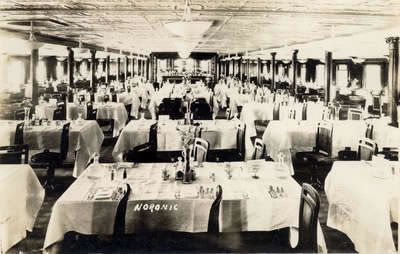
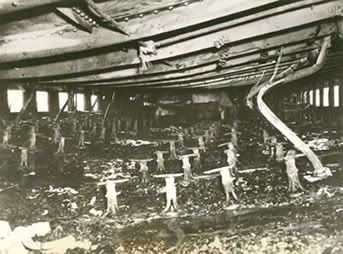
The fire stripped away identities, turning human bodies to calcined bone fragments; some victims were nothing but a skull or spine. There are touchingly gruesome tales of searchers entering the ship to find embracing skeletons in the hallways and the remains of the cabins. The remains had to be removed by shoveling them onto tarpaulins, as they crumbled when picked up. New advances in forensic odontology (including the use of X-rays) had to be made to identify Noronic victims; articles on the techniques developed as a result of this disaster are still being published today in forensic journals.
Newspaper articles covering the disaster began, as newspaper articles of this sort tend to do, with horrified pronoun-deficient headlines: 200 DIE ON FIERY SHIP. GREAT LAKES QUEEN BURNS. HOLOCAUST SINKS PLEASURE CRUISER AT TORONTO DOCK. 400 HOLIDAYERS ESCAPE FLAMING DEATH AMID SCENES OF HORROR.
The final conclusion of the Court report into the disaster placed the blame on the failure of the owners and captain in:
a) Holding a continuous fire patrol of the ship, instead of a cursory time-clock round every 45 minutes
b) Maintaining any organized system while the ship was in dock with passengers aboard by which “information as to the outbreak of fire could be promptly dispatched to some point from which men trained in the methods of dealing with fire could be immediately dispatched to the locality,” or “effective fire alarm and fire procedure”
c) Taking the threat of fire at a dock seriously and allowing all but fifteen of the crew to go play on shore and be potentially unavailable in the case of emergency
d) Developing and practicing any plan for waking and evacuating passengers in the case of a fire while in dock
e) Training the crew on what to do in case of fire or how to operate the extinguishers and hoses.
Or, to put it more baldly, being about as prepared for a dockside fire as a jumbo prawn would be to handle a credit-default swap. The scope of the failure to prepare for or anticipate anything of the sort is breathtaking. The owners knew perfectly well that there was no functional plan in place for dealing with this kind of disaster, and so did the captain–and there was nothing stopping him from taking any steps to remedy the situation. It’s the equivalent of driving a car with half the lug nuts loose and just sort of hoping the damn wheels won’t come off.
The Noronic fire may not have been preventable, but the loss of life associated with it was. Nobody ever did determine what started it, but my money’s on an indifferently butted cigarette tossed into the refuse box in the linen closet, which then spread rapidly throughout a ship lacking in regulation fire-resistant bulkheads, a ship lined with highly inflammable varnished wood, a ship without automatic fire-detection or sprinkler systems, a ship whose fire alarm system was Goldbergian in its unnecessary complexity and multiple stages, and a ship manned by a totally insufficient and untrained skeleton staff. The bellboy O’Neill could possibly have saved the ship had he sounded the alarm before attempting to put the fire out himself–but he didn’t. The story of the Noronic is a litany of “I didn’t,” “I don’t know,” “I cannot say that I have,” and “I can’t see any reason why they would.”
Captain Taylor lost his license for a year; an unknown number of people lost their lives. The steamship company paid out something like $3 million to the families of the victims. Rather horribly, another Canadian passenger ship, the SS Quebec, experienced a similar fire a year later: the Quebec fire was ultimately determined to be the result of arson and started in a linen locker. None of the safety regulations written after Noronic were put in place aboard Quebec, and the crew were just about as useless in trying to fight the fire and evacuate passengers. That was it for Canada Steamship Lines’ passenger cruises on the Great Lakes.
It’s too easy to make fun of the Noronic’s name, which I will now reveal is most likely in reference to Lake Noron, Quebec. It’s too easy to point out that “no we didn’t” and “moronic” overlap quite efficiently, so I will just leave you with First Officer Wood’s deathless turn of phrase:
“I think in cases of emergency, the officer goes where he can be the best help.”
In this case, over the side.
Information in this article is taken from the following sources:
CanadianHistory.suite101.com
www.centrenaufrages.ca, Courage Tales 5, accessed June 16, 2009
GenDisasters.com
Lost Liners
Report of Court of Investigation into the Circumstances Attending the Loss of the S.S. "Noronic" (1949), located at Tales of Tragedy and Triumph: Canadian Shipwrecks, a virtual museum exhibition at Library and Archives Canada
The Walkerville Times
Wiki
Wednesday, June 3, 2009
What warning label where? ValuJet Flight 592
Unless you spend a great deal of time in a chemistry lab or dabble in rocket propulsion, the concept of oxygen as a dangerous substance may not be immediately self-evident. Nor does the word “oxidizer” carry the same weight as, say, “explosive.”
Pressurized pure oxygen was responsible for the vicious rapidity of the flame propagation in the Apollo 1 launchpad fire. More recently, oxygen and the chemical reaction responsible for producing it killed a hundred and ten people and dug a crater in the bedrock of the Florida Everglades.
I was sixteen when ValuJet Flight 592 slammed into the swamp at over five hundred miles an hour. I remember hearing about it, and watching the pictures of the recovery effort on the news. They didn’t find many big pieces of anything, including people; a small amount of human tissue was strongly suspected of belonging to the first officer, but it wasn’t in any condition to provide proof. Eventually 68 of the 110 people aboard were identified. They’re still there, the victims of Flight 592. They’re in the mud, in the cracks in the bedrock, in the murky water.
ValuJet was one of the first low-cost airlines offering cheap fares with no frills, and its fleet was made up of aging McDonnell-Douglas DC-9 and MD-80 jets. It had a contract with several maintenance and repair facilities around the country to perform service and overhauls on its planes, three of which were qualified to provide heavy maintenance. One of these, located in Miami, was SabreTech.
The accident itself
On the afternoon of May 11, 1996, a Douglas DC-9-32, N904VJ, owned and operated by ValuJet Airlines, Inc. as flight 592, took off from Miami International Airport on a flight to William B. Hartsfield Atlanta International. Six minutes later, the crew requested an immediate return to Miami due to smoke in the cockpit and cabin. The interphone connecting the cabin and cockpit wasn’t working (one of many equipment failures plaguing ValuJet planes); contrary to regulations, the flight attendants had to open the door to communicate with the pilots, introducing smoke to the cockpit. Shouts in the background of “fire, fire, fire, fire” can be heard on the recording, coming from the cabin. Just before 2:14 PM, ten minutes after takeoff, the plane vanished from Miami radar.
When emergency personnel arrived at the scene they faced considerable challenges: the wreck site was a quarter-mile from the nearest road, located in a seven-foot-deep swamp in which visibility was approximately nil, and the plane had hit the ground with such force as to render it into lots of tiny little bits, surrounded by mud, sawgrass, and alligators. Nevertheless, through a very great deal of hard work on the part of a large number of searchers and the cooperation of various law enforcement agencies, enough fragments of wreckage were found, identified, and reassembled into a model of the accident aircraft to begin to offer some answers into the cause of the wreck.
Investigators knew that a fire had played some part in the disaster, although where it was located or what had caused it was still unknown. As they pieced together the shreds of the DC-9 fire damage began to appear, located in what had been the forward cargo bay of the plane. Wiring controlling the aircraft’s flight surfaces and engine thrust was burnt through, indicating that the crew had most likely lost control of the plane as the systems died. When the CVR and FDR were finally recovered, the data indicated that progressive control system failure following an initial anomaly had occurred, and this was corroborated by the discovery that the left-side floorboards had melted and collapsed, affecting the captain’s control cables.
Checking with SabreTech and ValuJet records, they found that the forward cargo bay on the accident flight had contained five boxes of "company materials" (COMAT) and a couple of landing-gear wheels, none of which theoretically should have started a fire; however, further investigation revealed that the contents of the COMAT boxes were listed as "Oxy Cannisters [sic] 'Empty'," at which point they began to realize that in all likelihood this had been a completely preventable tragedy.
Emergency oxygen on board commercial passenger airliners is provided not by pressurized oxygen tanks but by chemical oxygen generators. These are cylinders about the size of a tennis-ball can, containing a mixture of sodium chlorate, barium peroxide, and potassium perchlorate. If the cabin loses pressure the compartments holding these things will open, dropping those dinky plastic oxygen masks over the passengers’ heads; pulling on the masks tugs on a lanyard attached to the oxygen generator’s firing pin, setting off a little percussion cap. This produces enough energy to trigger the chemical reaction within the generator core whereby the sodium chlorate is reduced to sodium chloride and oxygen is given off in gas form; it’s a nice, elegant little reaction which does away with the need to carry dangerous pressurized tanks over passengers’ heads and allows the oxygen system to take up very little space.
However, this reaction is exothermic. Powerfully so. An activated oxygen generator is capable of reaching temperatures of five hundred degrees while it’s working; for this reason it is vitally important that when you are carrying these things around or storing them you put a safety cap over the firing pin, preventing them from being triggered by mistake. This would seem to be common sense.
The investigation into ValuJet’s and SabreTech’s shipping and labeling policies and history revealed that not only were the oxygen generators being carried in the accident aircraft’s forward cargo bay not empty or secured for transportation, they were also not appropriately marked, had not been identified as hazardous materials, and were in fact not recognized by maintenance personnel as dangerous. They had been stacked in the cardboard boxes without safety caps, covered with a layer of bubble wrap, and shoved into the cargo bay along with the spare wheels. Apparently these generators had been removed from ValuJet planes when they passed their expiration dates, then left sitting around minus safety caps for several weeks until personnel were told to clean up the storage rooms for an upcoming site visit/audit, whereupon they were packed into boxes–still sans safety caps, as apparently these were unavailable–and sat around some more until someone finally asked if he should send them to Atlanta and was told “okay, that sounds good to me.”
According to the stock clerk, he identified the generators as “empty canisters” because none of the mechanics had talked with him about what they were or what state they were in, and that he had just found the boxes sitting on the floor of the hold area one morning. He said he did not know what the items were. Nobody had bothered to read the ‘reason for removal’ tags on the generators.
Tests on similar oxygen generators in a mockup of the DC-9’s forward cargo bay demonstrated that not only was an activated generator in a cardboard box capable of starting a fire, within ten minutes of ignition the temperature on the ceiling of the cargo bay was reaching temperatures over 3,000 degrees F. Aluminum’s melting point is around 1,220 F, higher or lower depending on the alloy. There was no way the floor of the passenger compartment could withstand this kind of fire.
The forward cargo bay was supposedly fire-resistant due to its lack of ventilation, which would cause a standard fire to use up the available oxygen and burn out fairly quickly. However, not only did the oxygen generators reach ignition temperature, they also, well, generated oxygen, which fed the fire. Regulations didn’t require smoke/fire detection systems in cargo compartments of this type, nor any kind of fire suppression systems.
Going back to the battered black boxes, investigators found that at 2:10 pm, six minutes after takeoff and right before all the electrical systems went to hell, an unidentified sound was recorded on the CVR. According to the FDR, just before the sound, the airplane was climbing through 10,634 feet at 260 knots indicated airspeed. Simultaneous with the noise on the CVR, the FDR recorded a 33-knot decrease in indicated airspeed and a pressure altitude drop of 817 feet. The FDR airspeed and altitude data returned to normal values within 4 seconds. Altitude and speed data recorded on the FDR are based on readings from the static port on the left-hand side of the DC-9 (a small port open to the atmosphere, which registers the pressure of the outside air on the plane as it moves).
An increase of 69 pounds per square foot (psf) sensed by a static pressure sensor on the airplane would result in an 817-foot decrease in altitude (as recorded by the FDR). Further, an increase of 69 psf in static pressure would result in a decrease in airspeed of about 40 knots, which is consistent with a curve fit of the airspeed decrease recorded on the FDR. The brief anomaly in the readings is, therefore, consistent with a momentary jump in the static system pressure. What would cause this sudden pressure increase?
How about a bursting landing-gear tire in the forward cargo bay?
Tests showed that in fact one of the tires recovered from the crash site which was torn open could have produced this level of pressure increase as it blew during the fire. By calculating the length of time it took for the fire to heat up the tire to bursting point in a recreation of the cargo bay, investigators could work out roughly when the fire began–possibly as late as during the airplane’s takeoff roll. Almost immediately after the tire blew, the wiring bundles running under the cabin floor burned through and the crew began to lose control of the plane, as the fire ate its way into the passenger compartment.
Imagine it. You’re in a plane that was built the year Neil Armstrong walked on the moon, bound for Atlanta on a sunny afternoon in May. You’ve been delayed in departure for over an hour and you are probably overjoyed when the damn thing takes off; as usual, you’re looking out the window at the runway flashing by and wondering if the plane is going to make it into the air at all–and, as usual, it does, and the vast hand of inertia presses your butt into your seat as the captain climbs through two thousand feet and begins to bank left. If you’re on the left side of the cabin you can look down and see Miami lazily baking in the afternoon sun.
Then you smell something funny. Something burning. It’s coming from the front of the cabin, and it’s getting worse. People are starting to sound panicky up there, and now there’s flames, visible flames dancing on the floor, and you are in an airplane that is on fire. Perhaps the floor’s gone soft and is beginning to sag, too hot to touch; the carpet’s melting. Flames lick at the seats, and people have begun to scream; and now there’s smoke, black smoke rolling along the ceiling. You can’t get out: there’s nowhere to go. The flight attendants try to alert the cockpit, but the interphone isn’t working. They bang on the door and finally open it–which you absolutely must not do in a case of smoke in the cabin. The oxygen masks have not dropped. By now the crew are losing control and have radioed for an emergency return to Miami, and people are burning alive as the fire spreads and the temperature in the cabin soars. Without control over the engines, flaps, slats, ailerons, or rudder, Flight 592 is helplessly plummeting toward the ground.
Probably the passengers and crew were unconscious by the time of impact, overcome by heat and toxic fumes. Probably none of them were able to see the ground rushing up at them, or feel themselves blown apart by the force of the crash. Had any number of people done their jobs right, it wouldn’t have happened at all; had the SabreTech mechanics properly labeled the generators when they removed them from the aircraft, had they activated them and safely expended the cores as the manufacturer’s and other airlines’ procedures required before shipping them as hazardous materials, this would not have happened. ValuJet and SabreTech had received several warnings as a result of negligent or insufficient safety oversight, and despite the obvious necessity had not made changes to their operating procedures that would have prevented the accident from occurring.
ValuJet never recovered from the crash. In 1997 it merged with low-cost carrier AirTran Airways, and discarded the ValuJet name entirely. Today AirTran’s fleet is among the youngest in the field, with an average age of less than 4 years; in July 09 it will be serving 62 locations in the States. Since ValuJet bought AirTran and took on the AirTran name, the airline has not experienced any fatal accidents and is generally considered among the safest commercial airlines in the country. Lessons learned from the crash wrote new rules regarding oxygen generator disposal, COMAT and hazardous material transportation, compliance inspections, fire detection and suppression systems, and cargo bay design. Flight 592 could have been prevented; the changes made in the industry as a result of the tragedy will hopefully prevent anything like it from happening again.
Information in this post is taken from the official NTSB report.
Pressurized pure oxygen was responsible for the vicious rapidity of the flame propagation in the Apollo 1 launchpad fire. More recently, oxygen and the chemical reaction responsible for producing it killed a hundred and ten people and dug a crater in the bedrock of the Florida Everglades.
I was sixteen when ValuJet Flight 592 slammed into the swamp at over five hundred miles an hour. I remember hearing about it, and watching the pictures of the recovery effort on the news. They didn’t find many big pieces of anything, including people; a small amount of human tissue was strongly suspected of belonging to the first officer, but it wasn’t in any condition to provide proof. Eventually 68 of the 110 people aboard were identified. They’re still there, the victims of Flight 592. They’re in the mud, in the cracks in the bedrock, in the murky water.
ValuJet was one of the first low-cost airlines offering cheap fares with no frills, and its fleet was made up of aging McDonnell-Douglas DC-9 and MD-80 jets. It had a contract with several maintenance and repair facilities around the country to perform service and overhauls on its planes, three of which were qualified to provide heavy maintenance. One of these, located in Miami, was SabreTech.
The accident itself
On the afternoon of May 11, 1996, a Douglas DC-9-32, N904VJ, owned and operated by ValuJet Airlines, Inc. as flight 592, took off from Miami International Airport on a flight to William B. Hartsfield Atlanta International. Six minutes later, the crew requested an immediate return to Miami due to smoke in the cockpit and cabin. The interphone connecting the cabin and cockpit wasn’t working (one of many equipment failures plaguing ValuJet planes); contrary to regulations, the flight attendants had to open the door to communicate with the pilots, introducing smoke to the cockpit. Shouts in the background of “fire, fire, fire, fire” can be heard on the recording, coming from the cabin. Just before 2:14 PM, ten minutes after takeoff, the plane vanished from Miami radar.
When emergency personnel arrived at the scene they faced considerable challenges: the wreck site was a quarter-mile from the nearest road, located in a seven-foot-deep swamp in which visibility was approximately nil, and the plane had hit the ground with such force as to render it into lots of tiny little bits, surrounded by mud, sawgrass, and alligators. Nevertheless, through a very great deal of hard work on the part of a large number of searchers and the cooperation of various law enforcement agencies, enough fragments of wreckage were found, identified, and reassembled into a model of the accident aircraft to begin to offer some answers into the cause of the wreck.
Investigators knew that a fire had played some part in the disaster, although where it was located or what had caused it was still unknown. As they pieced together the shreds of the DC-9 fire damage began to appear, located in what had been the forward cargo bay of the plane. Wiring controlling the aircraft’s flight surfaces and engine thrust was burnt through, indicating that the crew had most likely lost control of the plane as the systems died. When the CVR and FDR were finally recovered, the data indicated that progressive control system failure following an initial anomaly had occurred, and this was corroborated by the discovery that the left-side floorboards had melted and collapsed, affecting the captain’s control cables.
Checking with SabreTech and ValuJet records, they found that the forward cargo bay on the accident flight had contained five boxes of "company materials" (COMAT) and a couple of landing-gear wheels, none of which theoretically should have started a fire; however, further investigation revealed that the contents of the COMAT boxes were listed as "Oxy Cannisters [sic] 'Empty'," at which point they began to realize that in all likelihood this had been a completely preventable tragedy.
Emergency oxygen on board commercial passenger airliners is provided not by pressurized oxygen tanks but by chemical oxygen generators. These are cylinders about the size of a tennis-ball can, containing a mixture of sodium chlorate, barium peroxide, and potassium perchlorate. If the cabin loses pressure the compartments holding these things will open, dropping those dinky plastic oxygen masks over the passengers’ heads; pulling on the masks tugs on a lanyard attached to the oxygen generator’s firing pin, setting off a little percussion cap. This produces enough energy to trigger the chemical reaction within the generator core whereby the sodium chlorate is reduced to sodium chloride and oxygen is given off in gas form; it’s a nice, elegant little reaction which does away with the need to carry dangerous pressurized tanks over passengers’ heads and allows the oxygen system to take up very little space.
However, this reaction is exothermic. Powerfully so. An activated oxygen generator is capable of reaching temperatures of five hundred degrees while it’s working; for this reason it is vitally important that when you are carrying these things around or storing them you put a safety cap over the firing pin, preventing them from being triggered by mistake. This would seem to be common sense.
The investigation into ValuJet’s and SabreTech’s shipping and labeling policies and history revealed that not only were the oxygen generators being carried in the accident aircraft’s forward cargo bay not empty or secured for transportation, they were also not appropriately marked, had not been identified as hazardous materials, and were in fact not recognized by maintenance personnel as dangerous. They had been stacked in the cardboard boxes without safety caps, covered with a layer of bubble wrap, and shoved into the cargo bay along with the spare wheels. Apparently these generators had been removed from ValuJet planes when they passed their expiration dates, then left sitting around minus safety caps for several weeks until personnel were told to clean up the storage rooms for an upcoming site visit/audit, whereupon they were packed into boxes–still sans safety caps, as apparently these were unavailable–and sat around some more until someone finally asked if he should send them to Atlanta and was told “okay, that sounds good to me.”
According to the stock clerk, he identified the generators as “empty canisters” because none of the mechanics had talked with him about what they were or what state they were in, and that he had just found the boxes sitting on the floor of the hold area one morning. He said he did not know what the items were. Nobody had bothered to read the ‘reason for removal’ tags on the generators.
Tests on similar oxygen generators in a mockup of the DC-9’s forward cargo bay demonstrated that not only was an activated generator in a cardboard box capable of starting a fire, within ten minutes of ignition the temperature on the ceiling of the cargo bay was reaching temperatures over 3,000 degrees F. Aluminum’s melting point is around 1,220 F, higher or lower depending on the alloy. There was no way the floor of the passenger compartment could withstand this kind of fire.
The forward cargo bay was supposedly fire-resistant due to its lack of ventilation, which would cause a standard fire to use up the available oxygen and burn out fairly quickly. However, not only did the oxygen generators reach ignition temperature, they also, well, generated oxygen, which fed the fire. Regulations didn’t require smoke/fire detection systems in cargo compartments of this type, nor any kind of fire suppression systems.
Going back to the battered black boxes, investigators found that at 2:10 pm, six minutes after takeoff and right before all the electrical systems went to hell, an unidentified sound was recorded on the CVR. According to the FDR, just before the sound, the airplane was climbing through 10,634 feet at 260 knots indicated airspeed. Simultaneous with the noise on the CVR, the FDR recorded a 33-knot decrease in indicated airspeed and a pressure altitude drop of 817 feet. The FDR airspeed and altitude data returned to normal values within 4 seconds. Altitude and speed data recorded on the FDR are based on readings from the static port on the left-hand side of the DC-9 (a small port open to the atmosphere, which registers the pressure of the outside air on the plane as it moves).
An increase of 69 pounds per square foot (psf) sensed by a static pressure sensor on the airplane would result in an 817-foot decrease in altitude (as recorded by the FDR). Further, an increase of 69 psf in static pressure would result in a decrease in airspeed of about 40 knots, which is consistent with a curve fit of the airspeed decrease recorded on the FDR. The brief anomaly in the readings is, therefore, consistent with a momentary jump in the static system pressure. What would cause this sudden pressure increase?
How about a bursting landing-gear tire in the forward cargo bay?
Tests showed that in fact one of the tires recovered from the crash site which was torn open could have produced this level of pressure increase as it blew during the fire. By calculating the length of time it took for the fire to heat up the tire to bursting point in a recreation of the cargo bay, investigators could work out roughly when the fire began–possibly as late as during the airplane’s takeoff roll. Almost immediately after the tire blew, the wiring bundles running under the cabin floor burned through and the crew began to lose control of the plane, as the fire ate its way into the passenger compartment.
Imagine it. You’re in a plane that was built the year Neil Armstrong walked on the moon, bound for Atlanta on a sunny afternoon in May. You’ve been delayed in departure for over an hour and you are probably overjoyed when the damn thing takes off; as usual, you’re looking out the window at the runway flashing by and wondering if the plane is going to make it into the air at all–and, as usual, it does, and the vast hand of inertia presses your butt into your seat as the captain climbs through two thousand feet and begins to bank left. If you’re on the left side of the cabin you can look down and see Miami lazily baking in the afternoon sun.
Then you smell something funny. Something burning. It’s coming from the front of the cabin, and it’s getting worse. People are starting to sound panicky up there, and now there’s flames, visible flames dancing on the floor, and you are in an airplane that is on fire. Perhaps the floor’s gone soft and is beginning to sag, too hot to touch; the carpet’s melting. Flames lick at the seats, and people have begun to scream; and now there’s smoke, black smoke rolling along the ceiling. You can’t get out: there’s nowhere to go. The flight attendants try to alert the cockpit, but the interphone isn’t working. They bang on the door and finally open it–which you absolutely must not do in a case of smoke in the cabin. The oxygen masks have not dropped. By now the crew are losing control and have radioed for an emergency return to Miami, and people are burning alive as the fire spreads and the temperature in the cabin soars. Without control over the engines, flaps, slats, ailerons, or rudder, Flight 592 is helplessly plummeting toward the ground.
Probably the passengers and crew were unconscious by the time of impact, overcome by heat and toxic fumes. Probably none of them were able to see the ground rushing up at them, or feel themselves blown apart by the force of the crash. Had any number of people done their jobs right, it wouldn’t have happened at all; had the SabreTech mechanics properly labeled the generators when they removed them from the aircraft, had they activated them and safely expended the cores as the manufacturer’s and other airlines’ procedures required before shipping them as hazardous materials, this would not have happened. ValuJet and SabreTech had received several warnings as a result of negligent or insufficient safety oversight, and despite the obvious necessity had not made changes to their operating procedures that would have prevented the accident from occurring.
ValuJet never recovered from the crash. In 1997 it merged with low-cost carrier AirTran Airways, and discarded the ValuJet name entirely. Today AirTran’s fleet is among the youngest in the field, with an average age of less than 4 years; in July 09 it will be serving 62 locations in the States. Since ValuJet bought AirTran and took on the AirTran name, the airline has not experienced any fatal accidents and is generally considered among the safest commercial airlines in the country. Lessons learned from the crash wrote new rules regarding oxygen generator disposal, COMAT and hazardous material transportation, compliance inspections, fire detection and suppression systems, and cargo bay design. Flight 592 could have been prevented; the changes made in the industry as a result of the tragedy will hopefully prevent anything like it from happening again.
Information in this post is taken from the official NTSB report.
Monday, June 1, 2009
Let's start this out with a bang, not a whimper: what went wrong at the King's Cross tube fire.
Only last night I found myself lost
By the station called King's Cross
Dead and wounded on either side
You know it's only a matter of time
--Pet Shop Boys
I used to smoke. I smoked until the end of October of last year, and for the most part while I was doing it I damn well enjoyed it and wanted to be doing it. When I stopped wanting to smoke, I stopped smoking.
Since then I’ve managed to stay on the wagon except for one experimental pack, and I didn’t enjoy that enough to consider taking it up again. But even when I was a confirmed smoker, I made sure my damn matches were out when I put them in the ashtray or dropped them to the tarmac. I lit with a lighter if possible, but if I used matches I shook them out.
Imagine knowing you killed thirty-one people because you didn’t bother to shake out your match. Imagine turning on the telly once you got home and realized that it could have been your match that started one of the worst underground fires since the Couronnes disaster in 1903. Imagine the feeling of that realization.
I wonder who it was, and whether they ever knew they had been responsible.
On the evening of November 18, 1987, the disaster began with very little drama. Far beyond the point where any action could have saved the station, the scope of the conflagration was not understood: only after a little “cardboard-box-sized” fire roared into flashover and incinerated people where they stood in the King’s Cross tube ticket hall did anyone have the slightest idea just how bad an escalator fire could get.
To begin at the beginning it is important to understand the layout of King’s Cross-St. Pancras station. This is one of the great spaghetti junctions of subterranean London, connecting the British Rail stations of King’s Cross and St. Pancras with the Piccadilly, Victoria, Metropolitan & Circle, and Northern tube lines. Building this thing must have been an incredible engineering feat; in the tube line ticket hall model we can see some of the complexity of the station design, and in the money shot we can get a comprehensive look at just what a warren of tubes and tunnels and escalators and shafts this place presented.
We must remember that a lot of the technology in the Tube stations dated back to the beginning of World War II. On the night of November 18, 1987, the escalators leading from the Piccadilly Line to the King’s Cross tube ticket hall were—like all the other escalators in the system—largely made of wood. Varnished wood. Thin, worn, varnished wood, under which ran a ceaseless procession of metal chain wheels and track wheels lubricated with grease that had not been inspected or changed since before the cabbage crates came over the briny. In the intervening decades, grime and dirt and dust and bits of paper and sweetie wrappers and hair and rat fur and more grime and more dirt and more dust had settled into this grease, stirred in by the ceaseless wheels, forming a dark pudding of lubricant and matter.
Some time before 7:30 P.M., somebody, presumably a passenger leaving the Piccadilly Line platforms via escalator 4 to the main tube ticket hall, stood on the right side of the escalator and lit a cigarette with a match. He or she dropped the match without making sure it was out, and it fell between the side of the escalator and the running track. Underneath the wooden steps, this match landed in the highly flammable grease mixture. This sludge caught on fire, and continued to burn merrily, lighting the undersides of the steps on fire and causing tongues of flame to lick up on the right-hand side of the escalator about halfway up. The ignition of the grease wasn’t noticed at once. Around 7:30, a passenger reported seeing small flames and wispy white smoke to authorities in the tube ticket hall.
The staff on duty that night were unfamiliar with the King's Cross station. Several staff members were off duty or on limited duty due to illness. Passengers were told, as the fire seemed to be small and not dangerous, to leave the station via the Victoria Line escalators nearby. Trains continued to stop at the station and passengers continued to disembark. Just before the first fire engines had arrived at the station, at 7:43 pm, trains were first warned not to stop at King’s Cross.
At this point nobody, not the firemen investigating the situation nor the passengers moving through the station, was aware of what would happen next. The fire in the Piccadilly Line escalator shaft was growing out of all proportion, consuming the paint on the walls and ceiling as it expanded. At 7:45 pm—-we know exactly when, because the digital clock in the ticket hall stopped working as its wires were burnt through-—the flames roaring up the Piccadilly Line shaft exploded into the ticket hall in a violent flashover, igniting every surface in the room. Passengers who had been directed to bypass the Piccadilly escalators via the Victoria escalators found themselves arriving in a chamber suddenly filled with a floor-to-ceiling blowlamp flame roaring from the shaft to their right. Paint and synthetic materials in the room, burning, gave off intensely toxic fumes that asphyxiated those who were not burnt to death.
Firemen had arrived at King’s Cross about two minutes prior to the flashover. During this period various firefighting teams became separated from one another, unable to communicate by radio as these units did not work underground, and unable to reach one another visually due to the thick black smoke. Disoriented and suffering from the intense heat, firefighters and passengers alike struggled to find exits.
At the time of the flashover several transport policemen were still directing passengers to leave the station via the Victoria Line escalators, unaware of the danger. Once they realized the ticket hall above was in flames, these officers did their best to rescue injured passengers and evacuate them from the station via alternate exit routes, but found several of these locked off. It’s possible that more people could have been saved if the exits to the station had all been clear. When the fire was finally contained and extinguished, at 1:46 the next morning, thirty passengers and one fireman were dead.
With a disaster of this magnitude the public was extremely vehement in its demands for answers and solutions. Obviously, the fact that the escalators were made of flammable wood had played a major part in the fire, but was the wood itself solely to blame? Investigators examined the unburnt parts of Piccadilly Line escalator #4, where the fire had begun, and found some disturbing results. The fire of November 18 had not been the first such incident on this escalator: multiple scorch marks in the paint on the undercarriage of the escalator frame indicated that small fires had started many times under this particular escalator, and had-—by sheer luck—-not propagated further. The possibility of arson was investigated and dropped. When the state of the grease and filth under the escalator tracks was discovered, investigators tested this sludge to see whether a carelessly dropped match could ignite it, and on the first attempt managed to cause a fire that licked up through the escalator steps and grew until seven or eight minutes later it was extinguished.
They knew how the fire had started, now. After a fire at Oxford Circus station some little time before, smoking had been prohibited in Underground stations. However, passengers ignored the ban and routinely lit up on the escalators on their way out of the station. Burnt matches and smoker’s materials were found under the right side of the elevators leading out of King’s Cross. It was most likely a discarded match that had sparked the blaze.
But why had a fire that had seemed at first to be nothing more than a couple of little flames and some wispy smoke turned into an inferno capable of killing thirty-one people? Investigators turned to Oxford University to request a computer model of the fire and its propagation. What they found seemed so incredible they asked if the computer scientists hadn’t forgotten a major variable such as gravity: the model showed the flames from the burning escalator steps lying down as they crept up the incline, flowing along the level of the steps and scarcely peeking above the handrails-—effectively hiding the magnitude of the fire from anyone looking at it from an angle. This would later become known as the “trench” effect. The model showed the hot gases from this flame path spiraling up and clockwise round the top of the tunnel, blasting out into the ticket hall with lethal force.
Despite skepticism, investigators created a scale model of the escalator involved in the fire. Under controlled conditions, they lit the model on fire and observed how the flames behaved. Surprisingly enough, the model fire behaved exactly as the computer had predicted, with the fire lying down along the trench of the escalator and erupting with considerable violence into the model ticket hall above.
Eventually, it was concluded that the fire progressed along the following lines. Beginning with the accidental ignition of grease and dirt below escalator 4 approximately halfway up, the fire burned for some little time and apparently did not appear particularly serious or dangerous to police and fire personnel on the scene. However, it quickly began to spread up the escalator, lying along the level of the steps as per the “trench effect,” until the heat it produced plus the pyrolyzates resulting from heat damage to paints, varnishes, and other substances formed sufficient hot gases to flow violently upward into the ticket hall in a sudden burst of flame generally termed a flashover.
Could the thirty-one people who died in King’s Cross have been saved had any one of a number of key individuals acted differently? Perhaps. But as a result of the King’s Cross fire, not only were wooden escalators throughout the Underground required to be replaced with metal, but communications strategies between station personnel, police, and emergency response teams were clarified and streamlined; fire-suppression sprinkler systems in Underground machinery were required to upgrade to meet new regulations; and firefighting theory the world over gained a new and important understanding of flame progression up an inclined plane in an enclosed environment.
Perhaps they didn’t die entirely in vain. But can you imagine what it must be like to have been one of the people to discard a lit match on Piccadilly Line Escalator 4 the night of November 18, and to realize that it might have been your match to blame for all those deaths? Can you imagine what that must feel like?
I have to wonder who that was, and whether they knew, and whether they’re alive now—and what they feel, every time the anniversary comes round.
All images are borrowed without permission and transferred to my own hosting from the official investigation into the disaster. Read it; it’s a fascinating document and well capable of wasting a lunch hour or two.
By the station called King's Cross
Dead and wounded on either side
You know it's only a matter of time
--Pet Shop Boys
I used to smoke. I smoked until the end of October of last year, and for the most part while I was doing it I damn well enjoyed it and wanted to be doing it. When I stopped wanting to smoke, I stopped smoking.
Since then I’ve managed to stay on the wagon except for one experimental pack, and I didn’t enjoy that enough to consider taking it up again. But even when I was a confirmed smoker, I made sure my damn matches were out when I put them in the ashtray or dropped them to the tarmac. I lit with a lighter if possible, but if I used matches I shook them out.
Imagine knowing you killed thirty-one people because you didn’t bother to shake out your match. Imagine turning on the telly once you got home and realized that it could have been your match that started one of the worst underground fires since the Couronnes disaster in 1903. Imagine the feeling of that realization.
I wonder who it was, and whether they ever knew they had been responsible.
On the evening of November 18, 1987, the disaster began with very little drama. Far beyond the point where any action could have saved the station, the scope of the conflagration was not understood: only after a little “cardboard-box-sized” fire roared into flashover and incinerated people where they stood in the King’s Cross tube ticket hall did anyone have the slightest idea just how bad an escalator fire could get.
To begin at the beginning it is important to understand the layout of King’s Cross-St. Pancras station. This is one of the great spaghetti junctions of subterranean London, connecting the British Rail stations of King’s Cross and St. Pancras with the Piccadilly, Victoria, Metropolitan & Circle, and Northern tube lines. Building this thing must have been an incredible engineering feat; in the tube line ticket hall model we can see some of the complexity of the station design, and in the money shot we can get a comprehensive look at just what a warren of tubes and tunnels and escalators and shafts this place presented.
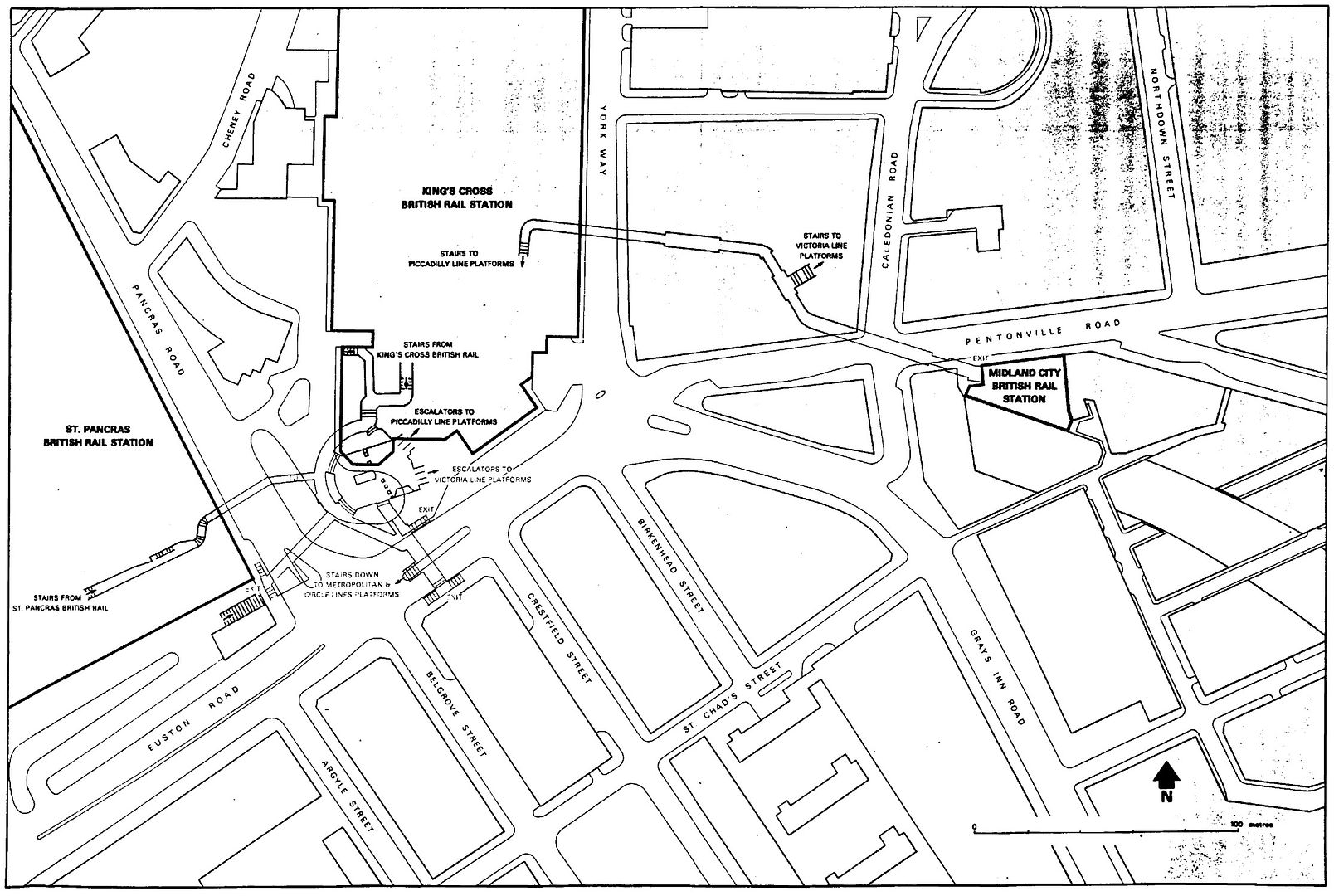
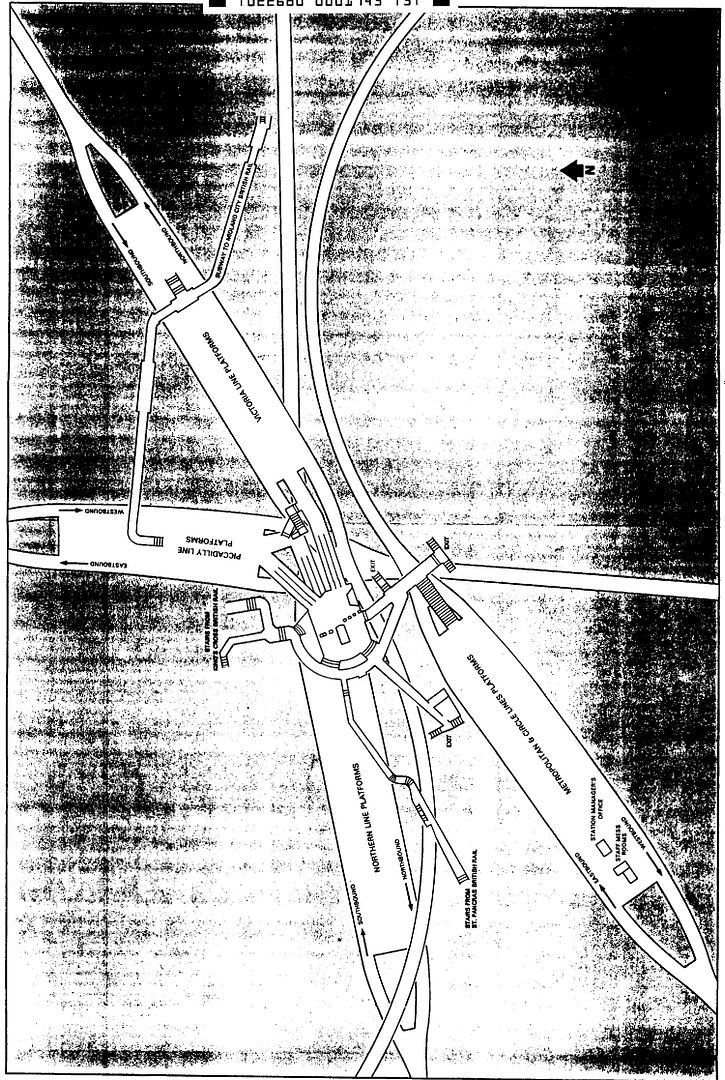

We must remember that a lot of the technology in the Tube stations dated back to the beginning of World War II. On the night of November 18, 1987, the escalators leading from the Piccadilly Line to the King’s Cross tube ticket hall were—like all the other escalators in the system—largely made of wood. Varnished wood. Thin, worn, varnished wood, under which ran a ceaseless procession of metal chain wheels and track wheels lubricated with grease that had not been inspected or changed since before the cabbage crates came over the briny. In the intervening decades, grime and dirt and dust and bits of paper and sweetie wrappers and hair and rat fur and more grime and more dirt and more dust had settled into this grease, stirred in by the ceaseless wheels, forming a dark pudding of lubricant and matter.


Some time before 7:30 P.M., somebody, presumably a passenger leaving the Piccadilly Line platforms via escalator 4 to the main tube ticket hall, stood on the right side of the escalator and lit a cigarette with a match. He or she dropped the match without making sure it was out, and it fell between the side of the escalator and the running track. Underneath the wooden steps, this match landed in the highly flammable grease mixture. This sludge caught on fire, and continued to burn merrily, lighting the undersides of the steps on fire and causing tongues of flame to lick up on the right-hand side of the escalator about halfway up. The ignition of the grease wasn’t noticed at once. Around 7:30, a passenger reported seeing small flames and wispy white smoke to authorities in the tube ticket hall.


The staff on duty that night were unfamiliar with the King's Cross station. Several staff members were off duty or on limited duty due to illness. Passengers were told, as the fire seemed to be small and not dangerous, to leave the station via the Victoria Line escalators nearby. Trains continued to stop at the station and passengers continued to disembark. Just before the first fire engines had arrived at the station, at 7:43 pm, trains were first warned not to stop at King’s Cross.
At this point nobody, not the firemen investigating the situation nor the passengers moving through the station, was aware of what would happen next. The fire in the Piccadilly Line escalator shaft was growing out of all proportion, consuming the paint on the walls and ceiling as it expanded. At 7:45 pm—-we know exactly when, because the digital clock in the ticket hall stopped working as its wires were burnt through-—the flames roaring up the Piccadilly Line shaft exploded into the ticket hall in a violent flashover, igniting every surface in the room. Passengers who had been directed to bypass the Piccadilly escalators via the Victoria escalators found themselves arriving in a chamber suddenly filled with a floor-to-ceiling blowlamp flame roaring from the shaft to their right. Paint and synthetic materials in the room, burning, gave off intensely toxic fumes that asphyxiated those who were not burnt to death.
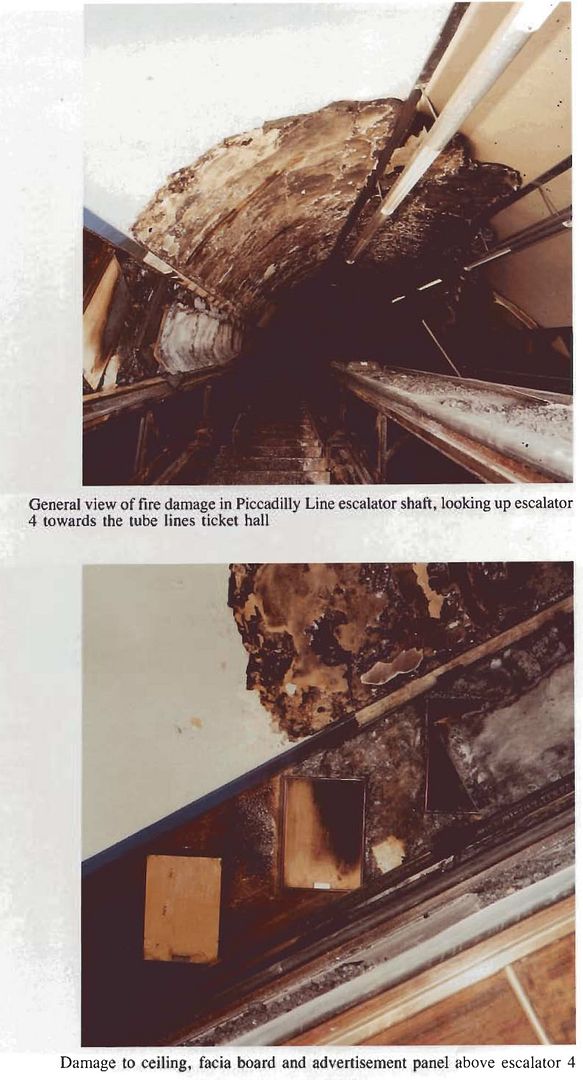
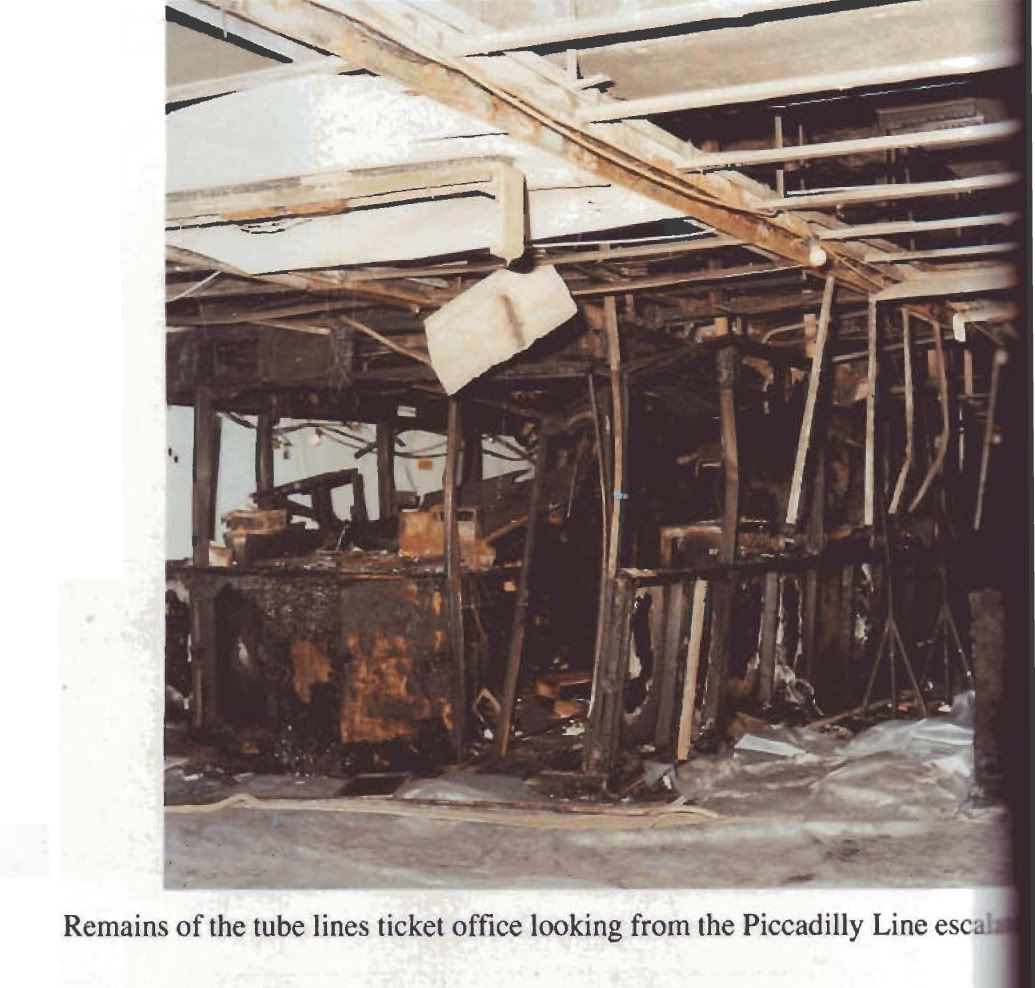
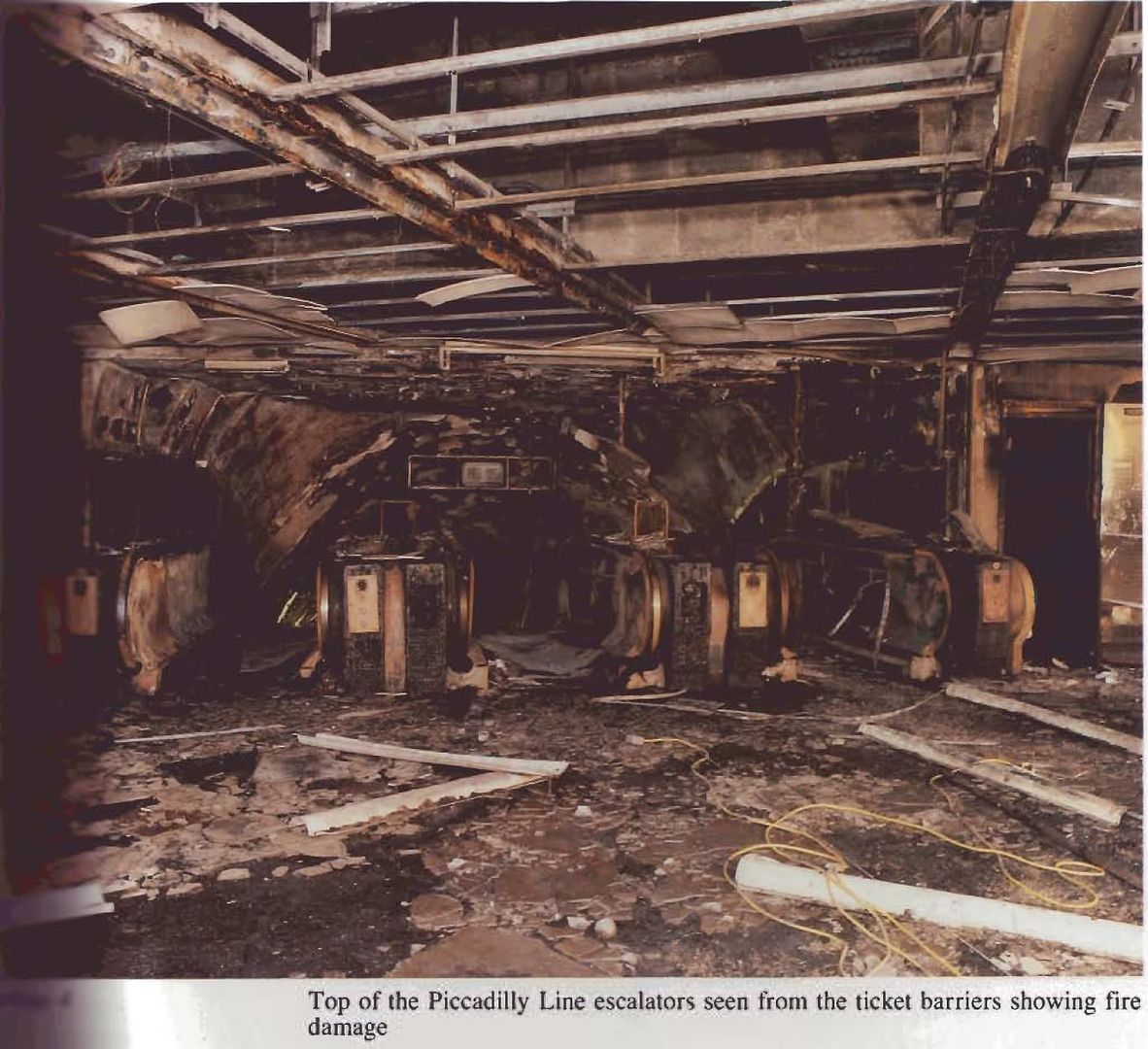
Firemen had arrived at King’s Cross about two minutes prior to the flashover. During this period various firefighting teams became separated from one another, unable to communicate by radio as these units did not work underground, and unable to reach one another visually due to the thick black smoke. Disoriented and suffering from the intense heat, firefighters and passengers alike struggled to find exits.
At the time of the flashover several transport policemen were still directing passengers to leave the station via the Victoria Line escalators, unaware of the danger. Once they realized the ticket hall above was in flames, these officers did their best to rescue injured passengers and evacuate them from the station via alternate exit routes, but found several of these locked off. It’s possible that more people could have been saved if the exits to the station had all been clear. When the fire was finally contained and extinguished, at 1:46 the next morning, thirty passengers and one fireman were dead.
With a disaster of this magnitude the public was extremely vehement in its demands for answers and solutions. Obviously, the fact that the escalators were made of flammable wood had played a major part in the fire, but was the wood itself solely to blame? Investigators examined the unburnt parts of Piccadilly Line escalator #4, where the fire had begun, and found some disturbing results. The fire of November 18 had not been the first such incident on this escalator: multiple scorch marks in the paint on the undercarriage of the escalator frame indicated that small fires had started many times under this particular escalator, and had-—by sheer luck—-not propagated further. The possibility of arson was investigated and dropped. When the state of the grease and filth under the escalator tracks was discovered, investigators tested this sludge to see whether a carelessly dropped match could ignite it, and on the first attempt managed to cause a fire that licked up through the escalator steps and grew until seven or eight minutes later it was extinguished.
They knew how the fire had started, now. After a fire at Oxford Circus station some little time before, smoking had been prohibited in Underground stations. However, passengers ignored the ban and routinely lit up on the escalators on their way out of the station. Burnt matches and smoker’s materials were found under the right side of the elevators leading out of King’s Cross. It was most likely a discarded match that had sparked the blaze.
But why had a fire that had seemed at first to be nothing more than a couple of little flames and some wispy smoke turned into an inferno capable of killing thirty-one people? Investigators turned to Oxford University to request a computer model of the fire and its propagation. What they found seemed so incredible they asked if the computer scientists hadn’t forgotten a major variable such as gravity: the model showed the flames from the burning escalator steps lying down as they crept up the incline, flowing along the level of the steps and scarcely peeking above the handrails-—effectively hiding the magnitude of the fire from anyone looking at it from an angle. This would later become known as the “trench” effect. The model showed the hot gases from this flame path spiraling up and clockwise round the top of the tunnel, blasting out into the ticket hall with lethal force.

Despite skepticism, investigators created a scale model of the escalator involved in the fire. Under controlled conditions, they lit the model on fire and observed how the flames behaved. Surprisingly enough, the model fire behaved exactly as the computer had predicted, with the fire lying down along the trench of the escalator and erupting with considerable violence into the model ticket hall above.


Eventually, it was concluded that the fire progressed along the following lines. Beginning with the accidental ignition of grease and dirt below escalator 4 approximately halfway up, the fire burned for some little time and apparently did not appear particularly serious or dangerous to police and fire personnel on the scene. However, it quickly began to spread up the escalator, lying along the level of the steps as per the “trench effect,” until the heat it produced plus the pyrolyzates resulting from heat damage to paints, varnishes, and other substances formed sufficient hot gases to flow violently upward into the ticket hall in a sudden burst of flame generally termed a flashover.


Could the thirty-one people who died in King’s Cross have been saved had any one of a number of key individuals acted differently? Perhaps. But as a result of the King’s Cross fire, not only were wooden escalators throughout the Underground required to be replaced with metal, but communications strategies between station personnel, police, and emergency response teams were clarified and streamlined; fire-suppression sprinkler systems in Underground machinery were required to upgrade to meet new regulations; and firefighting theory the world over gained a new and important understanding of flame progression up an inclined plane in an enclosed environment.
Perhaps they didn’t die entirely in vain. But can you imagine what it must be like to have been one of the people to discard a lit match on Piccadilly Line Escalator 4 the night of November 18, and to realize that it might have been your match to blame for all those deaths? Can you imagine what that must feel like?
I have to wonder who that was, and whether they knew, and whether they’re alive now—and what they feel, every time the anniversary comes round.
All images are borrowed without permission and transferred to my own hosting from the official investigation into the disaster. Read it; it’s a fascinating document and well capable of wasting a lunch hour or two.
Subscribe to:
Posts (Atom)