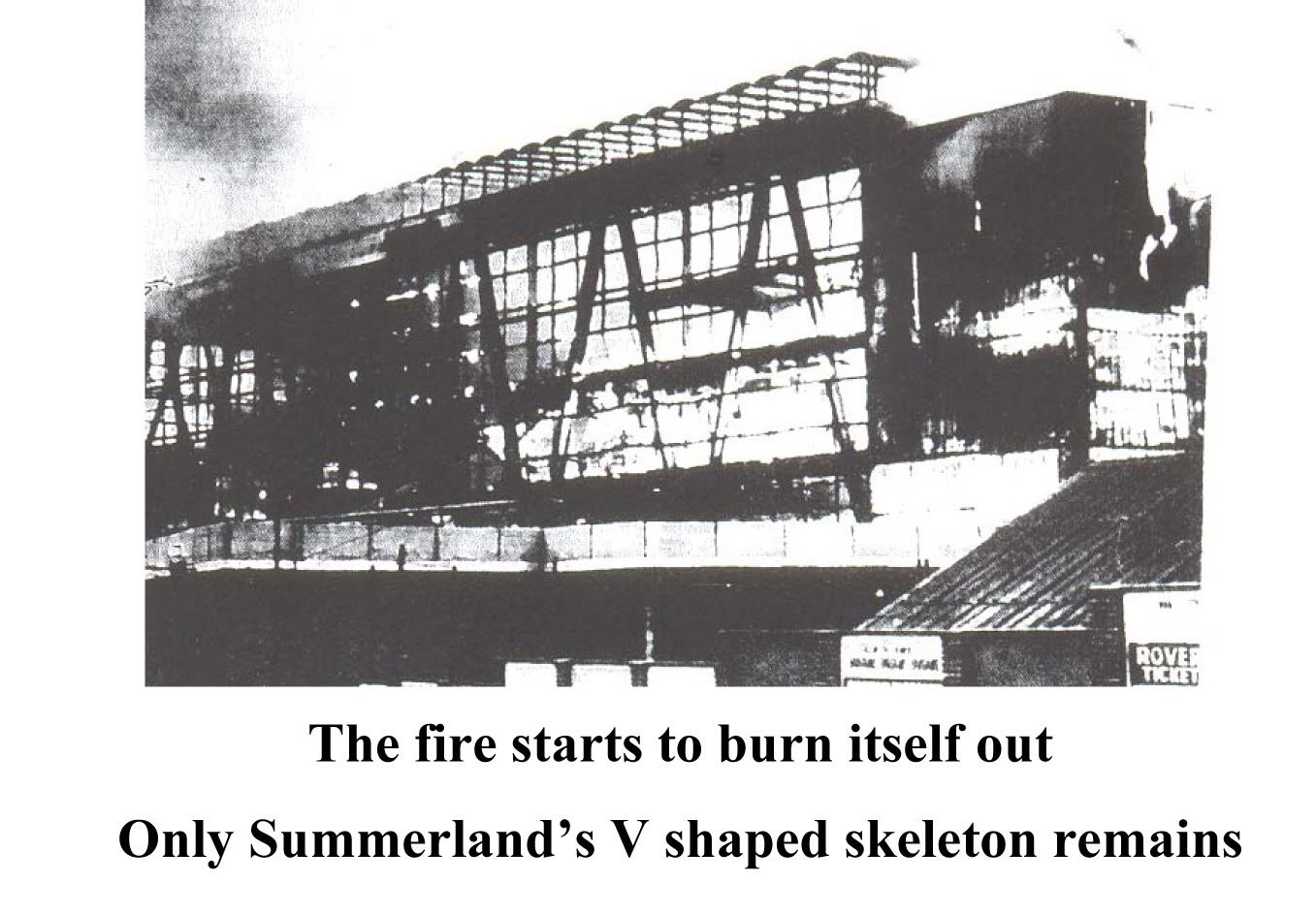
The word Summerland today conveys long pleasant golden days--the Lotus-Eaters' land in which it seemed always afternoon, a realm where the sun never set and the tiresome seasons never changed. This is because hardly anyone remembers what it meant to British holidaymakers in the dawn of the 1970s, or what it meant the morning of Friday, August the 3rd, 1973, when daylight revealed what was left of it.
It is interesting to compare the Summerland disaster to the King's Cross tube station fire. Fifty people died in Summerland, compared to thirty-one at King's Cross--but the King's Cross fire is mentioned far more often and gained far more media attention than did Summerland. Dr. Ian Phillips of the University of Birmingham has made what may be the most comprehensive and in-depth study of the Summerland disaster, which is well worth reading on its own; he muses that had a fire killed fifty holidaymakers in, say, Bournemouth, rather than on an obscure little island in the Irish Sea, it would have been a massive news story hailed as a national tragedy. He's right.
The Isle of Man is shaped roughly like a kipper. It is home to just over eighty thousand people, governed by the oldest parliament in the world, Tynwald; its flag shows a triskelion made of armored legs joined at the thigh. It has its own officially-recognised-as-a-legitimate-autochthonous-regional language, Manx Gaelic, and its indigenous Loaghtan sheep produce a particularly fine and much sought-after meat. And in 1971, it became home to a new concept in leisure: the first modern, completely climate-controlled, indoor holiday sports and entertainment center ever built in Britain.
Summerland in context
As the Sixties waned, the popularity of the British seaside holiday was fading in favour of cheap group tours to the Mediterranean. Spain in particular was attracting more and more lower-to-middle-class Britons who might otherwise have gone to Bournemouth or Minehead or even the Isle of Man for their summer hols. And honestly, anyone who's been to the British coastline in summer prior to, say, 2004 and the advent of summer temperatures regularly above eighty F would have to agree with them. British beaches are a) cold, b) windy, c) rainy, d) spiky or stony and e) all of the above at times, plus packed with hundreds of thousands of other determined holidaymakers and their porky children buying ice-creams and sticks of rock and cheap plastic pails and shovels to make sandcastles with. There's a certain dogged one-upsmanship associated with British holidaymaking: no matter how foully cold and rainy and disgusting it is, you are at the damn seaside and you are damn well going to paddle in the sea even if the sea is forty degrees fahrenheit and the colour of wet slate and everybody else is wrapped up in towels and anoraks and going "ooh isn't it cold." It is this mentality the planners of Summerland wished to exploit: instead of going off to Ibiza or Torremolinos or some other mucky foreign place where you were bound to get the runs, you could just nip off to the Isle of Man (a proper British holiday destination with regular ferries from places like Blackpool) and spend a fortnight in the endless tropical climate-controlled sunlight of Summerland.
The plot on which the Summerland/Aquadrome complex was constructed had long been used as a holiday/amusement park site. Located at one end of the promenade of Douglas, which became the Isle's capital in 1869, the site had first been developed in the 1790s for a structure called Derby Castle--at the time not even incorporated into Douglas, joined by a causeway. In the later 1800s the Castle property was bought by a gent who noticed the major uptick in tourist visits to the Isle and decided to capitalize on same by building what was in effect a prototype for Summerland: an entertainment center including a theater, ballroom, and restaurant/bar. There was even a roller-coaster and firework displays.
By the end of the 1800s the Derby Castle Company had merged with the other entertainment-venue companies vying with it for patrons. Through the World Wars, the entertainment center was used for various purposes such as factory work and storage for valuables from hotels used as internment-camps. It was said to be cursed; that anything built upon it would meet a sticky end.
After 1945 the Derby Castle property was bought by the "Douglas Corporation" in order to be redeveloped into a brand-new entertainment center designed to draw holidaymakers from the delights of the Mediterranean package holiday by replicating the attractions it theoretically offered. With the diminishing tourist trade and the lack of interesting and non-weather-dependent attractions in Douglas, the Isle wanted to create a center to entertain visitors even during truly awful weather. "The design presented," says a booklet produced by the Island's Development Company in 1972 (The Summerland Story, 1972, p.25), "is based on the idea of creating an environment where the sun always shines – an area in which the weather can be guaranteed and where every activity connected with a seaside holiday can be enjoyed by all ages. The scheme envisages, therefore, the maximum possible area enclosed by a structure designed to admit the maximum sunlight, implemented by artificial means, to create a permanent atmosphere of sub-tropical climate. Within this area it is aimed to produce a sense of being in the open air without the climatic hazards."
The arguments and agreements and parliamentary squabbling surrounding the development of what was to become Summerland are neither interesting nor uplifting. Suffice it to say that initially the swimming-baths (pool complex/Aquadrome) were definitely Wanted by the Isle government and money toward their construction was earmarked. At this point architects got involved--and at this point we start to see the inevitable confusion building. Perhaps Frank Gehry's architectural abortions aren't so bad after all: so far none of them has actively killed anybody.
The architects
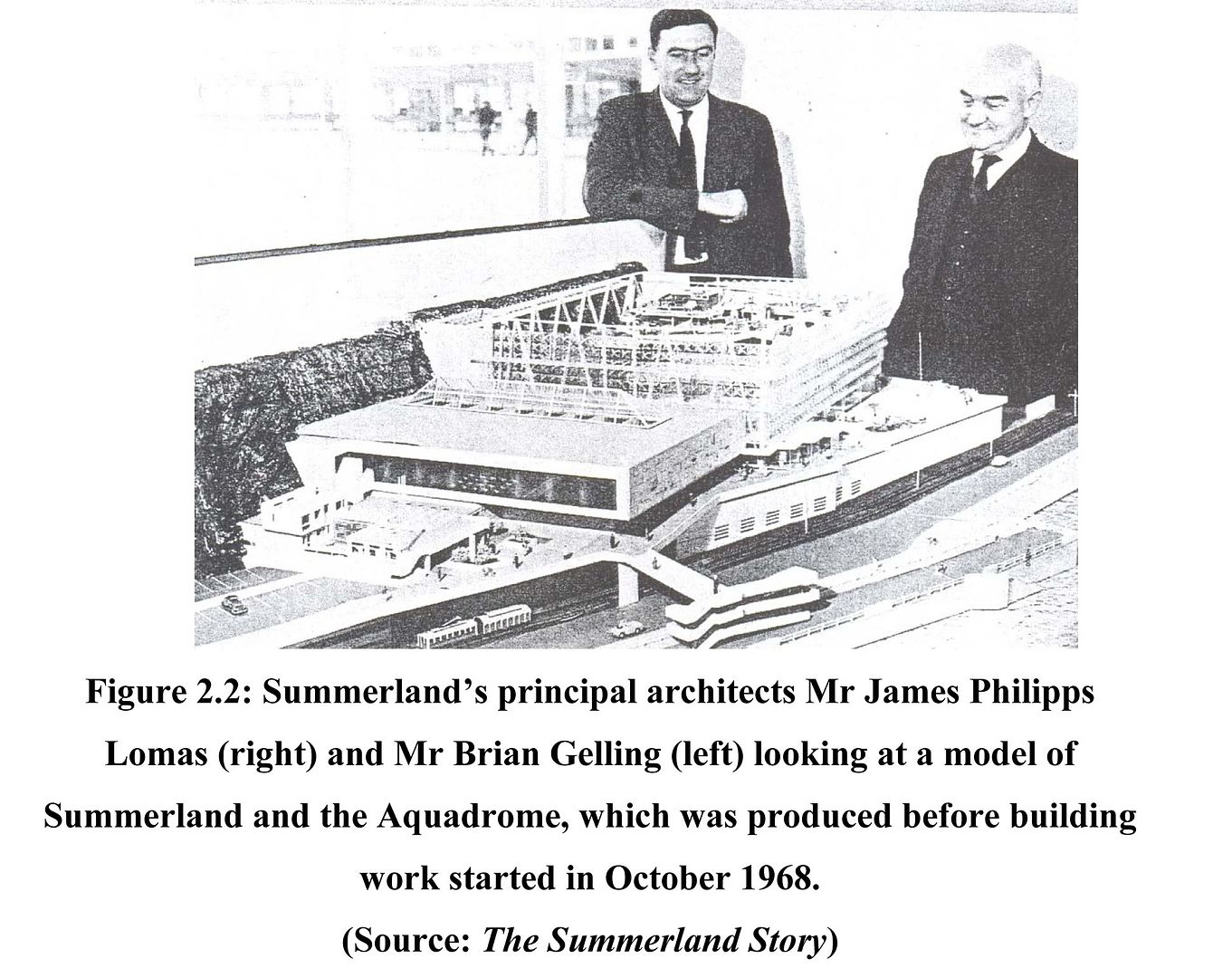
James Philipps Lomas, a Douglas architect with two lowercase Ps, won the contract for Summerland because his ideas were "rather more imaginative" than his competitors' (in the words of Douglas' Borough Engineer, Byrom, 1971, quoted in Phillips, s2 p58). Here is Lomas and his colleague Mr. Brian Gelling looking at a model of their creation. Notice that the Aquadrome, in the foreground, backs up directly against the cliff on one side. (Also notice that it's a horrible Brutalist disaster.) Lomas had never worked on anything outside the Isle of Man, whereas Gelling had been employed at a larger firm with experience designing leisure centers on mainland Britain; this firm, Gillinson, Barnett & Partners, was eventually to be appointed "associate architects" for the Summerland/Aquadrome project and do all the working drawings and all the research into materials needed for the work.
This last is significant. Summerland was to shake up the world of architecture with its unprecedented use of particular materials, the properties of which could have used a little more research.
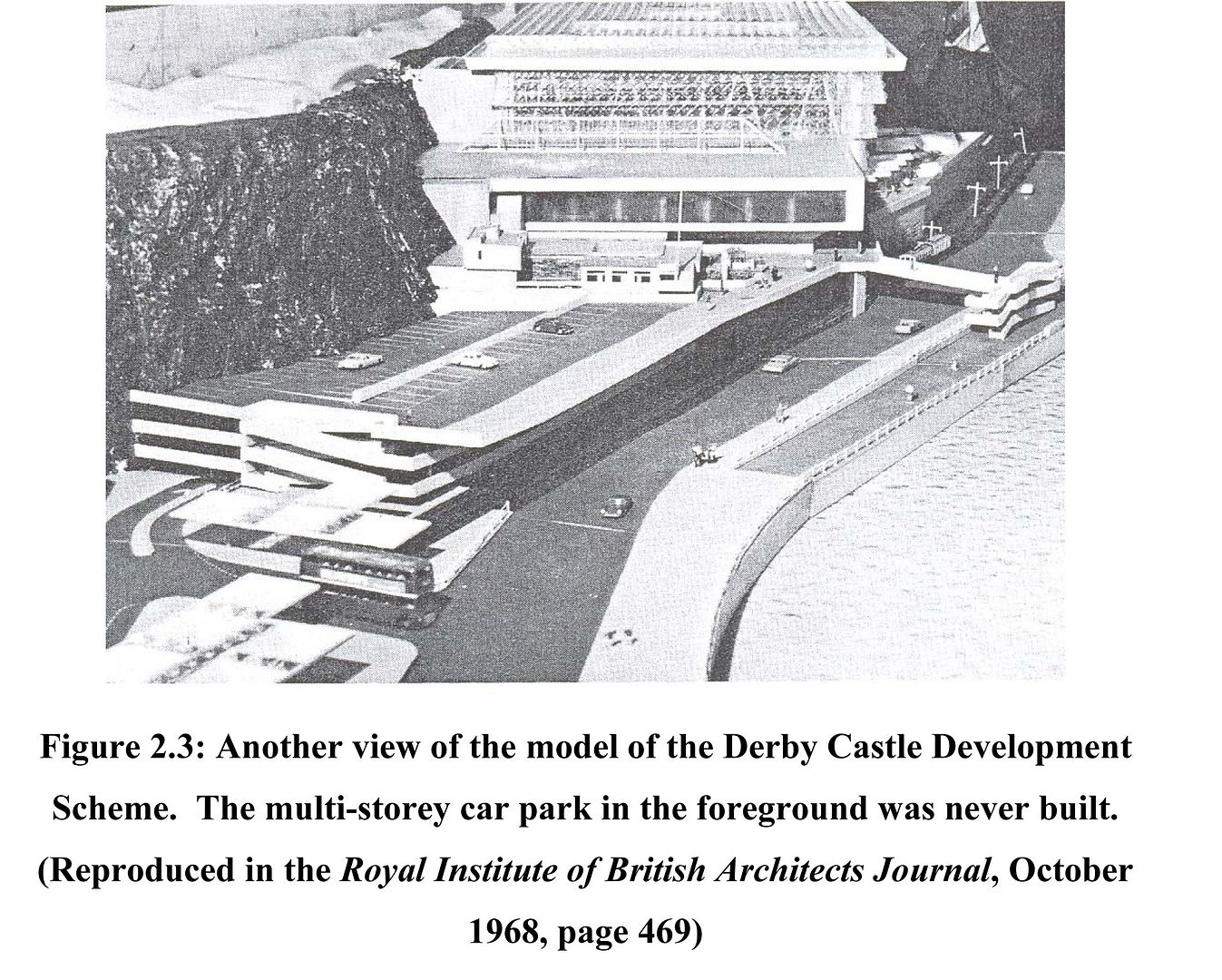
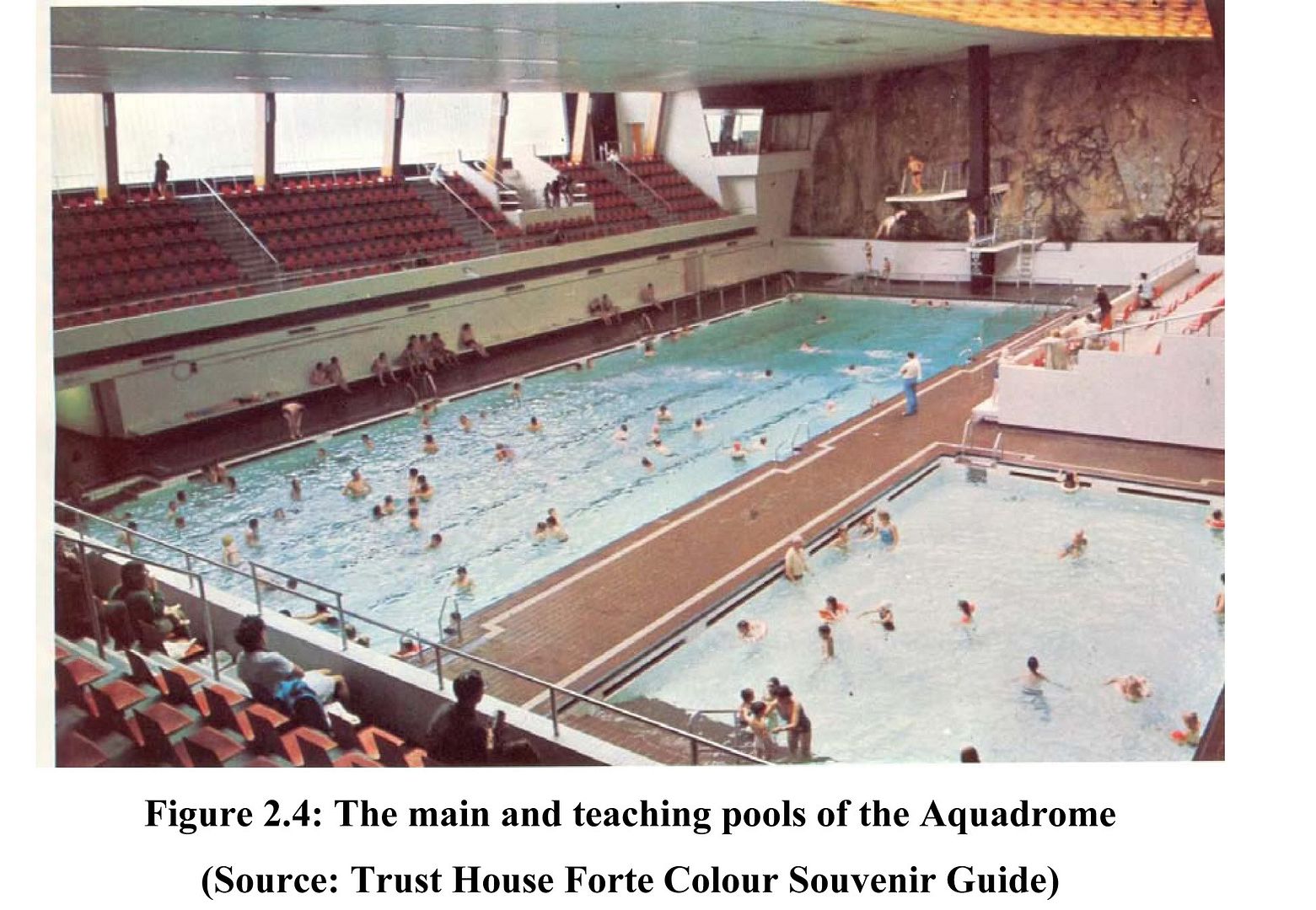
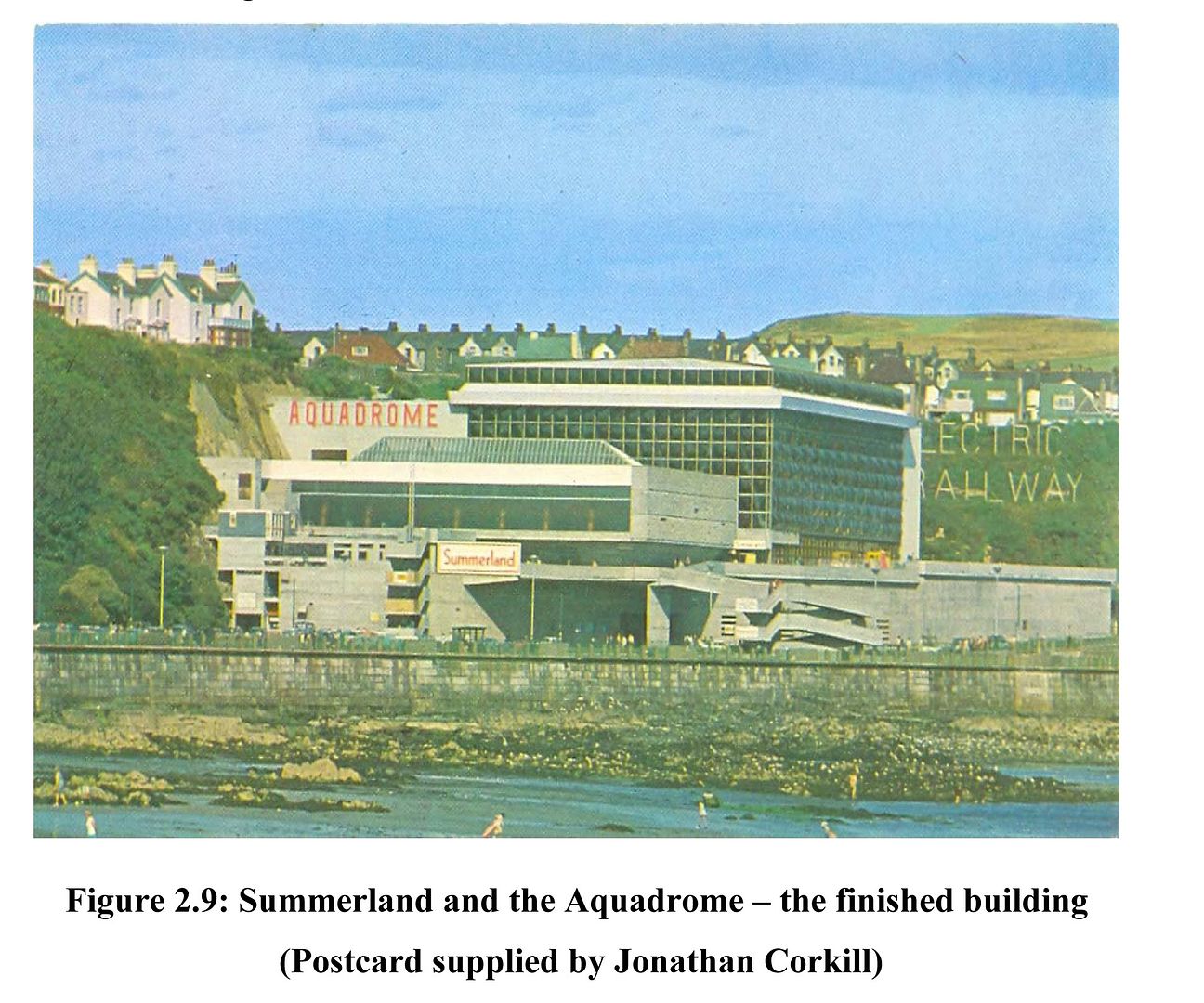
The construction of the Derby Castle Scheme had three components: the Aquadrome, Summerland itself, and a multistory car park which was never built. The Aquadrome featured two heated seawater pools with stadium seating, as well as a host of rather ominous-sounding other attractions including "aerotone, sauna, steam, hot, cold plunge, slipper, Vichy douche, massage, Russian vapour and Turkish baths." It opened in 1969 and was run by the Douglas Corporation (separate from Summerland). They had considerable difficulty sticking it to the cliff face that formed its fourth wall, and in fact had to bolt the cliff together to stabilize it, ending up with a messy and unbeautiful surface.
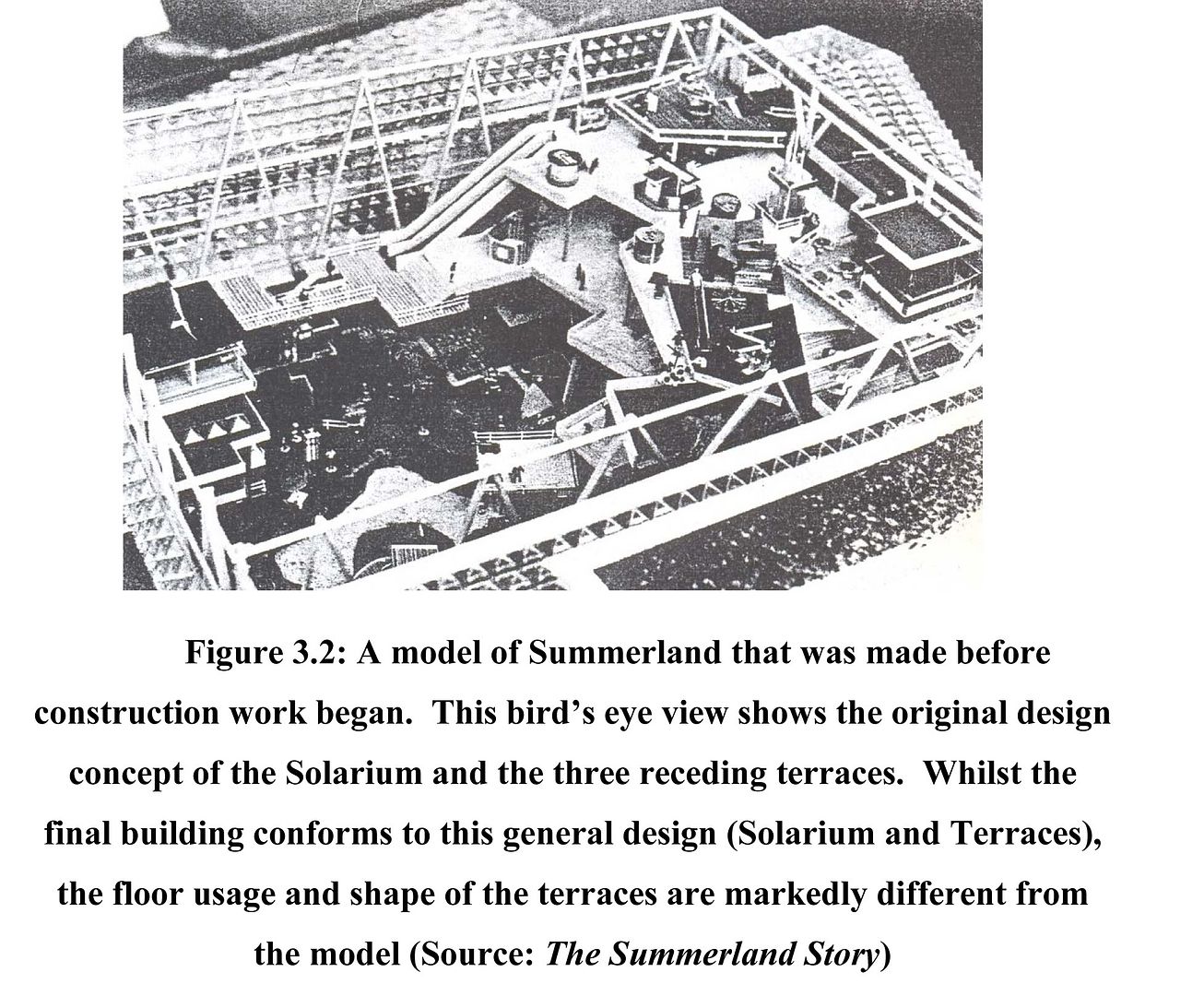
Summerland's plans had been drawn up in 1965. Construction didn't begin until 1968, and was disrupted in 1969 and 1970 by disagreements over the internal layout and what the probable tenant would end up doing with the building. An early model of the interior of the building shows a very different concept than what ended up being constructed. The Douglas Corporation waffled on a tenancy agreement for so long that in order to avoid expensive overruns the contract with the construction company was renegotiated to include just the building shell, rather than the internal structure. The shell was completed in December of 1970, just under the deadline. A new contract would have to be drawn up with the eventual tenant regarding the furnishings and fitting-out of the building. This is also significant, because the separation of internal and external structures involved a lot of fire code waivers and wriggling out of having to actually take structural precautions against disaster.
Douglas Corporation finally signed the UK hotel group Trust House Forte (THF) to a 21-year lease in December of 1970, which separated the managements of the Aquadrome and Summerland. Patrons would have to pay separate admission fees to the two attractions, and could not walk from one to the other without going outside, contrary to the original Scheme. The tenancy agreement did allow for work on the interior design and construction of Summerland to begin, and here is where the tragic flaws of the building begin to become manifest. The interior structure of Summerland was entirely done by the associate architects, Gillinson Bartnett & Partners, and not by Lomas and Gelling. Lomas's plans could not have taken into account design decisions made by Gillinson Barnett, and therefore could not have included an appropriate system of staircases and exits in the shell design to match the interior usage of the building.
After the fire, the investigation into Summerland's design unearthed this factor, which was used as an excuse by the architects: "The Commission was told that, during the long process of designing Summerland, the details of escape in case of fire could not be considered because the kind of occupancy, usage and activities were not decided, as no tenant had been nominated." (Summerland Fire Commission report, para 216, pg 21, quoted in Phillips, chapter 2.6, pg. 71.) The Commission wasn't having any of it, however, and concluded that Gillinson Barnett damn well could have made some educated guesses.
Materials
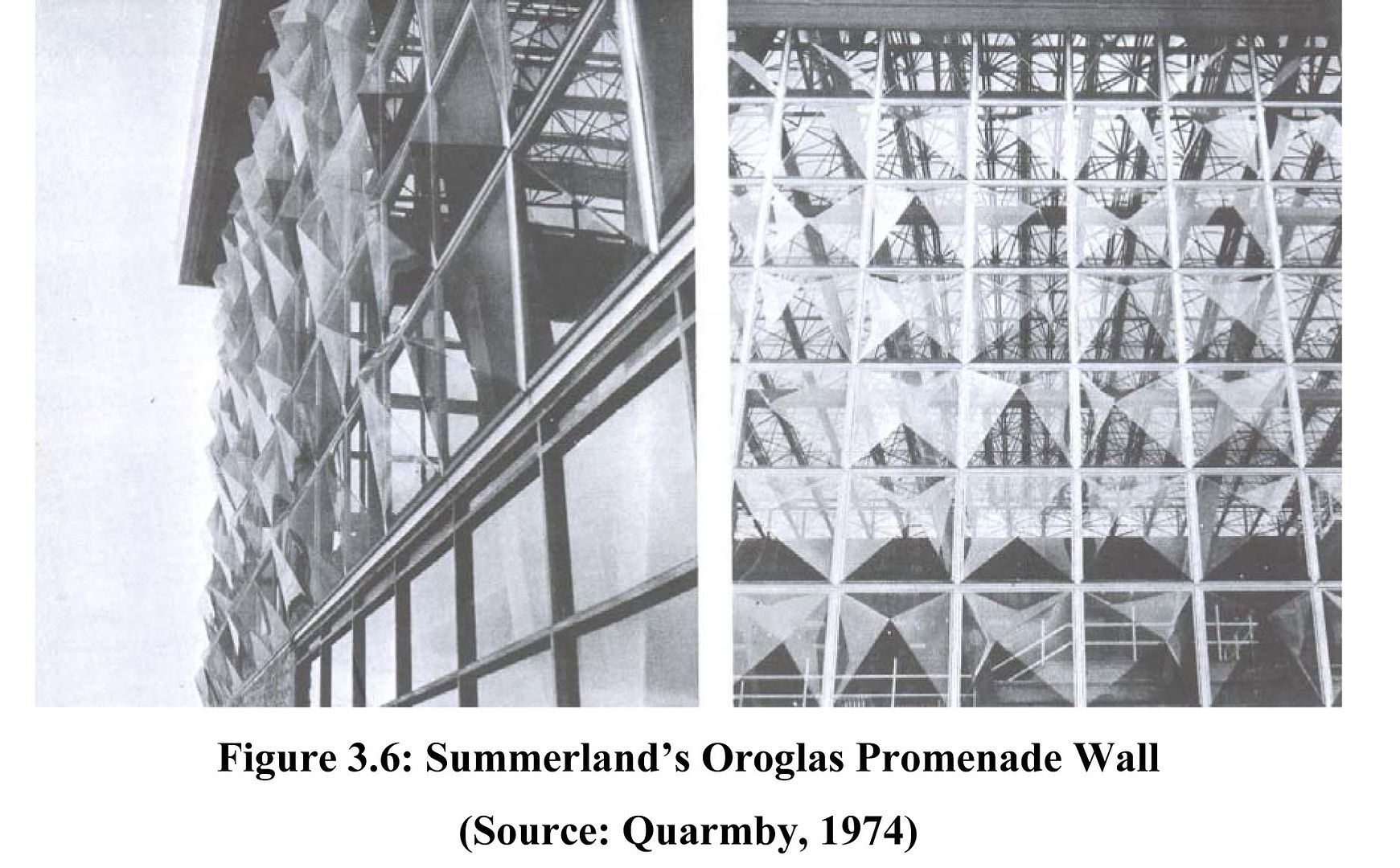
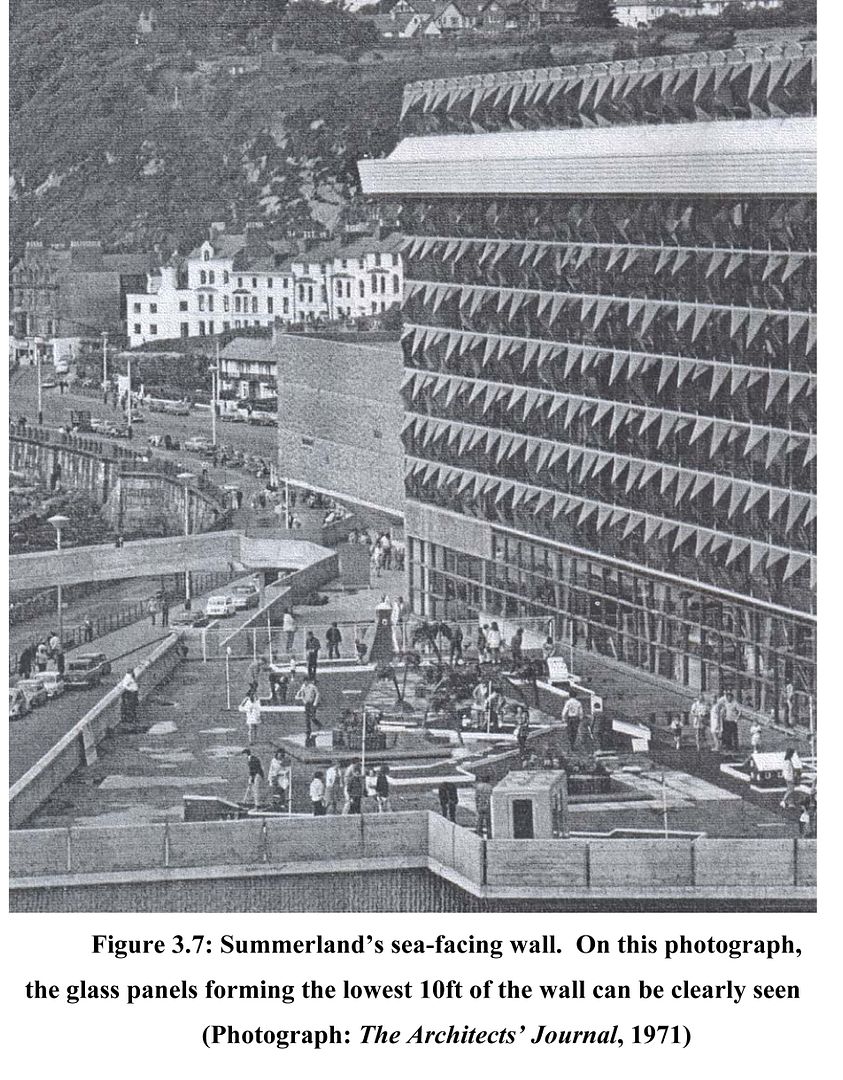
The revolutionary nature of Summerland as a concept was not so much based on its functioning as a leisure center but as a "weatherproof enveloping structure" within which visitors could enjoy the pleasures of a summer seaside holiday all year round. In order to create such a vast enclosed space, the associate architects turned to what was then a highly innovative building material, the polymethylmethacrylate sheeting sold as Oroglas. No one had ever used Oroglas on such a scale before: they created a whole roof and much of two walls of Summerland out of the stuff. This was not explicitly stated in minutes from the Tynwald discussions during the planning stages of the project: all the references to the construction used the words "glass" or "glass-like material," implying that the building would be constructed using largely traditional materials. Remember that it wasn't Lomas who was responsible for choosing materials, but the associate architects, Gillinson Barnett.
"The decision was taken to use Oroglas for Summerland by Mr Clifford Barnett at an early stage, and was confirmed amongst the architects before the Derby Castle Development Scheme brochure was presented to the Finance Committee of Douglas Corporation in August 1965 (chapter 2). Mr Barnett was not only insistent on an acrylic solution for Summerland; but a solution that involved the use of a particular type of acrylic sheeting manufactured by an American company that at the time had not been used on an extensive scale in Europe. His commitment to using Oroglas is picked up by the Summerland Fire Commission report (SFC Report, Paragraph 207, Page 69): “He [Mr Barnett] was clearly committed to it [Oroglas]”, the
report states....The architects wanted to create a building that was “unique and compelling” (The Summerland Story, 1972, Page 25). In the same brochure, the claim is made that Summerland would “set the architectural world alight for nothing had ever been designed to include so much of the transparent sheeting”." (Phillips, chapter 3, pg 98).
We don't need to point out the irony of the phrase "setting alight."
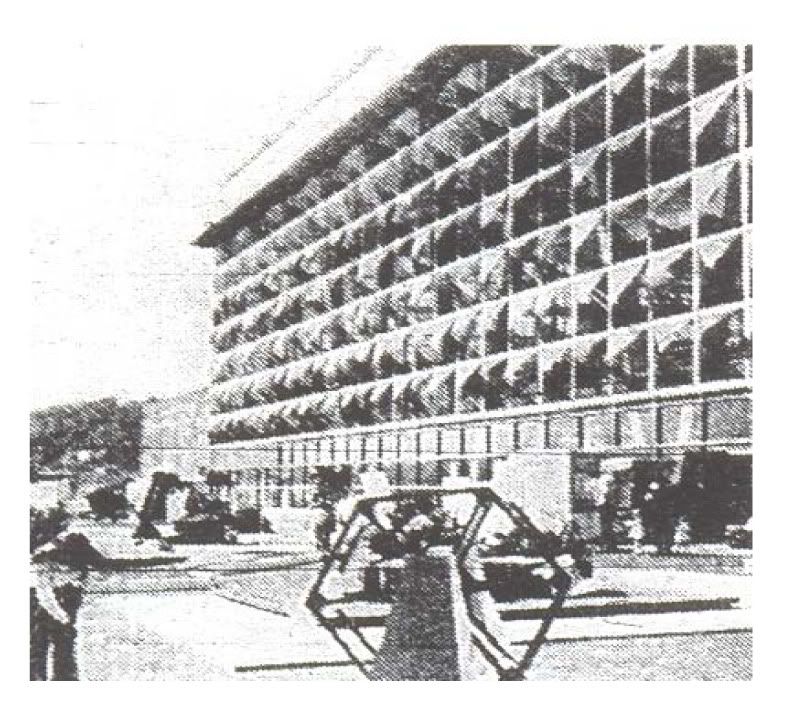
What did this marvelous material end up looking like in place? It looked like this. "Each panel catches the light to
provide an interesting and varying pattern on the façade," says the brochure. To modern eyes, it looks perhaps less interesting and innovative than "spiky," but at the time I.M. Pei had not constructed the Louvre pyramids and the Early Seventies Awful school of architecture was firmly in power.
Rohm and Haas, the manufacturers of Oroglas, themselves state that “There is no building code in America which would allow it [Oroglas] to be used overall as it was at the Summerland
centre. A structure like that would just not have been allowed in America.” U.S. fire codes require a comprehensive sprinkler system to be installed wherever Oroglas was used on a large scale, and in fact the UK subsidiaries of Rohm and Haas were aware of these codes and requirements...but did not pass them on to the Isle of Man chief fire officer.
The manufacturers knew Oroglas was combustible. Phillips refers to an ad hoc experiment conducted in Warwickshire by a council considering the use of the material in a project, in which a sample of Oroglas was set alight with a cigarette lighter and burned like merry hell: “The sample did not have chance to smoulder, as it burst into flames with a ferocity that I had not seen since like all young boys do, [I] set light to a ping-pong ball. It spat and flared, and we got a bit panicked that it would cause problems with the stuffy staff either side of our office.” An internal Rohm and Haas UK memo admitted that Oroglas could burn “in quite a frightening manner”. The letter warned that the material might not even fall free from its frame in the event of a fire. “The ways in which Oroglas may behave if involved in fire are not easy to predict and you should be cautious in discussions on this problem. The method of installation, size of panel and, in some circumstances, even the colour of material can have some effect.” (Phillips, chapter 3, pg 104.) One of the properties touted by the proponents of Oroglas was that it would soften and fall out of its frame at temperatures far below its ignition point, which was apparently known not to be the case. Rohm and Haas admitted after the fire that this information should have been provided to Mr. Pearson, the island's chief fire officer, but was not.
After the fire there was much throwing about of brains regarding whose fault it was that Oroglas was used in such amounts without a sprinkler system and whether the use of Oroglas had in fact been the cause of the fifty deaths. As it turned out it wasn't "Horrorglass" at fault for the disaster after all: it was another building material entirely, a substance called "Colour Galbestos," rolled steel sheeting coated in bitumen and asbestos.
Waive this for me
Isle of Man by-law 39 "requires a building’s external walls to be non-combustible and have a fire resistance of two hours." Both of these requirements were waived during the construction of Summerland, which is precisely why the disaster happened. Use of Oroglas was permitted due to a waiver requested by Lomas and granted on the understanding that, while Oroglas did not have a fire resistance of two hours, in case of fire it would theoretically soften and fall out of its frames, allowing people to escape through the gridwork of the walls. The Borough Engineer who recommended the by-law be waived to allow the use of Oroglas did so believing it to be non-combustible, which is rubbish. It's repeatedly stated that Lomas and the other architects assured the Douglas Corporation of Oroglas's non-combustibility, and this inaccurate statement of the material's properties shows up in promotional literature for the building. Post-fire investigations of Lomas and Gillinson Barnett show rather predictable mutual attribution of blame: Mr. Barnett calls Mr. Lomas cavalier in his approach to regulations, and Mr. Lomas claims that Mr. Barnett and his partners should have done their research and he trusted them when they said that Oroglas was totally safe. Either the architects didn't know they were telling porky pies or they didn't care. I don't know which is more disturbing.
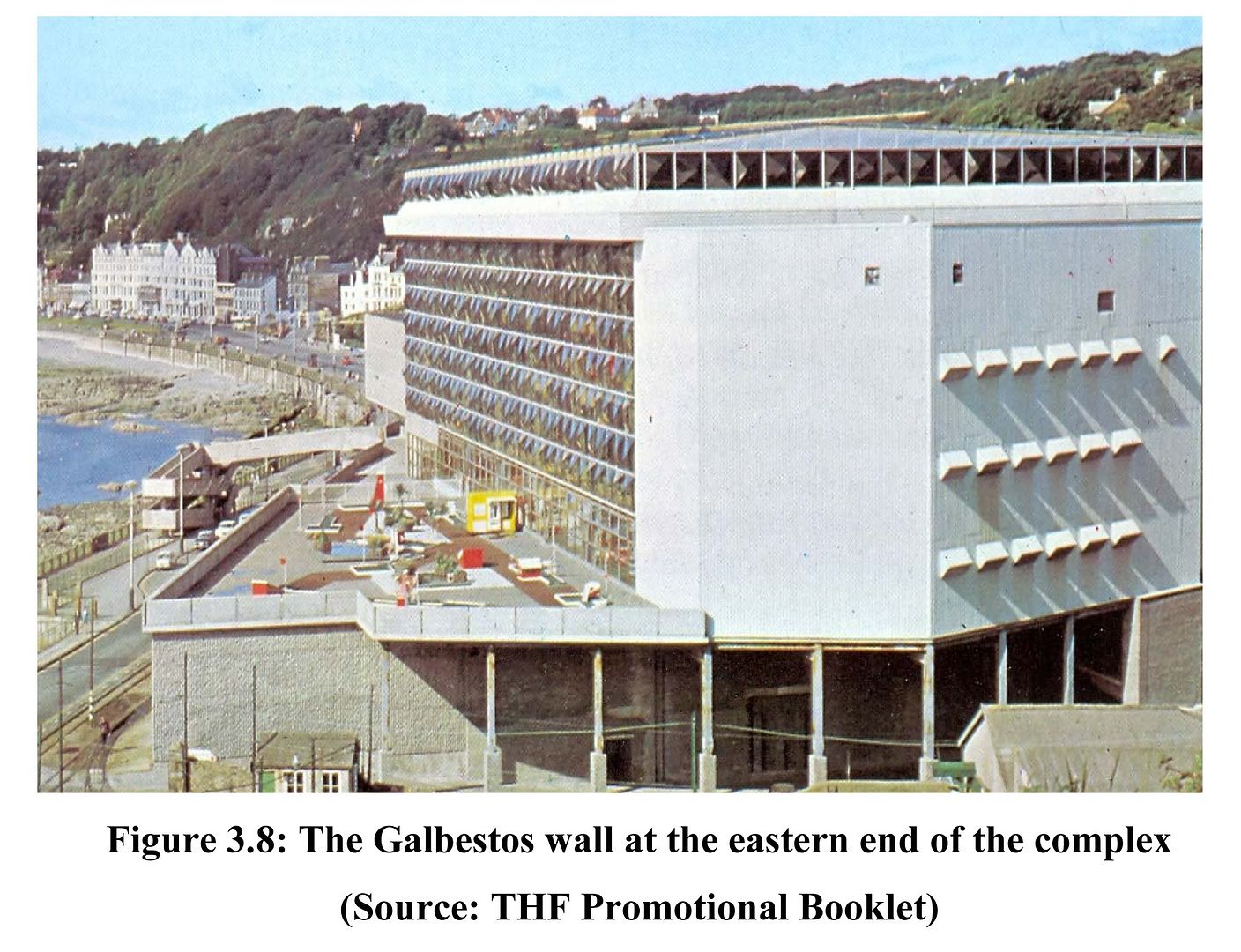
The use of Colour Galbestos on the building's east wall was even more of a violation of Law 39, as it is neither non-combustible or fire resistant. It was used in place of concrete or regular steel sheeting because it was cheaper, and permitted due to a truly astounding sequence of failures to communicate: the Borough Engineer suggested Law 39 be waived for it because "he considered it an adequate material in all the circumstances;" the Douglas Corporation meant to ask the Local Government Board for the waiver but never got around to it; the Local Government Board received plans including the use of Colour Galbestos without being notified that its use required further Law 39 waivers; the Chief Fire Officer was never consulted about the use of Galbestos because nobody twigged that it was, in fact, lethally inappropriate. Similarly, the decision to use combustible plastic-coated fiberboard Decalin for the interior wall of the amusement arcade was made off the cuff and never discussed amongst the architects and designers with regards to the fact that it caught fire like anything.
Opening
Reaction to Summerland when it finally opened in 1971 was mixed. The building's promoters, unsurprisingly, thought it was just wonderful: “[Summerland] stands as a pulsating memorial to the foresight of its planners and supporters. It can only confound the critics of the controversial scheme when they see for themselves what has been achieved…The result can only be a source of pride to the whole Island...It will undoubtedly attract the widest publicity – not only because it is unique in the western world, but because it caters so ideally for leisure and relaxation in the unreliable climate of the United Kingdom," according to a full-page advertisement appearing in the Isle of Man Examiner on 16th July, 1971. Others were not convinced. John Carter, the travel journalist and TV presenter (Holiday and Wish you were here?) commented in The Times (19th May, 1973):“The centre’s glossy brochure claims it has ‘Attractions for every taste’, but I must beg to be excused from that generalization. I do not like motorway restaurants, either, but that is another variation on the theme.” (Phillips, chapter 3, pp. 116-118.)
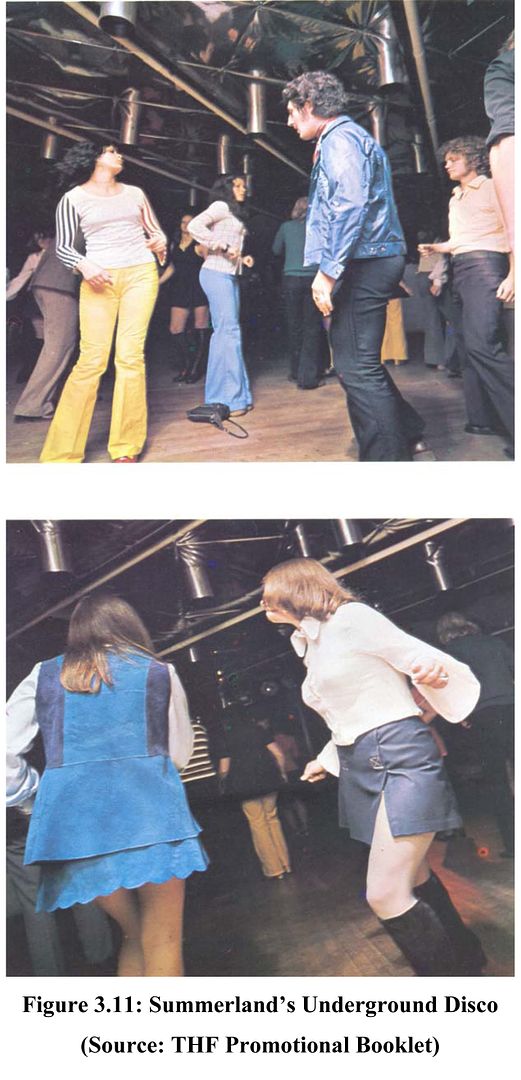
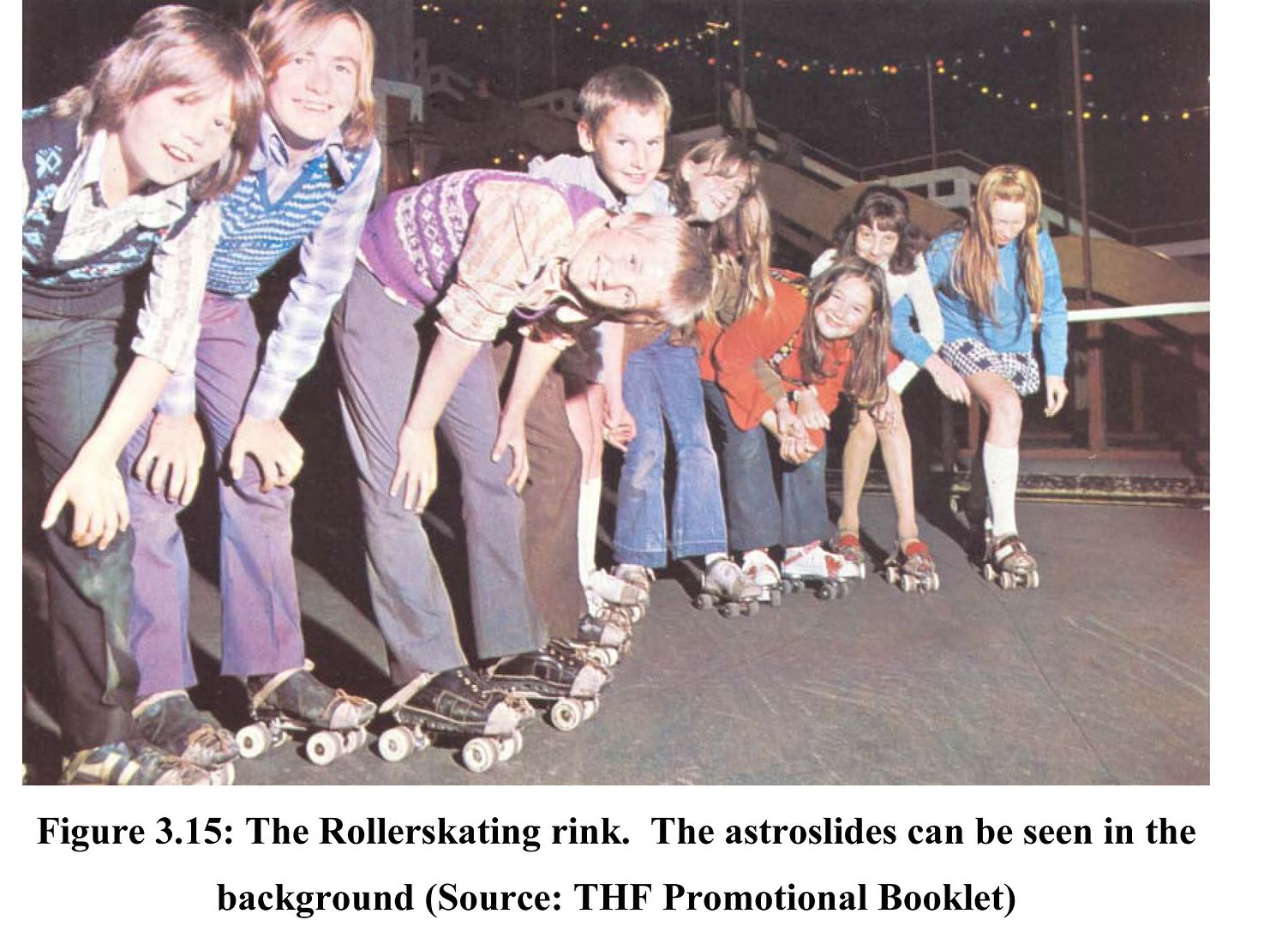
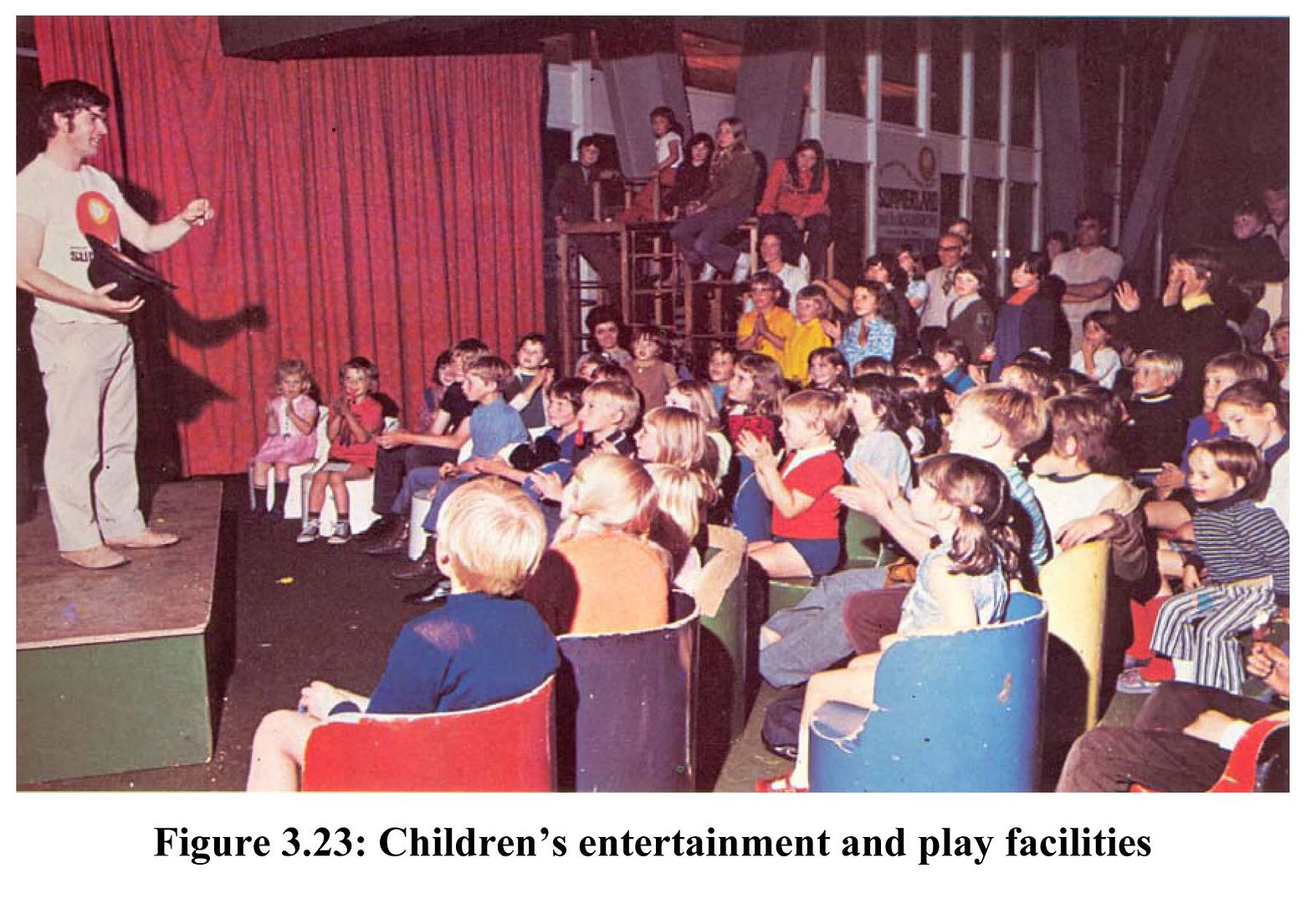
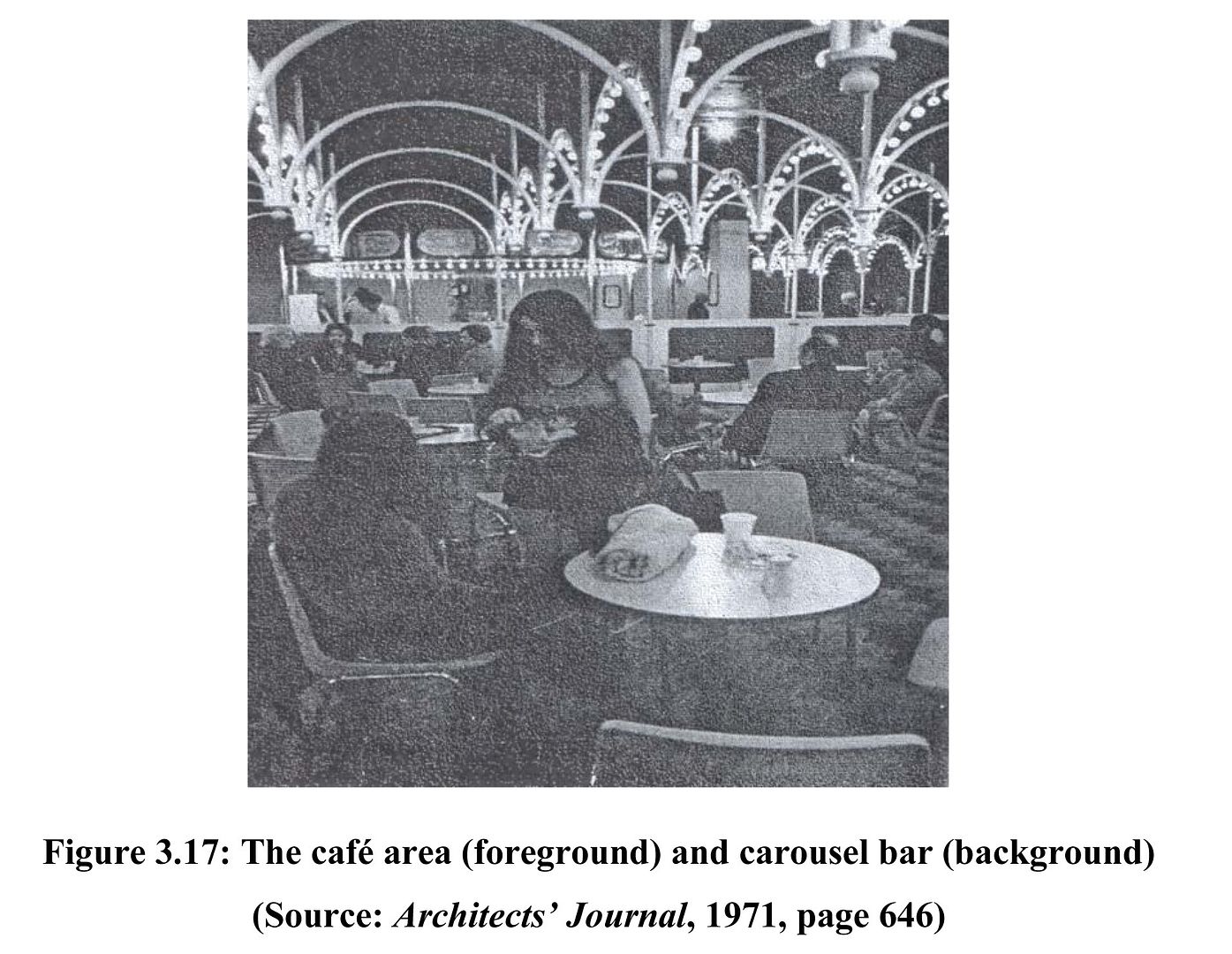
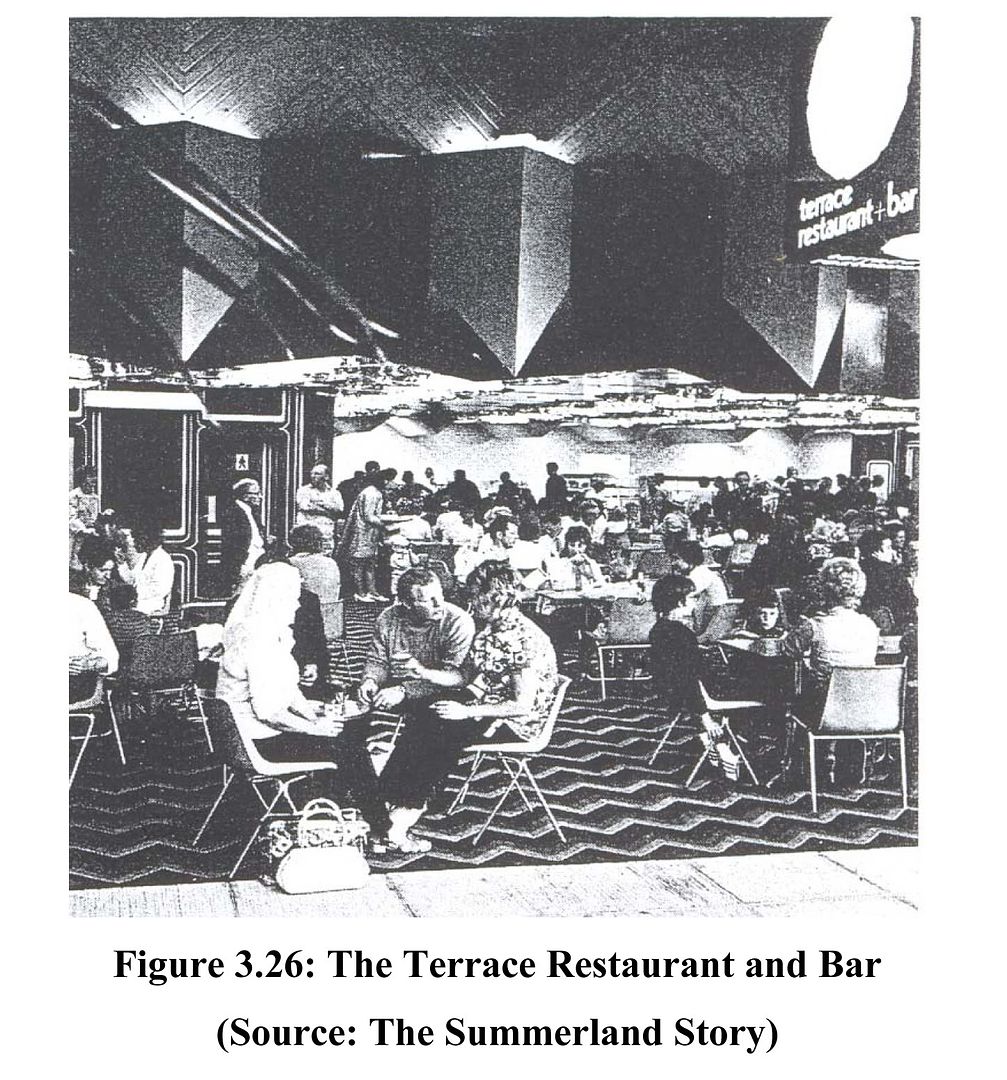
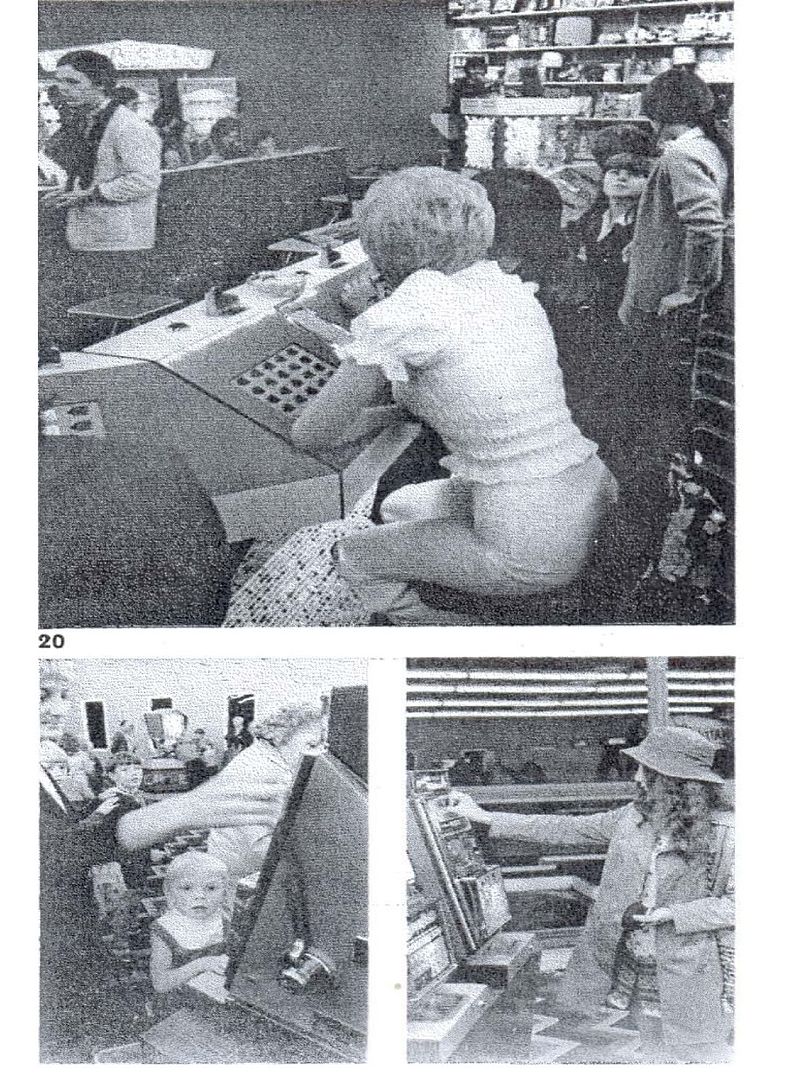
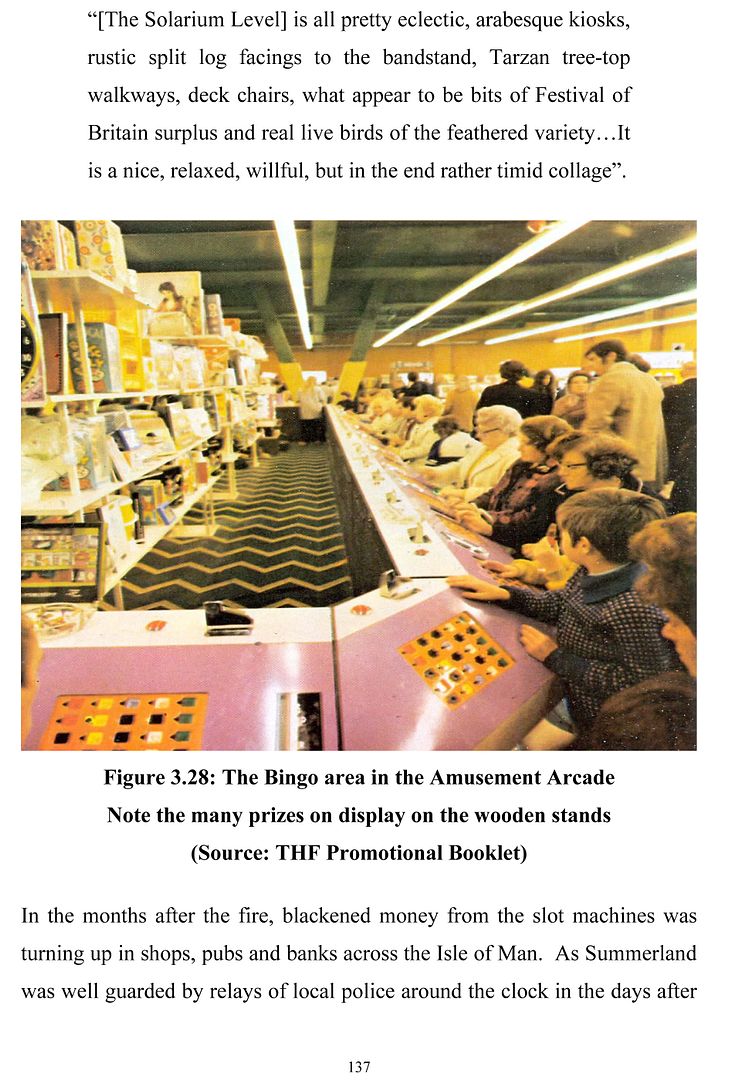
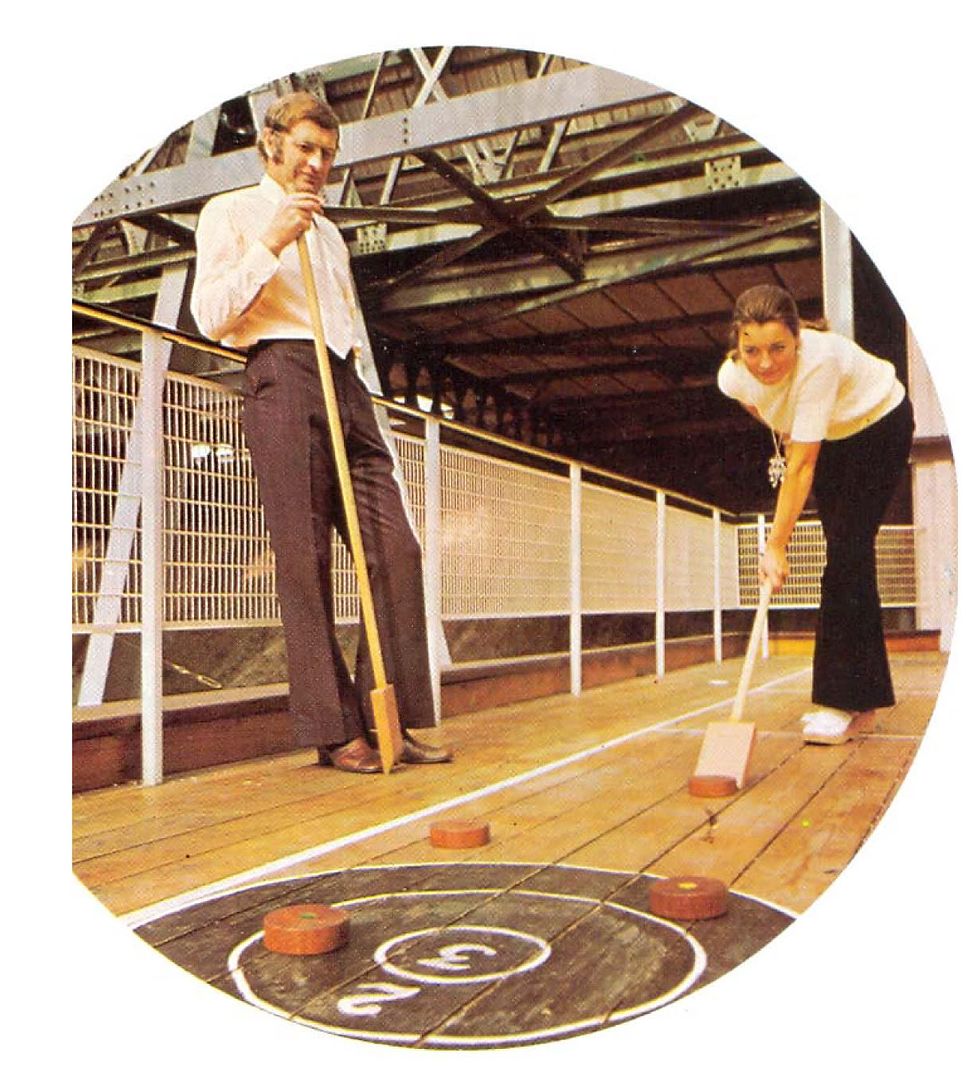
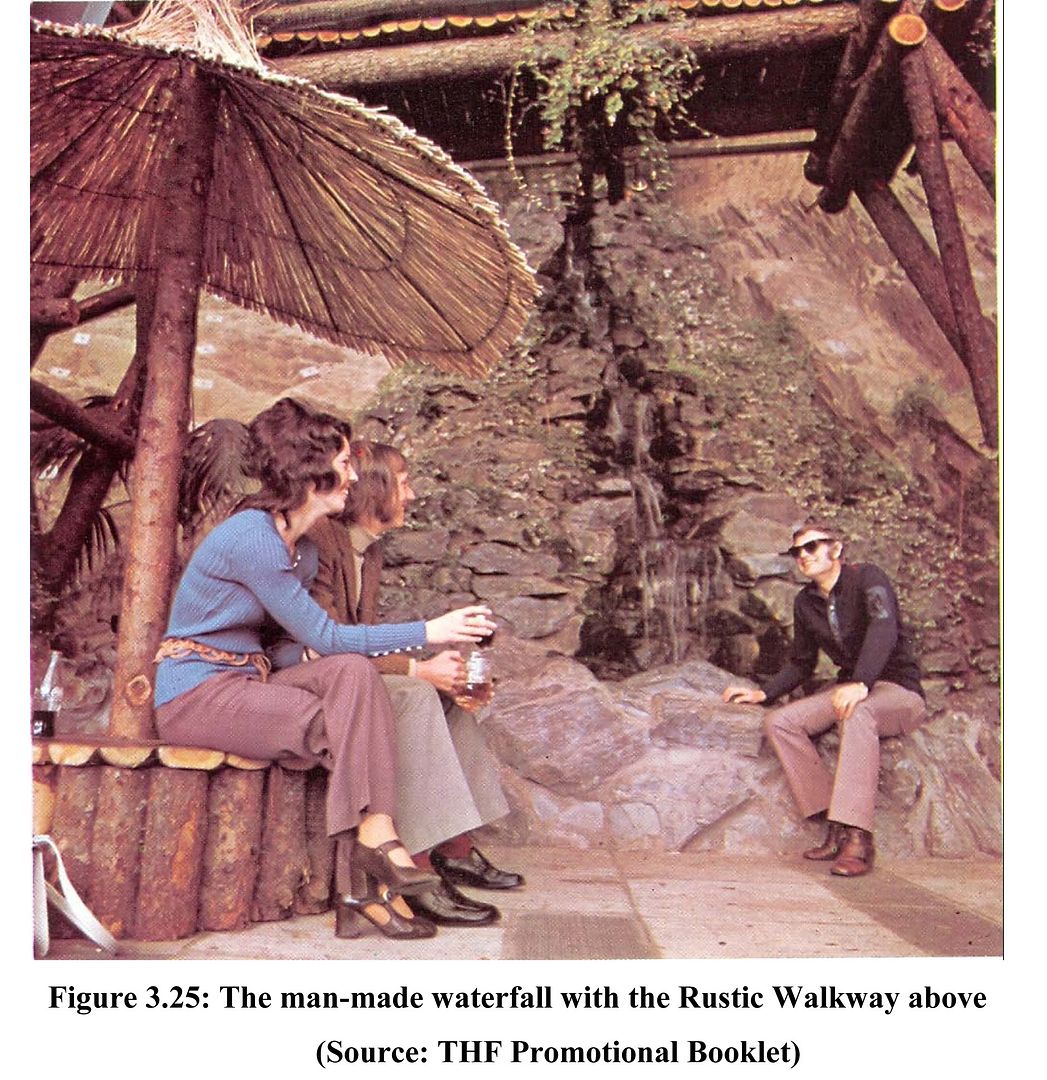
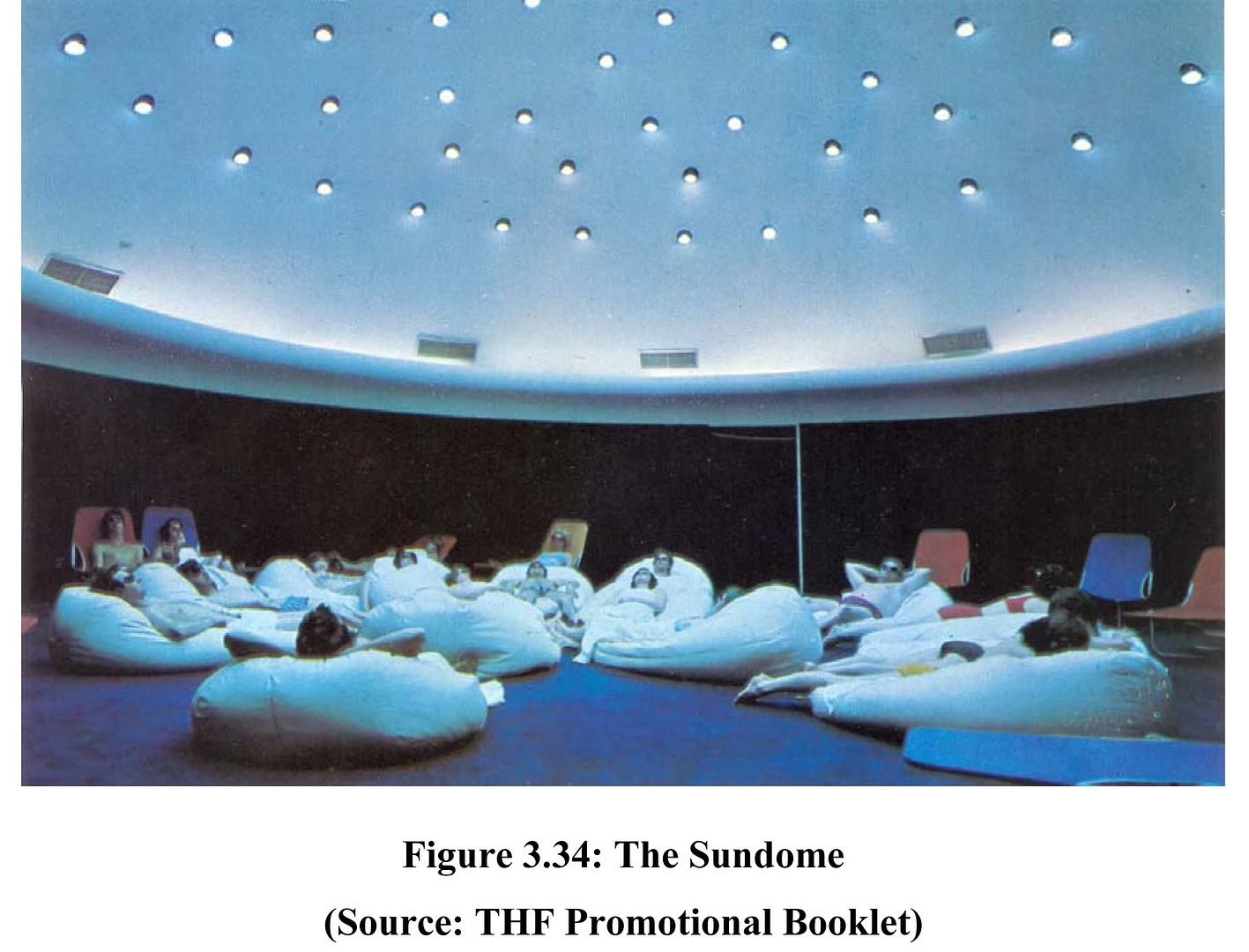
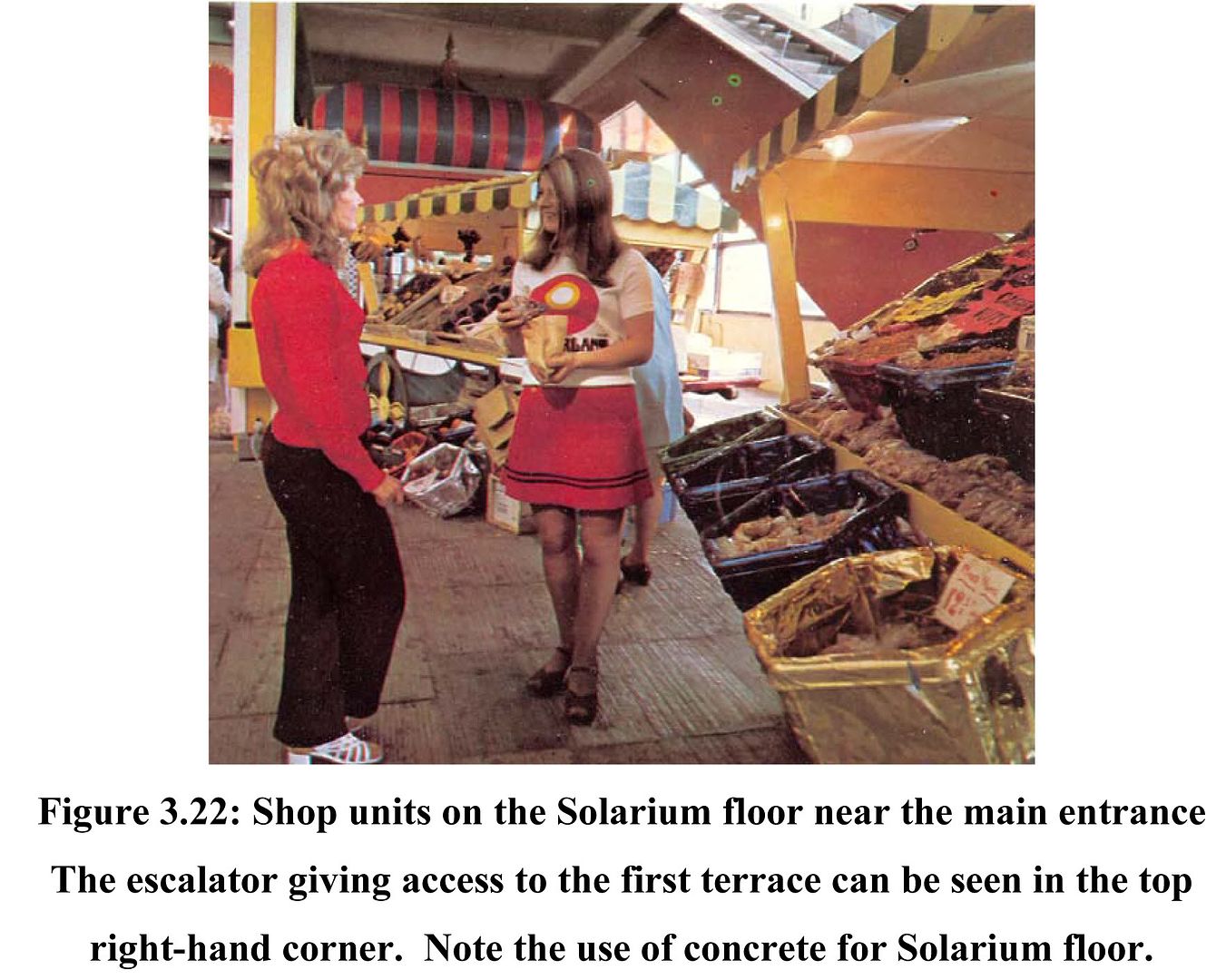
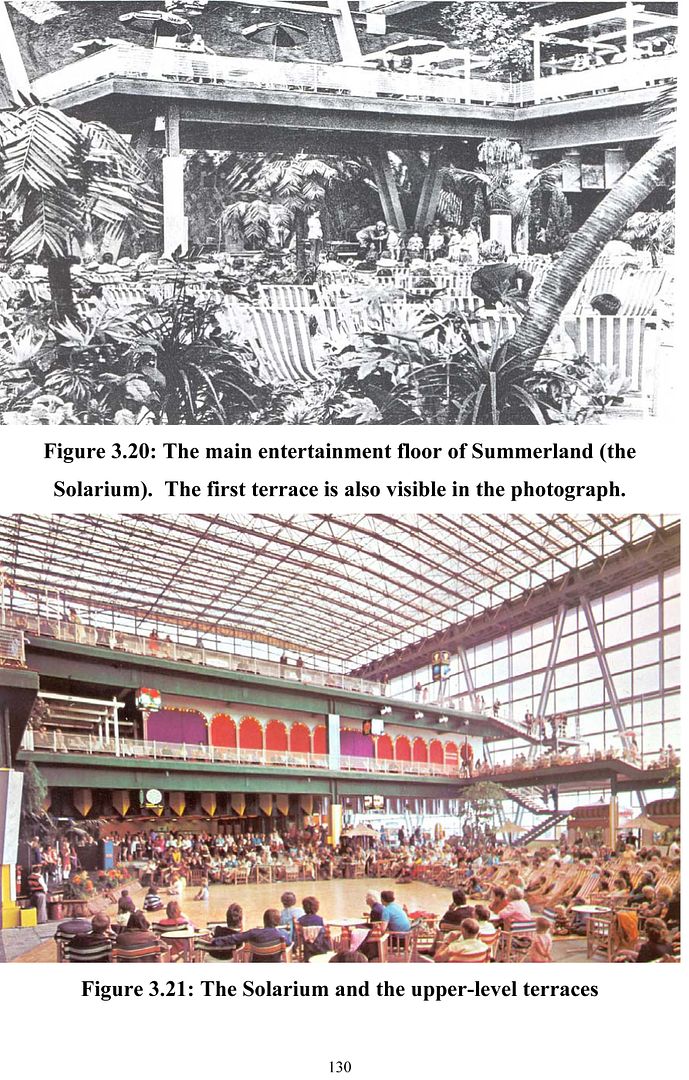
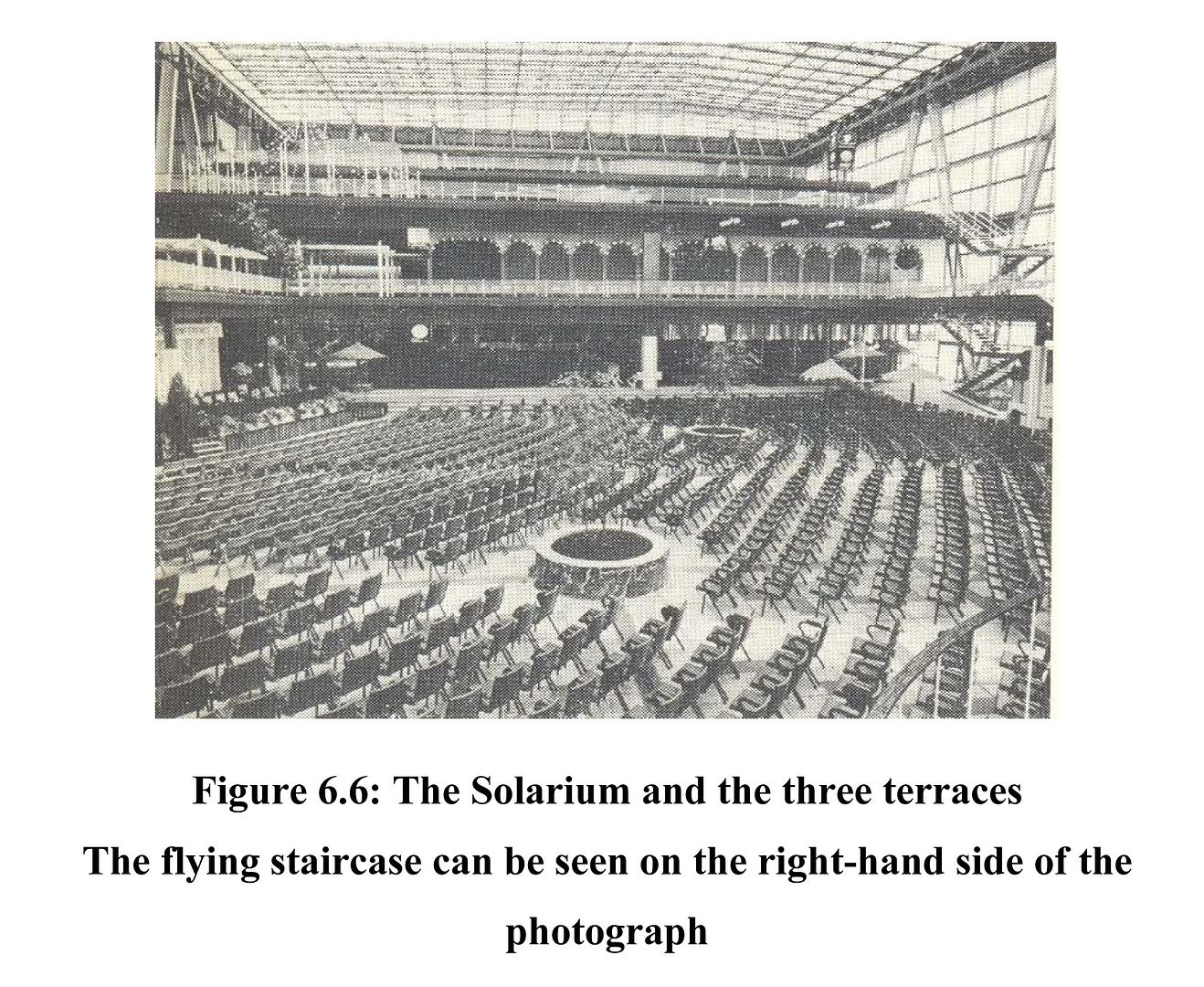
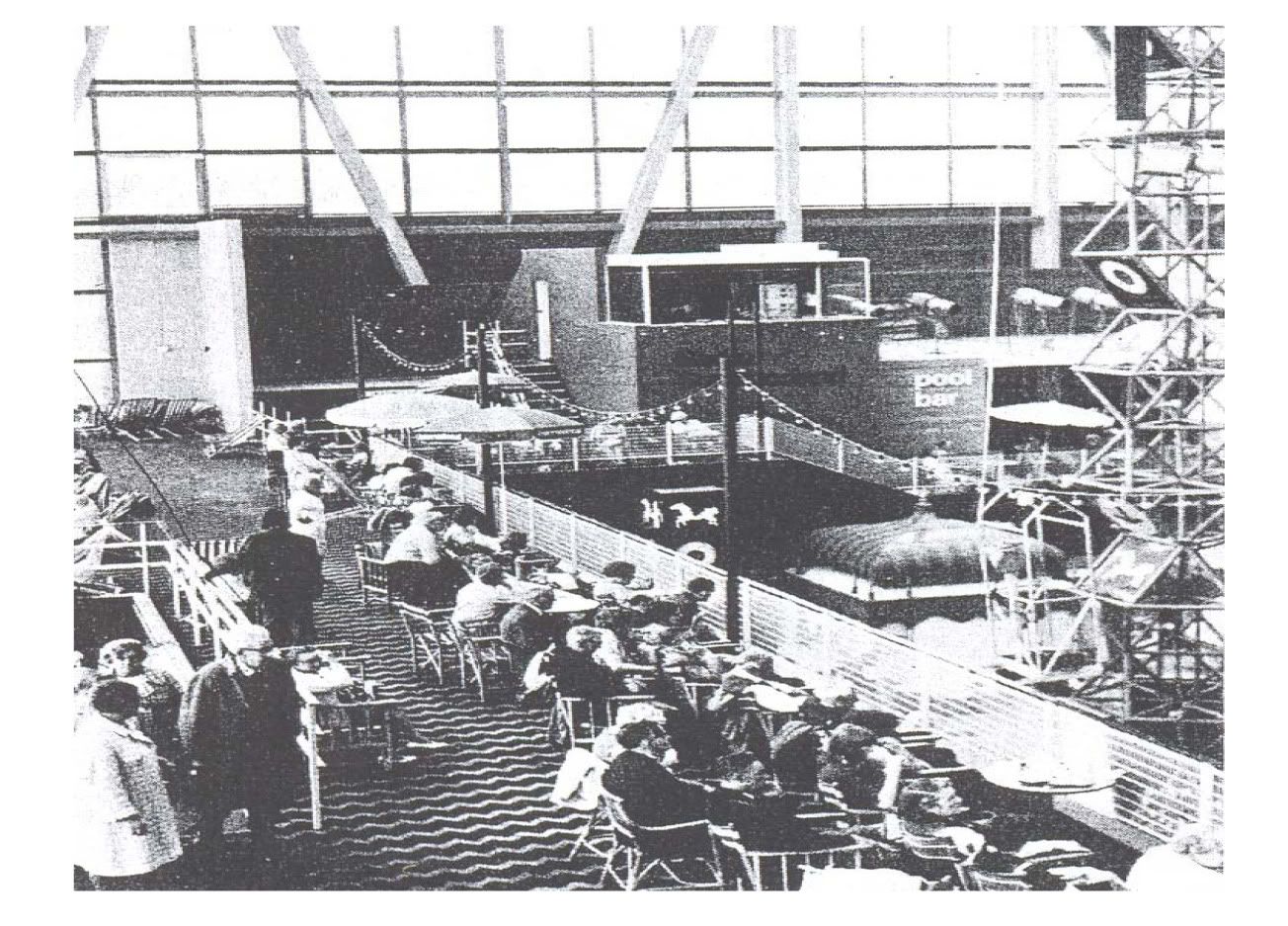
Inside, Summerland offered a wide range of attractions including children's entertainment and play facilities, cafes, restaurants, and bars, amusement arcades, bingo, shuffleboard and artificial waterfalls, a tanning room, shops, and of course the Solarium--which was used for mass performances.
Despite the fact that its logo looks a bit like a gigantic pimple (or possibly the Eye of Sauron) the pictures convey a certain enthusiastic sort of gaiety. To modern eyes, Summerland drips with 1970s kitsch; James Lileks would have gone mad over the Marquee Showbar's purple and red awnings and plastic chestnut trees, or the bingo arcade's dental-appliance-pink and dog-diarrhea-yellow colour scheme. It's the apotheosis of Organized 1970s Fun, and not unlike one specific concept of Hell.
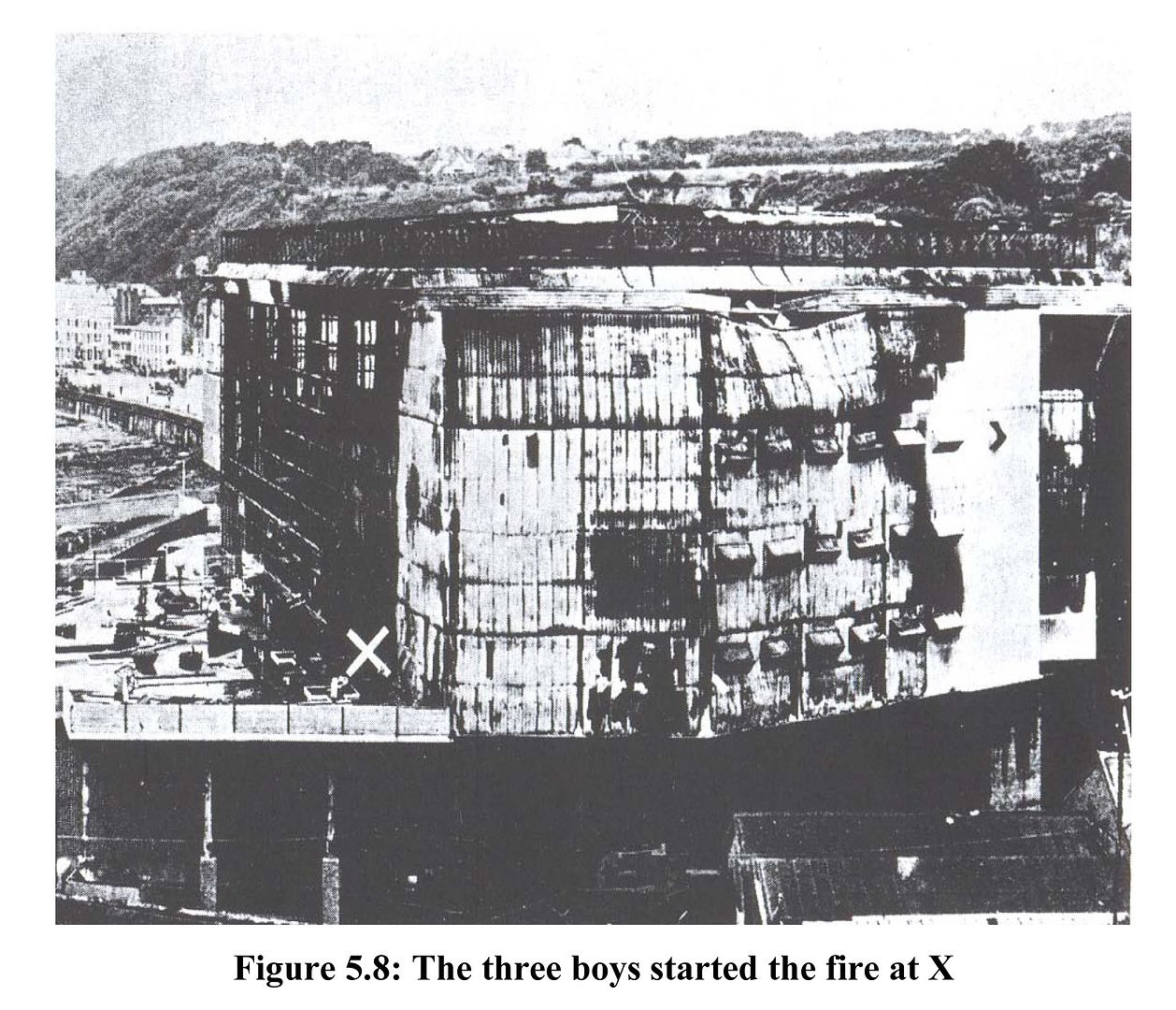
Now imagine all of this on a drizzly August evening in 1973, packed with around two thousand people listening to accordion music, dancing, drinking, roller-skating, tanning, eating, and generally spending money. It's still light outside as eight o'clock draws near. Outside on the terrace, where the mini-golf course is set up, three boys are hiding in a disassembled kiosk set up against the Galbestos part of the promenade wall, sharing an illicit cigarette.
The fire
The Summerland fire was started by a discarded match. While they were smoking, shortly before 7:40 pm, one of the boys lit a match which caught something inside the kiosk on fire. Apparently not realizing this or not thinking it would burn out of control, he joined his friends and some other boys on the terrace to talk about football. Soon afterward, they smelled something burning, and found that the floor of the kiosk was on fire. They tried to put it out, but the fire was beyond their control, and they ran away in fear.
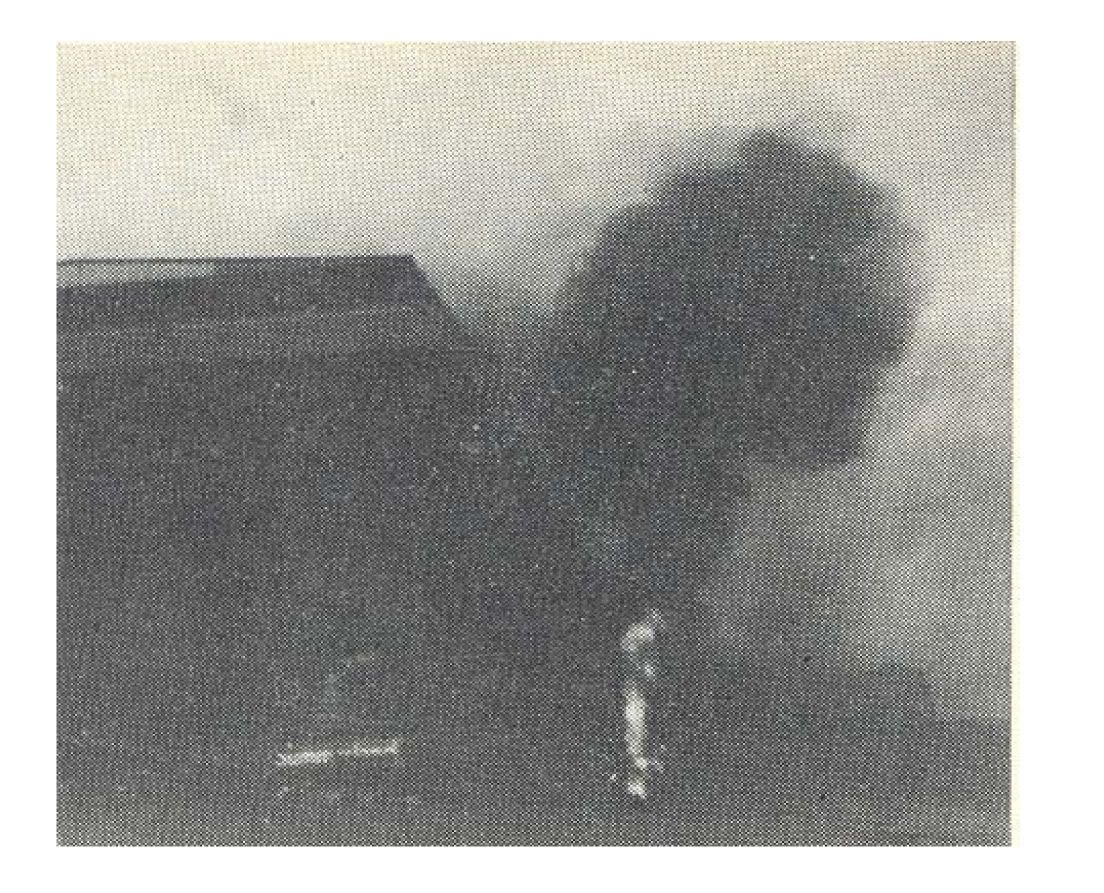
By itself the kiosk fire would not have caused the disaster had Summerland been constructed of materials adherent to by-law 39. The fact that the fire was located right up against a wall made of Colour Galbestos doomed the center and fifty people inside it. An extremely fuzzy photograph taken between the fire's ignition and the full involvement of Summerland itself shows smoke and flames rising from the kiosk on the outside of the promenade wall: nobody knew that in fact it had also started a concealed fire inside the wall of the building. Holidaymakers alerted the staff to the fire around 7:55 pm, and staff members joined at least one patron in trying to fight the fire with chemical extinguishers and the building's fire hoses.
Even the staff thought the external wall was regular steel sheeting and would prevent the fire entering the building. In fact, it was already inside:
"The Colour Galbestos used at Summerland consisted of a zinc coated steel core, which was “covered with asbestos felt saturated with bitumen and then faced with a polyester resin coating” (SFC Report, Paragraph 152, Page 53). When the burning kiosk collapsed against Summerland, the Galbestos wall rapidly became red hot and ignited the material’s combustible coating (polyester resin and bitumen) probably after around 80 seconds (Sam Webb, RIBA, Personal Communication). Since the core (steel and zinc) of the Colour Galbestos has a high thermal conductivity, fumes were soon given off on the inner side of the wall after two-and-a-quarter minutes. “Strong flames” were coming from the Galbestos one minute later." (Phillips, chapter 6, pp.268-269.) The damaged Galbestos wall shows how the stuff buckled and twisted in the heat.
The inner wall, made of a plastic-coated fiberboard called Decalin, was also combustible. When the fire breached the Galbestos wall and entered the void, it ignited the inner side of the Decalin wall and spread across the eastern end of the building between the two walls. Phillips offers some chilling data: "It is estimated that the fire in the void started around 4-6 minutes after the external fire had become established in the remains of the mini-golf course kiosk. This internal fire then gained intensity – but at all times being confined to the void – over the next ten minutes between about 7.45pm and 7.55pm (Time estimate by Professor Rasbash; see SFC Report Paragraph 106, Page 38). It is not known what temperatures were reached in the void, but they may have reached 1000 degrees C close to and after the Decalin wall gave way..." (Phillips, chapter 6, p.273.)
When the fire broke through into the interior of the building, it did so at the ceiling of the amusement arcade (directly beneath the Marquee Showbar level), probably because the only firestopping within the void was located at that level (asbestos sprayed on metal girder). The flames roared across the ceiling of the arcade like a blowlamp, spreading rapidly across flammable furnishings and decorations. By the time the first flames were seen within the building, a considerable portion of the wall had already been burning for some time: with the breach of the inner wall, air rushed in and rapidly fed the fire. From the amusement arcade the fire spread, igniting the Oroglas promenade wall alongside the flying staircase, which caught fire after being exposed to flame for less than two minutes. Burning plastic dribbled to the Solarium below.
Eyewitness accounts agree that the fire spread incredibly rapidly--"as if the place had been doused with petrol," "like a bomb," "worse than the Blitz," "within ten seconds the whole place was on fire," "like wildfire," "the building went up like paper and was wrecked in no time at all." There was no warning, no fire alarm bell was sounded, and no official call was made to evacuate the building other than a terrified compere's shout over a microphone. People on the Marquee Showbar level and above had few escape routes from the building, all of which rapidly became jammed with struggling people. And the Oroglas--far from softening and dropping harmlessly out of its frames--was burning. Molten blobs of burning plastic rained on the screaming people struggling to get out, spreading fire across the Solarium floor. The gap between the terraces and the Oroglas wall acted as a chimney, sucking fire upward to the roof, which burnt out in perhaps ten minutes after ignition. The plastic panels had no time to soften and drop harmlessly from their frames: the temperature of the hot gases and of the flames themselves brought it up to ignition point in seconds. Recall the ad hoc experiment done in Warwickshire on a sample of Oroglas: once alight, it burned fiercely.
Of the vastly insufficient number of exits from the building, several were locked, including two of the main entrance doors and one fire exit immediately adjacent: some of these could be battered open, as the doors into the Aquadrome were, and some could not. People lost their way in the toxic black smoke and were overcome. Parents relaxing on the upper terraces were separated from their children playing in the lower-level skating rinks and the amusement arcade, some of them permanently. At 8:11 the lights went out as the manager shut off the power in the mistaken belief that it would improve safety by preventing electrical fires: the only light left was that thrown by the fire itself, obscured by billows of smoke. The emergency lighting, designed to come on in the event of a power failure, failed--either because the generators wouldn't start or because the switch to them was set in the "off" position. A supposedly safe enclosed exit stairway (the northeast service staircase) was not only not designed for use as an emergency exit but was also now pitch black and full of smoke.
The first alarm was called in to the Douglas fire station at 8:01 by a passing taxi driver; the second was from a boat offshore. Only after those did anyone in Summerland call for the fire brigade. No automatic fire alarm had been rung from the burning building whatsoever: this was investigated as having been either due to the setup of the alarm system or to fire destroying alarm wires. Once the fire engines arrived, however, there was little they could do: the fire had taken too great a hold and had too much fuel for them to hope to extinguish it. The main focus was then shifted to trying to prevent the Aquadrome from a similar fate.
By ten past nine--only an hour and a half after it began--the fire was under control, and by eleven the firemen were beginning to bring out the bodies.
The inquiry into the disaster published its report in May of 1974. Prior to the report's publication, most of the theories about the factors responsible for the deaths focused on the rapid fire spread due to the extensive use of Oroglas, the locked exit doors, and the delayed and disorganized evacuation of the building. In fact the Oroglas theory was still being cited as late as 2006 (Phillips mentions an article in the Isle of Man Examiner in March of 06 containing the line “Summerland was rebuilt without the lethal plastic dome, which had been responsible for so many deaths”). The Summerland Fire Commission report, however, scotches this theory, revealing the catastrophic combination of Galbestos and Decalin that had played a major role in the early development and spread of the fire. The combination of inappropriate material use, open plan design, insufficient staircases and exits, and delayed evacuation is what really caused the deaths of fifty people in Summerland.
The first three of these causes can be attributed to poor or nonexistent communication and research on the part of the architects and planners; the fourth could not be avoided, as there was no sign of the fire inside the building until twenty minutes after it had begun. People were still paying to enter Summerland for that twenty minutes after the boys' accidental ignition of the disassembled kiosk on the terrace. Nobody had any idea that the fire had penetrated the Galbestos and was burning fiercely inside the wall; the staff had had no reason to suspect that evacuation was necessary until after it was already far too late to save everyone inside.
Summerland's fire alarm system, like the Noronic's, had two stages. Public break-glass alarm points around the building would show up on an indicator panel in the "Control Room" when smashed, but would not sound the public alarm. A staff member monitoring the indicator panel would then be responsible for verifying the fire and sounding the alarms if necessary (by either smashing a staff fire alarm glass outside the control room or pushing a "test" button, not the Sound Alarm switch, on the console). The built-in delay was meant to allow for investigation of false alarms, but the fire station should automatically have been alerted when the public trigger was smashed. The fact that it wasn't indicates that the alarm panel itself had been taken apart and physically modified to extend the built-in delay to the automatic fire brigade alert, which Summerland had had done after prior false alarms without notifying the Chief Fire Officer. Which is a lethal version of "it's easier to ask forgiveness than permission."
As if the handy pre-sabotaged alarm system wasn't bad enough, the power supply to run it wasn't up to code, it turned out during the investigation. If the mains wiring was destroyed by fire, the backup generators were supposed to be able to provide power to run the alarm, but when these were examined after the fire they appeared to have been inoperable. Furthermore, the operator in the Control Room had had no training on the fire alarm system, did not know how to use the system, and was not aware that running the system was part of her duties.
The Control Room was set on the first terrace level facing the Solarium and the three terraces against the east wall, allowing the operator a continuous view of most of the interior. It was used in actual practice as the sound and light/announcer's booth for the Solarium, and in fact the operator on duty at the time of the fire reported not to the Fire Officer but to the Entertainments Manager, which gives you an idea of the room's role in the running of the building. There was in effect no fire and safety oversight from the Control Room, nor had there been under the management in place at the time of the fire. (It is worth pointing out that the first manager to run Summerland did take the Control Room seriously and its operators under his oversight were trained in emergency responses.)
When the fire started, the 19-year-old operator in the control room was not bothered because it appeared to be outside the building and no fire alarm station had buzzed on her panel as having been smashed. Even after the first public alarm glass had been smashed, no indicators were received in the Control Room, suggesting that the alarm system was already dead due to fire in the wall burning through the wiring. The operator could have sounded the actual alarm and sent a signal to the fire station, but did not do so. According to the report, "she felt that it was pointless to make an announcement because the fire was so evident in the building by this stage" (SFC report, paragraph 167, p 58, quoted in Phillips chapter 6 p. 278.)
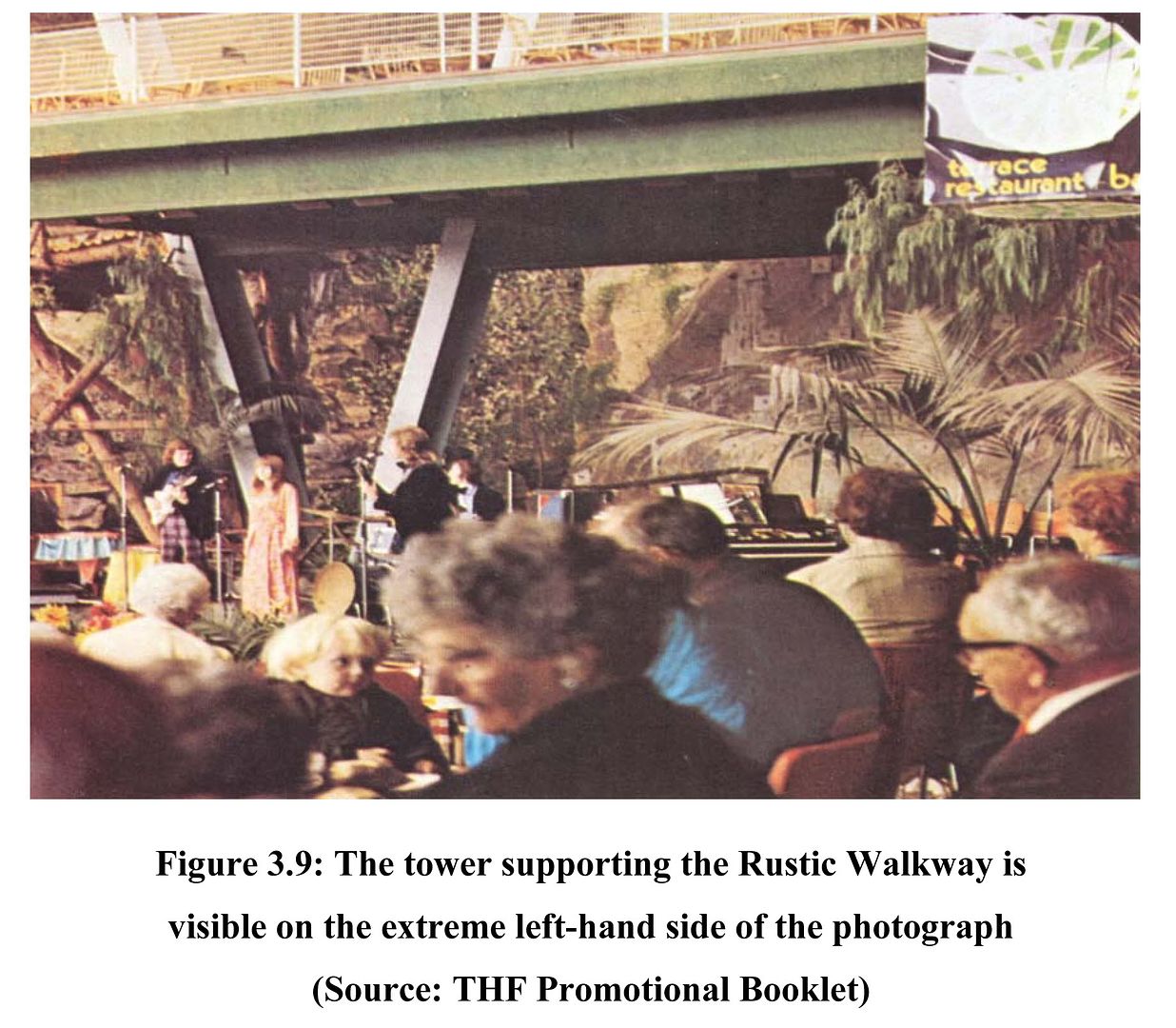
The locked exit doors turned out, on analysis, not to have been as desperately fatal a factor as might be thought. Most of the deaths occurred on the terraces or the (few) staircases leading down from them to the Solarium floor or directly out of the building. From the third ("Cruise Deck", the highest point in the building) to the second terrace (Leisure Level) there was only one exit (the flying staircase); on the Leisure Level there was access to the flying staircase as well as the northeast service staircase which descended to the ground level and opened directly to the outside. From the first terrace one had a choice of the service staircase, the flying staircase, or the "rustic walkway" (an afterthought, not in the original plans). People struggling to escape from the terraces joined the throng on the Solarium floor running for the exits if they were lucky: if they weren't, they were stuck either on the terraces as the fire spread or on the staircases jammed with panicked people screaming in terror. The flying staircase--for many people the only exit of which they were aware--became enveloped in flames, killing at least 13 as they were overcome by fire and fumes or leapt to their deaths in the blaze below.
No villains
The official report's conclusion that the disaster was an accident attributable to human error and not to any specific "villain" surprised many. Here's what they said:
“In all the above inadequacies and failings, it seems to the Commission that there were no villains. Within a certain climate of euphoria at the development of this interesting concept, there were many human errors and failures and it was the accumulation of these, too much reliance upon an‘old boy’ network and some very ill-defined and poor communications which led to the disaster. It would be unjust not to acknowledge that not every failure which is obvious now would be obvious before the disaster put structure and people to the test."
Death by misadventure was the coroner's verdict--times fifty--and this, too, infuriated those who had lost loved ones in the disaster. If the architects and planners, the companies who sold them the materials, and the management in place at the time of the fire could not be held responsible, who could? God? Bad luck? The "curse" of the Derby Castle site?
There are no answers, but the Corporate Manslaughter Act of 2007--a result of unsuccessful prosecutions in cases of disaster--means that if anything like Summerland ever happens again, it would be possible to find the management of the building liable. As with almost every disaster, Summerland spurred the creation of new and more stringent safety codes and regulations, meant to address the various elements of the situation that had led to the appalling death toll. This comes as cold comfort to the families of the victims.
We should remember Summerland not for its kitsch and its desperately misguided concept. We should remember it because it is still the deadliest building fire to have occurred in Britain since the end of World War Two. We should remember it because the decisions that led to disaster are individually small and perhaps understandable: decisions that are likely to have occurred over and over since 1973. We should remember it because new is not always better, and because regulations are not always there to be waived.
Summerland was rebuilt in a vastly subdued version after the fire, but struggled to break even: in 2006 it and the Aquadrome, which had survived the fire, were demolished. After forty years the Derby Castle site has rid itself of a lingering scar, and Douglas--and the Isle of Man--can move on.
Information in this post is from Dr. Ian Phillips's book detailing the results of his research into the Summerland disaster. The book is available on the Web at Dr. Phillips's Birmingham University page. All images in this post are from Dr. Phillips's book (complete with original caption and citations where possible) and moved to my own hosting for purposes of illustration. No copyright infringement is intended and no money is being made: the research was done by Dr. Phillips, not myself, and this post is intended merely to present in summary the conclusions detailed in his work.
Wiki's article on the disaster states variously that 50 and 51 people were killed: there is controversy over the above-50 death toll figure, but Dr. Phillips states that he was unable to find any evidence to support the notion that more than fifty died.
Showing posts with label oversight fail. Show all posts
Showing posts with label oversight fail. Show all posts
Thursday, July 30, 2009


![[Summerland]](http://img.photobucket.com/albums/v104/ceruleancynic/summerland/summerlandbrochurecover.jpg)



Friday, June 26, 2009
It does matter what you do with your old equipment: Goiânia’s dance with cesium-flavoured death
This is a story with two subjects. On the one hand, we have another blatantly irresponsible organization failing to take the most basic safety precautions; on the other, we have the deadly results of ignorance. It’s far from the only tale of its kind; the list of radiological accidents in developing or less-developed countries is depressingly long.
In order to explain how Goiânia happened, we need to touch briefly on the nature of the machine that started the disaster. Radiotherapy for cancer can take many forms: teletherapy (now known as external beam radiotherapy), where the source of radiation is outside but focused on the body; brachytherapy, where sealed radioactive sources are placed inside or next to the part of the body needing treatment; and systemic or unsealed source radiotherapy, where a soluble radionuclide is injected or ingested into the body. Mostly when people think of radiotherapy they think of external-beam/teletherapy machines with the rotating gantry and patient couch.
These days EBRT is mostly performed using linear accelerators, which produce a powerful beam of beta radiation (electrons) or X-rays with the push of a button and do not require dangerous radioactive source capsules, but in the early days of teletherapy they didn’t have that option. The two most common radioactive substances used as teletherapy sources are cobalt-60 and cesium-137. Both of these will kill you quite quickly if you pick them up in your hands: the machines using them rely on massive lead shields to limit the radiation to a controlled, collimated beam. The cesium-137 source in the Goiânia accident was filled with highly soluble, highly dispersible powder, rather than pellets of metallic solid material. This would prove to be important.
The unit involved in the accident was a Cesapan F-3000, a 1950s Italian design containing what was probably a source capsule manufactured in America in the seventies. It would have looked a little something like this (images from IAEA report). The rather ominous-looking head was capable of moving up and down on its support pillar and rotating through a couple of horizontal axes, and contained the source capsule in a rotating assembly that could move to line up the window in the capsule with the radiation aperture in the head, as illustrated here. The window in the shielding of the capsule, through which radiation could escape, was made of iridium. According to the International Atomic Energy Agency (IAEA) report, the source itself was of standard international dimensions and potency.
This machine was left in the derelict premises of a private radiotherapy clinic in Goiânia, capital of Goiâs State, Brazil, after the partnership that owned it dissolved toward the end of 1985; a cobalt teletherapy unit from the same clinic premises was removed and transferred to a new facility, but the cesium unit stayed where it was. We aren't sure why.
Vagrants used the gutted building to shelter in; wildlife came and went, and the Cesapan F-3000 stood there growing quietly more obsolete. It is perhaps surprising that it remained unmolested for two years before enterprising locals considered its potential scrap value.
On September 10, 1987, two men, A and B, began to try to dismantle the machine. It took a while and several attempts, but by September 13 they'd managed to extract the rotating assembly from the massive shielding of the radiation head. Outside this shielding, the unprotected source was giving off 465 rads an hour, or 4.65 Gray if you want to be modern about it. For comparison, the accepted annual radiation dose for non-nuclear-workers in the USA is between 1 and 5 millisieverts, or ~ 0.001 to 0.005 Gray.
They put the assembly in a wheelbarrow and took it to A's house; A had suggested salvaging the machine for scrap in the first place. That day, both of them began to vomit; over the next few days, B developed diarrhea and edema of his hand, which subsequently would develop into a burn corresponding to the size and shape of the window in the source capsule. They attributed their symptoms to something they'd eaten, and in fact when B saw a doctor he was told his symptoms were due to a food allergy and he was to take it easy for a week.
The real horror begins
In the days between September 13 and September 18, A had been tinkering with the rotating source assembly, which he'd dumped under a mango tree in his yard. He was trying to get the source capsule free of the assembly. At some point he managed to break the iridium window of the source with a screwdriver.
He thought that perhaps the intensely radioactive cesium thus exposed might be gunpowder, and tried to light it.
On the 18th he managed to get the breached source free of the rotating assembly, and sold the whole mess to a third man, C, who owned a junkyard nearby. That night, C went into the garage where the bits were stored and noticed that the stuff in the broken capsule was emitting a blue glow, and brought the capsule into his house to show it to his wife. Because it was so pretty and so strange, they thought it might be valuable, or have supernatural powers, and invited their friends over to have a look. On the 21st one of these friends dug out some of the powder with a screwdriver and took it away with him to give to his family and friends. Quite a few of them rubbed it on their skin like body glitter. C received a total dose of 7Gy and survived. His wife (5.7 Gy) would not.
I know this reads like a horror novel. It gets worse.
More people were (unsurprisingly) suffering the symptoms of acute radiation sickness: C's vomiting wife was examined at a local hospital, diagnosed with food poisoning, and sent home to rest. Her mother came over to take care of her, and took home a dose of 4.3 Gy.
Two of C's employees were tasked with removing lead from the remnants of the assembly, and worked on it from September 22 to 24. Directly exposed to the breached source capsule, they would be among the four victims who did not survive.
The last of the four fatalities was C's six-year-old niece, whose father had visited C and taken away some of the glowing powder. This was left on the table and handled by the family during meals. The little girl had played with the powder and put her fingers into her mouth. According to one source, when international medical teams arrived to treat the victims, they found her in an isolated room in the hospital because the staff were afraid to go near her.
On the 23rd, B was admitted to hospital: his skin lesions were diagnosed as related to some exotic disease, and on the 27th he was transferred to the Tropical Diseases Hospital.
The authorities finally become aware of the accident
After doing its damage to C's friends and family, the source and rotating assembly were sold to a second junkyard. The sudden epidemic of vomiting and diarrhea among their acquaintances was not lost on C's wife, who became convinced that the glowing powder from the capsule was responsible for all the sickness. On the 28th, ten days after the source was transferred to C's ownership, she and one of C's employees went to collect the remains of the source and rotating assembly from the second junkyard, put it in a plastic bag, and took it by bus to a hospital, spreading contamination as they went. The employee and C's wife presented a doctor, P, with the source in its bag, and she told him that it was "killing her family."
By now the employee who had carried the bag was developing a serious radiation burn on his shoulder, where it had rested, and he and C's wife were sent to the Tropical Diseases Hospital, where B and several other contamination victims had been sent for treatment. One of the doctors at the TDH was beginning to suspect that in fact the nearly identical symptoms of this whole cohort of patients could have been caused by radiation, and he contacted a colleague who had independently been contacted by Dr. P. Dr. P had initially thought that the bag contained bits from X-ray apparatus, and became wary of it, moving it outside the facility (and thus probably saving his own life).
The doctors at the TDH had another look at the patients, with the mysterious bag's contents in mind, and agreed that it would be a good idea to contact the state department of the environment; when they did, it was recommended that a medical physicist examine the package.
On the 29th they found a medical physicist, W. He found a radiation monitor used for uranium prospecting, which had a range of 0.03–30 microgray/hour, and set off for the hospital where the source was currently located: quite some distance away he noticed that the monitor was pegged no matter where he pointed it. He assumed it was malfunctioning and went back to fetch a different one, which showed exactly the same thing as soon as he turned it on.
At this point W realized that something was desperately wrong. At the hospital, Dr. P had become sufficiently concerned about the source in its bag that he had called the fire department, which had arrived and was preparing to chuck the whole thing into a handy river; W arrived on the scene just in time to prevent this. He convinced them to evacuate the hospital and make sure no one else got near it, and after talking with Dr. P they set off together to C's junkyard–where the monitor again read off the scale.
The official response begins
W, among others, managed after some effort to notify the secretary of health. Once the authorities had been convinced that yes, in fact, this was a huge deal and would require evacuation of a large number of people, steps began to be taken with considerably greater speed. The physicist and physician at the radiotherapy clinic's new location were notified, and the source was tentatively traced to the abandoned clinic and the cesium unit.
Civil defense forces were notified; the TDH was informed that a number of patients were contaminated; the known sites of contamination were resurveyed with equipment from the radiotherapy clinic; an emergency receiving and decontamination facility was set up in a local stadium. W, the physicist who had initially discovered the contamination, was contacted by an individual who had intended to cut up the source for C with an oxyacetylene torch (but had luckily forgot), who explained several useful details to the investigation.
International teams were sent in to decontaminate and treat the victims of the disaster. There is not a great deal that can be done in cases of radiation sickness: therapy consisted of dealing with the acute period of bone marrow suppression and subsequent immune deficiency, treating the burns, removing radiation from the body (decorporation), and general support. It's rather terrible to consider that many of these patients recontaminated their skin repeatedly by sweating; the cesium in their bodies found its way out in everything. Chelation with Prussian blue helped a significant number of the victims, a point which recalls the hopeless suggestion of treating Louis Slotin with methylene blue after his deadly exposure to plutonium criticality.
The final count of persons with significant contamination, out of the hundred thousand screened, was two hundred and forty-four. Most of those were lucky and received fractionated doses--spread over a long time period, giving the body's tissues a chance to attempt to recover from the damage. Some were not. The dead of Goiânia had to be buried in lead coffins surrounded by concrete.
Cesium didn't just destroy people in Goiânia, it destroyed property and livelihoods. Seven houses had to be demolished, so badly contaminated they could not be made safe. Topsoil was removed by the ton. In total 85 houses had to be decontaminated.
More than anything Goiânia stands as a blazingly vivid example of the importance of keeping sources secured. A number of factors conspired to make this accident as deadly as it was: criminal negligence on the part of the radiotherapy clinic which failed to remove and secure the capsule from the teletherapy unit, the nature of the radioactive material--its mysterious and magical blue glow entranced people, significantly increasing the scope of the disaster, and its powdery nature was easily dispersed and easily soluble--and the remote location of the disaster site. But the lesson of Goiânia applies to all source capsules, not just cesium in remote and unsophisticated locations.
Sadly, it's not a lesson that's been learned particularly well. In the years since Goiânia, unsecured radiation sources have caused at least four radiological accidents around the world. In Samut Prakarn, Thailand, a disused cobalt-60 teletherapy head was partially dismantled, taken from an unsecured storage location, and sold as scrap metal–in February of 2000. It's still happening. It will continue to happen as long as those in charge of radiation sources fail in their responsibility to keep them secure.
In many ways the eighties were a great time for death by radiation. You had Chernobyl, you had the 1983 Ciudad Juarez accident in Mexico–eerily similar to Goiânia–you had the Therac-25 linear accelerator deaths; but it hasn't stopped. People need to pay more attention to things that have happened, if they want to live very much longer; and people who take the responsibility to treat their fellow humans with lethal radiation must take the responsibility to prevent their fellow humans from dying of it.
Information in this article is from the IAEA report on the incident, available at www-pub.iaea.org/MTCD/publications/PDF/Pub815_web.pdf, and from Wiki.
In order to explain how Goiânia happened, we need to touch briefly on the nature of the machine that started the disaster. Radiotherapy for cancer can take many forms: teletherapy (now known as external beam radiotherapy), where the source of radiation is outside but focused on the body; brachytherapy, where sealed radioactive sources are placed inside or next to the part of the body needing treatment; and systemic or unsealed source radiotherapy, where a soluble radionuclide is injected or ingested into the body. Mostly when people think of radiotherapy they think of external-beam/teletherapy machines with the rotating gantry and patient couch.
These days EBRT is mostly performed using linear accelerators, which produce a powerful beam of beta radiation (electrons) or X-rays with the push of a button and do not require dangerous radioactive source capsules, but in the early days of teletherapy they didn’t have that option. The two most common radioactive substances used as teletherapy sources are cobalt-60 and cesium-137. Both of these will kill you quite quickly if you pick them up in your hands: the machines using them rely on massive lead shields to limit the radiation to a controlled, collimated beam. The cesium-137 source in the Goiânia accident was filled with highly soluble, highly dispersible powder, rather than pellets of metallic solid material. This would prove to be important.
The unit involved in the accident was a Cesapan F-3000, a 1950s Italian design containing what was probably a source capsule manufactured in America in the seventies. It would have looked a little something like this (images from IAEA report). The rather ominous-looking head was capable of moving up and down on its support pillar and rotating through a couple of horizontal axes, and contained the source capsule in a rotating assembly that could move to line up the window in the capsule with the radiation aperture in the head, as illustrated here. The window in the shielding of the capsule, through which radiation could escape, was made of iridium. According to the International Atomic Energy Agency (IAEA) report, the source itself was of standard international dimensions and potency.
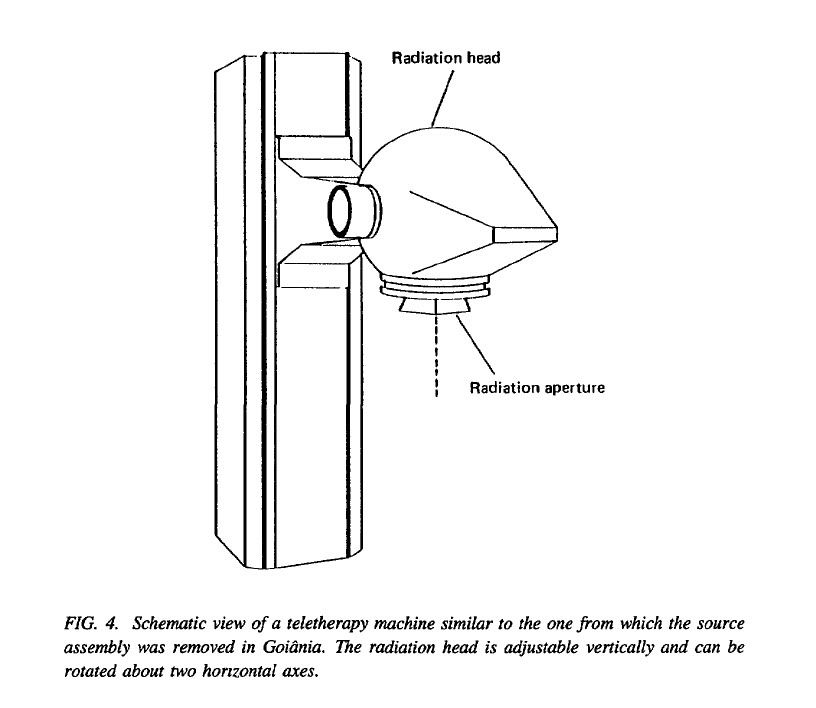

This machine was left in the derelict premises of a private radiotherapy clinic in Goiânia, capital of Goiâs State, Brazil, after the partnership that owned it dissolved toward the end of 1985; a cobalt teletherapy unit from the same clinic premises was removed and transferred to a new facility, but the cesium unit stayed where it was. We aren't sure why.
Vagrants used the gutted building to shelter in; wildlife came and went, and the Cesapan F-3000 stood there growing quietly more obsolete. It is perhaps surprising that it remained unmolested for two years before enterprising locals considered its potential scrap value.
On September 10, 1987, two men, A and B, began to try to dismantle the machine. It took a while and several attempts, but by September 13 they'd managed to extract the rotating assembly from the massive shielding of the radiation head. Outside this shielding, the unprotected source was giving off 465 rads an hour, or 4.65 Gray if you want to be modern about it. For comparison, the accepted annual radiation dose for non-nuclear-workers in the USA is between 1 and 5 millisieverts, or ~ 0.001 to 0.005 Gray.
They put the assembly in a wheelbarrow and took it to A's house; A had suggested salvaging the machine for scrap in the first place. That day, both of them began to vomit; over the next few days, B developed diarrhea and edema of his hand, which subsequently would develop into a burn corresponding to the size and shape of the window in the source capsule. They attributed their symptoms to something they'd eaten, and in fact when B saw a doctor he was told his symptoms were due to a food allergy and he was to take it easy for a week.
The real horror begins
In the days between September 13 and September 18, A had been tinkering with the rotating source assembly, which he'd dumped under a mango tree in his yard. He was trying to get the source capsule free of the assembly. At some point he managed to break the iridium window of the source with a screwdriver.
He thought that perhaps the intensely radioactive cesium thus exposed might be gunpowder, and tried to light it.
On the 18th he managed to get the breached source free of the rotating assembly, and sold the whole mess to a third man, C, who owned a junkyard nearby. That night, C went into the garage where the bits were stored and noticed that the stuff in the broken capsule was emitting a blue glow, and brought the capsule into his house to show it to his wife. Because it was so pretty and so strange, they thought it might be valuable, or have supernatural powers, and invited their friends over to have a look. On the 21st one of these friends dug out some of the powder with a screwdriver and took it away with him to give to his family and friends. Quite a few of them rubbed it on their skin like body glitter. C received a total dose of 7Gy and survived. His wife (5.7 Gy) would not.
I know this reads like a horror novel. It gets worse.
More people were (unsurprisingly) suffering the symptoms of acute radiation sickness: C's vomiting wife was examined at a local hospital, diagnosed with food poisoning, and sent home to rest. Her mother came over to take care of her, and took home a dose of 4.3 Gy.
Two of C's employees were tasked with removing lead from the remnants of the assembly, and worked on it from September 22 to 24. Directly exposed to the breached source capsule, they would be among the four victims who did not survive.
The last of the four fatalities was C's six-year-old niece, whose father had visited C and taken away some of the glowing powder. This was left on the table and handled by the family during meals. The little girl had played with the powder and put her fingers into her mouth. According to one source, when international medical teams arrived to treat the victims, they found her in an isolated room in the hospital because the staff were afraid to go near her.
On the 23rd, B was admitted to hospital: his skin lesions were diagnosed as related to some exotic disease, and on the 27th he was transferred to the Tropical Diseases Hospital.
The authorities finally become aware of the accident
After doing its damage to C's friends and family, the source and rotating assembly were sold to a second junkyard. The sudden epidemic of vomiting and diarrhea among their acquaintances was not lost on C's wife, who became convinced that the glowing powder from the capsule was responsible for all the sickness. On the 28th, ten days after the source was transferred to C's ownership, she and one of C's employees went to collect the remains of the source and rotating assembly from the second junkyard, put it in a plastic bag, and took it by bus to a hospital, spreading contamination as they went. The employee and C's wife presented a doctor, P, with the source in its bag, and she told him that it was "killing her family."
By now the employee who had carried the bag was developing a serious radiation burn on his shoulder, where it had rested, and he and C's wife were sent to the Tropical Diseases Hospital, where B and several other contamination victims had been sent for treatment. One of the doctors at the TDH was beginning to suspect that in fact the nearly identical symptoms of this whole cohort of patients could have been caused by radiation, and he contacted a colleague who had independently been contacted by Dr. P. Dr. P had initially thought that the bag contained bits from X-ray apparatus, and became wary of it, moving it outside the facility (and thus probably saving his own life).
The doctors at the TDH had another look at the patients, with the mysterious bag's contents in mind, and agreed that it would be a good idea to contact the state department of the environment; when they did, it was recommended that a medical physicist examine the package.
On the 29th they found a medical physicist, W. He found a radiation monitor used for uranium prospecting, which had a range of 0.03–30 microgray/hour, and set off for the hospital where the source was currently located: quite some distance away he noticed that the monitor was pegged no matter where he pointed it. He assumed it was malfunctioning and went back to fetch a different one, which showed exactly the same thing as soon as he turned it on.
At this point W realized that something was desperately wrong. At the hospital, Dr. P had become sufficiently concerned about the source in its bag that he had called the fire department, which had arrived and was preparing to chuck the whole thing into a handy river; W arrived on the scene just in time to prevent this. He convinced them to evacuate the hospital and make sure no one else got near it, and after talking with Dr. P they set off together to C's junkyard–where the monitor again read off the scale.
The official response begins
W, among others, managed after some effort to notify the secretary of health. Once the authorities had been convinced that yes, in fact, this was a huge deal and would require evacuation of a large number of people, steps began to be taken with considerably greater speed. The physicist and physician at the radiotherapy clinic's new location were notified, and the source was tentatively traced to the abandoned clinic and the cesium unit.
Civil defense forces were notified; the TDH was informed that a number of patients were contaminated; the known sites of contamination were resurveyed with equipment from the radiotherapy clinic; an emergency receiving and decontamination facility was set up in a local stadium. W, the physicist who had initially discovered the contamination, was contacted by an individual who had intended to cut up the source for C with an oxyacetylene torch (but had luckily forgot), who explained several useful details to the investigation.
International teams were sent in to decontaminate and treat the victims of the disaster. There is not a great deal that can be done in cases of radiation sickness: therapy consisted of dealing with the acute period of bone marrow suppression and subsequent immune deficiency, treating the burns, removing radiation from the body (decorporation), and general support. It's rather terrible to consider that many of these patients recontaminated their skin repeatedly by sweating; the cesium in their bodies found its way out in everything. Chelation with Prussian blue helped a significant number of the victims, a point which recalls the hopeless suggestion of treating Louis Slotin with methylene blue after his deadly exposure to plutonium criticality.
The final count of persons with significant contamination, out of the hundred thousand screened, was two hundred and forty-four. Most of those were lucky and received fractionated doses--spread over a long time period, giving the body's tissues a chance to attempt to recover from the damage. Some were not. The dead of Goiânia had to be buried in lead coffins surrounded by concrete.
Cesium didn't just destroy people in Goiânia, it destroyed property and livelihoods. Seven houses had to be demolished, so badly contaminated they could not be made safe. Topsoil was removed by the ton. In total 85 houses had to be decontaminated.
More than anything Goiânia stands as a blazingly vivid example of the importance of keeping sources secured. A number of factors conspired to make this accident as deadly as it was: criminal negligence on the part of the radiotherapy clinic which failed to remove and secure the capsule from the teletherapy unit, the nature of the radioactive material--its mysterious and magical blue glow entranced people, significantly increasing the scope of the disaster, and its powdery nature was easily dispersed and easily soluble--and the remote location of the disaster site. But the lesson of Goiânia applies to all source capsules, not just cesium in remote and unsophisticated locations.
Sadly, it's not a lesson that's been learned particularly well. In the years since Goiânia, unsecured radiation sources have caused at least four radiological accidents around the world. In Samut Prakarn, Thailand, a disused cobalt-60 teletherapy head was partially dismantled, taken from an unsecured storage location, and sold as scrap metal–in February of 2000. It's still happening. It will continue to happen as long as those in charge of radiation sources fail in their responsibility to keep them secure.
In many ways the eighties were a great time for death by radiation. You had Chernobyl, you had the 1983 Ciudad Juarez accident in Mexico–eerily similar to Goiânia–you had the Therac-25 linear accelerator deaths; but it hasn't stopped. People need to pay more attention to things that have happened, if they want to live very much longer; and people who take the responsibility to treat their fellow humans with lethal radiation must take the responsibility to prevent their fellow humans from dying of it.
Information in this article is from the IAEA report on the incident, available at www-pub.iaea.org/MTCD/publications/PDF/Pub815_web.pdf, and from Wiki.
Friday, June 12, 2009
I love the smell of corporate negligence in the morning: the Boston Molasses Flood
Clichés tend to become clichés for a reason. “Slow as molasses” is generally an apt statement: molasses is highly viscous and therefore flows at a slow rate of speed. Comparing something slow to the movement of molasses is valid.
Except when the molasses is going thirty-five miles an hour.
Ninety years ago, Boston’s North End was the home of the city’s busiest center of commerce: the North End Paving Yard and the Commercial Street Wharf. Freighters from all over the world crowded against one another, taking on or discharging cargoes–livestock, tea, coffee, wool, raw materials for a hundred different trades; locomotives shunted freight cars to and from the wharf to deliver or receive goods from the ships. Stonecutters chipped and shaped pavement blocks in the Yard. Successive waves of immigrants had settled in the neighborhood, and the patter of stevedores and dockhands and blacksmiths and drivers varied from Italian to Irish. There was a lot of work to be had, and a lot of workers competing for it.
One of the landmarks of the North End waterfront was the United States Industrial Alcohol Company’s fifty-foot-high storage tank, holding the molasses the company used to distill its product. This tank, capable of holding over two million gallons of molasses, was used to store molasses from freight tankers before discharging it to railway tank cars for transportation to USIA’s distillation plant. It had been built in a tearing hurry during the month of December, 1915, after lengthy delays in negotiation regarding leasing the land for the tank site and securing permission for the construction. USIA needed the tank ready to accept a shipment of molasses by December 31, and by jingo it was completed in time.
It wasn’t tested to see how the construction held up, of course, because it would have taken days and dollars to fill it up with water: the individual responsible for the construction of the tank, Arthur P. Jell, happened to be the treasurer of USIA’s subsidiary Purity Distilling, and was well aware of the amount the company stood to lose if they wasted any time. Jell instructed that the tank should be filled with water to the level of six inches, enough to cover the joint at the base of the construction, and when this did not result in leaks he declared the tank safe for use.
In point of fact it leaked like an enuretic hamster. In February 1916, two months after completion, the tank was observed to be leaking molasses from its seams, dribbling the stuff in slow streams down the outside to pool around the base in quantities sufficient for children to come and scoop it up in pails. The leaks had been reported to the company, and Jell ordered the tank recaulked twice and painted brown to hide the leaks.
Stephen Puleo’s comprehensive book on the disaster, The Dark Tide, describes one employee, Isaac Gonzalez, as feeling the tank vibrate and hearing it groan every time a shipment of molasses was pumped in. According to Puleo, Gonzalez was deeply concerned about the tank’s structural integrity, and when he was warned after mentioning the leakage that voicing further complaints or concerns to management would get him fired, he took it upon himself to do what he could to lower the risk of disaster. This included sleeping in an office next to the tank so as to be able to sound an alarm in case of imminent rupture. On one of the nights he spent in the office by the tank, he received an anonymous phone call stating that the tank would be blown up with dynamite and everyone who worked there would be killed.
This last was more of a worrisome threat than might be imagined. At the time, USIA’s ethanol was being used in manufacturing munitions for the war in Europe; it was thought that the anti-war anarchists who had been operating in the area might target the plant. After that phone call Gonzalez no longer slept by the tank; however, Puleo’s book offers a vivid description of his nightly visits to the plant to secretly release molasses into the harbor and ease the pressure within the tank:
Working quickly, Isaac twisted open a valve and began releasing molasses into the harbor, and along with it any gasses that had built up inside the tank. After ten minutes, he closed and tightened the valve. He had no idea how many gallons of molasses had been dumped, and practically speaking knew it would make little difference in the overall capacity of the tank, which held over two million gallons when it was full. Isaac also knew that he would be fired, prosecuted, and most likely sent to jail if Mr. Jell ever found out about these late-night visits. But dumping the molasses helped clear his head and made him feel less helpless. (Puleo, p.5)
Over the next two years the tank continued to dribble molasses and make alarming groaning noises when the supply was pumped in, but nothing more. Most likely no single factor can be blamed for its disastrous failure: a combination of shoddy and rapid construction, lack of maintenance or safety oversight, freak temperature changes, and general bad luck was probably responsible.
The temperature on the 15th was forty-three degrees Fahrenheit, unseasonably warm for January; on the 12th it had been two degrees, on the 13th sixteen, and on the 14th it had jumped from sixteen to forty. Fermentation may have taken place within the tank as the temperature rose sharply, producing carbon dioxide and increasing the tank’s internal pressure beyond its structural limits. Whatever was responsible, the result was the same.
Half past noon on Wednesday, January 15, a low rumbling noise like a train passing by shook the ground, accompanied by a rapid staccato machine-gun roar as the tank rivets shot away from their plates and the bottom of the massive tank ruptured, spewing out approximately 2,300,000 gallons of molasses. The force of the escaping fluid split the remains of the tank in half.
In a 1965 article originally printed in Yankee Magazine, John Mason describes the first moments of the disaster:
[In] less time than it takes to tell it, molasses had filled the five-foot loading pit, and was creeping over the threshold of the warehouse door. The four loaded freight cars were washed like chips down the track. The half-loaded car was caught on the foaming crest of the eight-foot wave and, with unbelievable force, hurled through the corrugated iron walls of the terminal.
The freight house shook and shivered as the molasses outside, now five feet deep, pushed against the building. Then the doors and windows caved in, and a rushing-roaring river of molasses rolled like molten lava into the freight shed, knocking over the booths where freight clerks were checking their lists.
Like madmen they fought the on-rushing tide, trying to swim in the sticky stuff that sucked them down. Tons of freight—shoes, potatoes—barrels and boxes—tumbled and splashed on the frothy-foaming mass, now so heavy the floors gave way, letting tons of the stuff into the cellar. Down there the workers died like rats in a trap. Some tried to dash up the stairs but they slipped and fell—and disappeared.
As the fifty-eight-foot-high tank split wide open, more molasses poured out under a pressure of two tons per square foot. Men, women, children and animals were caught, hurled into the air, or dashed against freight cars only to fall back and sink from sight in the slowly moving mass.
Having wiped the freight house off the face of the Earth, the molasses lahar proceeded to take out part of the El support, destroying a section of track, knocked over a fire station, filled up a Public Works building, and turned a number of houses into gluey matchwood, moving at an estimated thirty-five miles per hour.* Twenty-one people died, either crushed to death or drowned in molasses–which if you stop to think about it is a peculiarly horrible way to die–and a hundred and fifty more were injured in the disaster. Two of the dead could not be identified, too battered and candied for recognition.
Unlike floods of, say, water, the molasses flood’s clean-up took weeks. Squirting water on the ankle-deep goo did nothing at all; firemen eventually had to use salt water to blast molasses from the streets and walls, washing it down into the harbor (which was brown and redolent of sugar for months). It took 87,000 man-hours to clean up the mess, and a further six years before the ensuing trial was completed and a report published. USIA, unsurprisingly, was found responsible for the disaster through an insufficient “factor of safety,” meaning they didn’t build the damn tank strong enough to hold its contents. Which Isaac Gonzalez pointed out to Arthur Jell in 1915.
Today the site of the tank has been turned into a playground, next to a park; there’s a small plaque at the entrance to the park commemorating the flood:
On January 15, 1919, a molasses tank at 529 Commercial Street exploded under pressure, killing 21 people. A 40-foot wave of molasses buckled the elevated railroad tracks, crushed buildings and inundated the neighborhood. Structural defects in the tank combined with unseasonably warm temperatures contributed to the disaster.
They say that on hot days you can still smell ninety-year-old molasses in the air. It’s still there, of course, in the joints between bricks, in the ground, in the earth. It’s the sweet smell of criminal negligence–less sickly than trichloroethylene, but no less accusatory.
* Cecil Adams of The Straight Dope discusses the speed of the flow (note that Adams apparently supports the conspiracy theory that USIA decided to fill up the tank to distill molasses into grain alcohol for liquor before Prohibition killed the market for good):
I consulted with Gareth McKinley, professor of mechanical engineering at MIT, and established that the theoretical maximum rate of flow for a (roughly) 50-foot column of liquid, ignoring density and viscosity, was 38 mph. Surprisingly, molasses's stiffness would have slowed things only a bit--making certain assumptions about Reynolds number and whatnot that I expect some gratitude for not sharing, the flow rate would have been mostly a function of inertia (i.e., mass) rather than viscosity. Bottom line: 35 mph was a pretty good guess.
Information in this article was taken from the following:
John Mason, “Eric Postpischil's Molasses Disaster Pages, Yankee Magazine Article,” Eric Postpischil's Domain, 29 August 2007, accessed 12 June 2009
Edwards Park, “Eric Postpischil's Molasses Disaster Pages, Smithsonian Article,” Eric Postpischil's Domain, 29 August 2007, accessed 12 June 2009
Puleo, Stephen, "Dark Tide: The Great Boston Molasses Flood of 1919". Beacon Press, 2004, preview available at Google Books
and of course
Wiki
Except when the molasses is going thirty-five miles an hour.
Ninety years ago, Boston’s North End was the home of the city’s busiest center of commerce: the North End Paving Yard and the Commercial Street Wharf. Freighters from all over the world crowded against one another, taking on or discharging cargoes–livestock, tea, coffee, wool, raw materials for a hundred different trades; locomotives shunted freight cars to and from the wharf to deliver or receive goods from the ships. Stonecutters chipped and shaped pavement blocks in the Yard. Successive waves of immigrants had settled in the neighborhood, and the patter of stevedores and dockhands and blacksmiths and drivers varied from Italian to Irish. There was a lot of work to be had, and a lot of workers competing for it.
One of the landmarks of the North End waterfront was the United States Industrial Alcohol Company’s fifty-foot-high storage tank, holding the molasses the company used to distill its product. This tank, capable of holding over two million gallons of molasses, was used to store molasses from freight tankers before discharging it to railway tank cars for transportation to USIA’s distillation plant. It had been built in a tearing hurry during the month of December, 1915, after lengthy delays in negotiation regarding leasing the land for the tank site and securing permission for the construction. USIA needed the tank ready to accept a shipment of molasses by December 31, and by jingo it was completed in time.
It wasn’t tested to see how the construction held up, of course, because it would have taken days and dollars to fill it up with water: the individual responsible for the construction of the tank, Arthur P. Jell, happened to be the treasurer of USIA’s subsidiary Purity Distilling, and was well aware of the amount the company stood to lose if they wasted any time. Jell instructed that the tank should be filled with water to the level of six inches, enough to cover the joint at the base of the construction, and when this did not result in leaks he declared the tank safe for use.
In point of fact it leaked like an enuretic hamster. In February 1916, two months after completion, the tank was observed to be leaking molasses from its seams, dribbling the stuff in slow streams down the outside to pool around the base in quantities sufficient for children to come and scoop it up in pails. The leaks had been reported to the company, and Jell ordered the tank recaulked twice and painted brown to hide the leaks.
Stephen Puleo’s comprehensive book on the disaster, The Dark Tide, describes one employee, Isaac Gonzalez, as feeling the tank vibrate and hearing it groan every time a shipment of molasses was pumped in. According to Puleo, Gonzalez was deeply concerned about the tank’s structural integrity, and when he was warned after mentioning the leakage that voicing further complaints or concerns to management would get him fired, he took it upon himself to do what he could to lower the risk of disaster. This included sleeping in an office next to the tank so as to be able to sound an alarm in case of imminent rupture. On one of the nights he spent in the office by the tank, he received an anonymous phone call stating that the tank would be blown up with dynamite and everyone who worked there would be killed.
This last was more of a worrisome threat than might be imagined. At the time, USIA’s ethanol was being used in manufacturing munitions for the war in Europe; it was thought that the anti-war anarchists who had been operating in the area might target the plant. After that phone call Gonzalez no longer slept by the tank; however, Puleo’s book offers a vivid description of his nightly visits to the plant to secretly release molasses into the harbor and ease the pressure within the tank:
Working quickly, Isaac twisted open a valve and began releasing molasses into the harbor, and along with it any gasses that had built up inside the tank. After ten minutes, he closed and tightened the valve. He had no idea how many gallons of molasses had been dumped, and practically speaking knew it would make little difference in the overall capacity of the tank, which held over two million gallons when it was full. Isaac also knew that he would be fired, prosecuted, and most likely sent to jail if Mr. Jell ever found out about these late-night visits. But dumping the molasses helped clear his head and made him feel less helpless. (Puleo, p.5)
Over the next two years the tank continued to dribble molasses and make alarming groaning noises when the supply was pumped in, but nothing more. Most likely no single factor can be blamed for its disastrous failure: a combination of shoddy and rapid construction, lack of maintenance or safety oversight, freak temperature changes, and general bad luck was probably responsible.
The temperature on the 15th was forty-three degrees Fahrenheit, unseasonably warm for January; on the 12th it had been two degrees, on the 13th sixteen, and on the 14th it had jumped from sixteen to forty. Fermentation may have taken place within the tank as the temperature rose sharply, producing carbon dioxide and increasing the tank’s internal pressure beyond its structural limits. Whatever was responsible, the result was the same.
Half past noon on Wednesday, January 15, a low rumbling noise like a train passing by shook the ground, accompanied by a rapid staccato machine-gun roar as the tank rivets shot away from their plates and the bottom of the massive tank ruptured, spewing out approximately 2,300,000 gallons of molasses. The force of the escaping fluid split the remains of the tank in half.
In a 1965 article originally printed in Yankee Magazine, John Mason describes the first moments of the disaster:
[In] less time than it takes to tell it, molasses had filled the five-foot loading pit, and was creeping over the threshold of the warehouse door. The four loaded freight cars were washed like chips down the track. The half-loaded car was caught on the foaming crest of the eight-foot wave and, with unbelievable force, hurled through the corrugated iron walls of the terminal.
The freight house shook and shivered as the molasses outside, now five feet deep, pushed against the building. Then the doors and windows caved in, and a rushing-roaring river of molasses rolled like molten lava into the freight shed, knocking over the booths where freight clerks were checking their lists.
Like madmen they fought the on-rushing tide, trying to swim in the sticky stuff that sucked them down. Tons of freight—shoes, potatoes—barrels and boxes—tumbled and splashed on the frothy-foaming mass, now so heavy the floors gave way, letting tons of the stuff into the cellar. Down there the workers died like rats in a trap. Some tried to dash up the stairs but they slipped and fell—and disappeared.
As the fifty-eight-foot-high tank split wide open, more molasses poured out under a pressure of two tons per square foot. Men, women, children and animals were caught, hurled into the air, or dashed against freight cars only to fall back and sink from sight in the slowly moving mass.
Having wiped the freight house off the face of the Earth, the molasses lahar proceeded to take out part of the El support, destroying a section of track, knocked over a fire station, filled up a Public Works building, and turned a number of houses into gluey matchwood, moving at an estimated thirty-five miles per hour.* Twenty-one people died, either crushed to death or drowned in molasses–which if you stop to think about it is a peculiarly horrible way to die–and a hundred and fifty more were injured in the disaster. Two of the dead could not be identified, too battered and candied for recognition.
Unlike floods of, say, water, the molasses flood’s clean-up took weeks. Squirting water on the ankle-deep goo did nothing at all; firemen eventually had to use salt water to blast molasses from the streets and walls, washing it down into the harbor (which was brown and redolent of sugar for months). It took 87,000 man-hours to clean up the mess, and a further six years before the ensuing trial was completed and a report published. USIA, unsurprisingly, was found responsible for the disaster through an insufficient “factor of safety,” meaning they didn’t build the damn tank strong enough to hold its contents. Which Isaac Gonzalez pointed out to Arthur Jell in 1915.
Today the site of the tank has been turned into a playground, next to a park; there’s a small plaque at the entrance to the park commemorating the flood:
On January 15, 1919, a molasses tank at 529 Commercial Street exploded under pressure, killing 21 people. A 40-foot wave of molasses buckled the elevated railroad tracks, crushed buildings and inundated the neighborhood. Structural defects in the tank combined with unseasonably warm temperatures contributed to the disaster.
They say that on hot days you can still smell ninety-year-old molasses in the air. It’s still there, of course, in the joints between bricks, in the ground, in the earth. It’s the sweet smell of criminal negligence–less sickly than trichloroethylene, but no less accusatory.
* Cecil Adams of The Straight Dope discusses the speed of the flow (note that Adams apparently supports the conspiracy theory that USIA decided to fill up the tank to distill molasses into grain alcohol for liquor before Prohibition killed the market for good):
I consulted with Gareth McKinley, professor of mechanical engineering at MIT, and established that the theoretical maximum rate of flow for a (roughly) 50-foot column of liquid, ignoring density and viscosity, was 38 mph. Surprisingly, molasses's stiffness would have slowed things only a bit--making certain assumptions about Reynolds number and whatnot that I expect some gratitude for not sharing, the flow rate would have been mostly a function of inertia (i.e., mass) rather than viscosity. Bottom line: 35 mph was a pretty good guess.
Information in this article was taken from the following:
John Mason, “Eric Postpischil's Molasses Disaster Pages, Yankee Magazine Article,” Eric Postpischil's Domain, 29 August 2007, accessed 12 June 2009
Edwards Park, “Eric Postpischil's Molasses Disaster Pages, Smithsonian Article,” Eric Postpischil's Domain, 29 August 2007, accessed 12 June 2009
Puleo, Stephen, "Dark Tide: The Great Boston Molasses Flood of 1919". Beacon Press, 2004, preview available at Google Books
and of course
Wiki
Wednesday, June 3, 2009
What warning label where? ValuJet Flight 592
Unless you spend a great deal of time in a chemistry lab or dabble in rocket propulsion, the concept of oxygen as a dangerous substance may not be immediately self-evident. Nor does the word “oxidizer” carry the same weight as, say, “explosive.”
Pressurized pure oxygen was responsible for the vicious rapidity of the flame propagation in the Apollo 1 launchpad fire. More recently, oxygen and the chemical reaction responsible for producing it killed a hundred and ten people and dug a crater in the bedrock of the Florida Everglades.
I was sixteen when ValuJet Flight 592 slammed into the swamp at over five hundred miles an hour. I remember hearing about it, and watching the pictures of the recovery effort on the news. They didn’t find many big pieces of anything, including people; a small amount of human tissue was strongly suspected of belonging to the first officer, but it wasn’t in any condition to provide proof. Eventually 68 of the 110 people aboard were identified. They’re still there, the victims of Flight 592. They’re in the mud, in the cracks in the bedrock, in the murky water.
ValuJet was one of the first low-cost airlines offering cheap fares with no frills, and its fleet was made up of aging McDonnell-Douglas DC-9 and MD-80 jets. It had a contract with several maintenance and repair facilities around the country to perform service and overhauls on its planes, three of which were qualified to provide heavy maintenance. One of these, located in Miami, was SabreTech.
The accident itself
On the afternoon of May 11, 1996, a Douglas DC-9-32, N904VJ, owned and operated by ValuJet Airlines, Inc. as flight 592, took off from Miami International Airport on a flight to William B. Hartsfield Atlanta International. Six minutes later, the crew requested an immediate return to Miami due to smoke in the cockpit and cabin. The interphone connecting the cabin and cockpit wasn’t working (one of many equipment failures plaguing ValuJet planes); contrary to regulations, the flight attendants had to open the door to communicate with the pilots, introducing smoke to the cockpit. Shouts in the background of “fire, fire, fire, fire” can be heard on the recording, coming from the cabin. Just before 2:14 PM, ten minutes after takeoff, the plane vanished from Miami radar.
When emergency personnel arrived at the scene they faced considerable challenges: the wreck site was a quarter-mile from the nearest road, located in a seven-foot-deep swamp in which visibility was approximately nil, and the plane had hit the ground with such force as to render it into lots of tiny little bits, surrounded by mud, sawgrass, and alligators. Nevertheless, through a very great deal of hard work on the part of a large number of searchers and the cooperation of various law enforcement agencies, enough fragments of wreckage were found, identified, and reassembled into a model of the accident aircraft to begin to offer some answers into the cause of the wreck.
Investigators knew that a fire had played some part in the disaster, although where it was located or what had caused it was still unknown. As they pieced together the shreds of the DC-9 fire damage began to appear, located in what had been the forward cargo bay of the plane. Wiring controlling the aircraft’s flight surfaces and engine thrust was burnt through, indicating that the crew had most likely lost control of the plane as the systems died. When the CVR and FDR were finally recovered, the data indicated that progressive control system failure following an initial anomaly had occurred, and this was corroborated by the discovery that the left-side floorboards had melted and collapsed, affecting the captain’s control cables.
Checking with SabreTech and ValuJet records, they found that the forward cargo bay on the accident flight had contained five boxes of "company materials" (COMAT) and a couple of landing-gear wheels, none of which theoretically should have started a fire; however, further investigation revealed that the contents of the COMAT boxes were listed as "Oxy Cannisters [sic] 'Empty'," at which point they began to realize that in all likelihood this had been a completely preventable tragedy.
Emergency oxygen on board commercial passenger airliners is provided not by pressurized oxygen tanks but by chemical oxygen generators. These are cylinders about the size of a tennis-ball can, containing a mixture of sodium chlorate, barium peroxide, and potassium perchlorate. If the cabin loses pressure the compartments holding these things will open, dropping those dinky plastic oxygen masks over the passengers’ heads; pulling on the masks tugs on a lanyard attached to the oxygen generator’s firing pin, setting off a little percussion cap. This produces enough energy to trigger the chemical reaction within the generator core whereby the sodium chlorate is reduced to sodium chloride and oxygen is given off in gas form; it’s a nice, elegant little reaction which does away with the need to carry dangerous pressurized tanks over passengers’ heads and allows the oxygen system to take up very little space.
However, this reaction is exothermic. Powerfully so. An activated oxygen generator is capable of reaching temperatures of five hundred degrees while it’s working; for this reason it is vitally important that when you are carrying these things around or storing them you put a safety cap over the firing pin, preventing them from being triggered by mistake. This would seem to be common sense.
The investigation into ValuJet’s and SabreTech’s shipping and labeling policies and history revealed that not only were the oxygen generators being carried in the accident aircraft’s forward cargo bay not empty or secured for transportation, they were also not appropriately marked, had not been identified as hazardous materials, and were in fact not recognized by maintenance personnel as dangerous. They had been stacked in the cardboard boxes without safety caps, covered with a layer of bubble wrap, and shoved into the cargo bay along with the spare wheels. Apparently these generators had been removed from ValuJet planes when they passed their expiration dates, then left sitting around minus safety caps for several weeks until personnel were told to clean up the storage rooms for an upcoming site visit/audit, whereupon they were packed into boxes–still sans safety caps, as apparently these were unavailable–and sat around some more until someone finally asked if he should send them to Atlanta and was told “okay, that sounds good to me.”
According to the stock clerk, he identified the generators as “empty canisters” because none of the mechanics had talked with him about what they were or what state they were in, and that he had just found the boxes sitting on the floor of the hold area one morning. He said he did not know what the items were. Nobody had bothered to read the ‘reason for removal’ tags on the generators.
Tests on similar oxygen generators in a mockup of the DC-9’s forward cargo bay demonstrated that not only was an activated generator in a cardboard box capable of starting a fire, within ten minutes of ignition the temperature on the ceiling of the cargo bay was reaching temperatures over 3,000 degrees F. Aluminum’s melting point is around 1,220 F, higher or lower depending on the alloy. There was no way the floor of the passenger compartment could withstand this kind of fire.
The forward cargo bay was supposedly fire-resistant due to its lack of ventilation, which would cause a standard fire to use up the available oxygen and burn out fairly quickly. However, not only did the oxygen generators reach ignition temperature, they also, well, generated oxygen, which fed the fire. Regulations didn’t require smoke/fire detection systems in cargo compartments of this type, nor any kind of fire suppression systems.
Going back to the battered black boxes, investigators found that at 2:10 pm, six minutes after takeoff and right before all the electrical systems went to hell, an unidentified sound was recorded on the CVR. According to the FDR, just before the sound, the airplane was climbing through 10,634 feet at 260 knots indicated airspeed. Simultaneous with the noise on the CVR, the FDR recorded a 33-knot decrease in indicated airspeed and a pressure altitude drop of 817 feet. The FDR airspeed and altitude data returned to normal values within 4 seconds. Altitude and speed data recorded on the FDR are based on readings from the static port on the left-hand side of the DC-9 (a small port open to the atmosphere, which registers the pressure of the outside air on the plane as it moves).
An increase of 69 pounds per square foot (psf) sensed by a static pressure sensor on the airplane would result in an 817-foot decrease in altitude (as recorded by the FDR). Further, an increase of 69 psf in static pressure would result in a decrease in airspeed of about 40 knots, which is consistent with a curve fit of the airspeed decrease recorded on the FDR. The brief anomaly in the readings is, therefore, consistent with a momentary jump in the static system pressure. What would cause this sudden pressure increase?
How about a bursting landing-gear tire in the forward cargo bay?
Tests showed that in fact one of the tires recovered from the crash site which was torn open could have produced this level of pressure increase as it blew during the fire. By calculating the length of time it took for the fire to heat up the tire to bursting point in a recreation of the cargo bay, investigators could work out roughly when the fire began–possibly as late as during the airplane’s takeoff roll. Almost immediately after the tire blew, the wiring bundles running under the cabin floor burned through and the crew began to lose control of the plane, as the fire ate its way into the passenger compartment.
Imagine it. You’re in a plane that was built the year Neil Armstrong walked on the moon, bound for Atlanta on a sunny afternoon in May. You’ve been delayed in departure for over an hour and you are probably overjoyed when the damn thing takes off; as usual, you’re looking out the window at the runway flashing by and wondering if the plane is going to make it into the air at all–and, as usual, it does, and the vast hand of inertia presses your butt into your seat as the captain climbs through two thousand feet and begins to bank left. If you’re on the left side of the cabin you can look down and see Miami lazily baking in the afternoon sun.
Then you smell something funny. Something burning. It’s coming from the front of the cabin, and it’s getting worse. People are starting to sound panicky up there, and now there’s flames, visible flames dancing on the floor, and you are in an airplane that is on fire. Perhaps the floor’s gone soft and is beginning to sag, too hot to touch; the carpet’s melting. Flames lick at the seats, and people have begun to scream; and now there’s smoke, black smoke rolling along the ceiling. You can’t get out: there’s nowhere to go. The flight attendants try to alert the cockpit, but the interphone isn’t working. They bang on the door and finally open it–which you absolutely must not do in a case of smoke in the cabin. The oxygen masks have not dropped. By now the crew are losing control and have radioed for an emergency return to Miami, and people are burning alive as the fire spreads and the temperature in the cabin soars. Without control over the engines, flaps, slats, ailerons, or rudder, Flight 592 is helplessly plummeting toward the ground.
Probably the passengers and crew were unconscious by the time of impact, overcome by heat and toxic fumes. Probably none of them were able to see the ground rushing up at them, or feel themselves blown apart by the force of the crash. Had any number of people done their jobs right, it wouldn’t have happened at all; had the SabreTech mechanics properly labeled the generators when they removed them from the aircraft, had they activated them and safely expended the cores as the manufacturer’s and other airlines’ procedures required before shipping them as hazardous materials, this would not have happened. ValuJet and SabreTech had received several warnings as a result of negligent or insufficient safety oversight, and despite the obvious necessity had not made changes to their operating procedures that would have prevented the accident from occurring.
ValuJet never recovered from the crash. In 1997 it merged with low-cost carrier AirTran Airways, and discarded the ValuJet name entirely. Today AirTran’s fleet is among the youngest in the field, with an average age of less than 4 years; in July 09 it will be serving 62 locations in the States. Since ValuJet bought AirTran and took on the AirTran name, the airline has not experienced any fatal accidents and is generally considered among the safest commercial airlines in the country. Lessons learned from the crash wrote new rules regarding oxygen generator disposal, COMAT and hazardous material transportation, compliance inspections, fire detection and suppression systems, and cargo bay design. Flight 592 could have been prevented; the changes made in the industry as a result of the tragedy will hopefully prevent anything like it from happening again.
Information in this post is taken from the official NTSB report.
Pressurized pure oxygen was responsible for the vicious rapidity of the flame propagation in the Apollo 1 launchpad fire. More recently, oxygen and the chemical reaction responsible for producing it killed a hundred and ten people and dug a crater in the bedrock of the Florida Everglades.
I was sixteen when ValuJet Flight 592 slammed into the swamp at over five hundred miles an hour. I remember hearing about it, and watching the pictures of the recovery effort on the news. They didn’t find many big pieces of anything, including people; a small amount of human tissue was strongly suspected of belonging to the first officer, but it wasn’t in any condition to provide proof. Eventually 68 of the 110 people aboard were identified. They’re still there, the victims of Flight 592. They’re in the mud, in the cracks in the bedrock, in the murky water.
ValuJet was one of the first low-cost airlines offering cheap fares with no frills, and its fleet was made up of aging McDonnell-Douglas DC-9 and MD-80 jets. It had a contract with several maintenance and repair facilities around the country to perform service and overhauls on its planes, three of which were qualified to provide heavy maintenance. One of these, located in Miami, was SabreTech.
The accident itself
On the afternoon of May 11, 1996, a Douglas DC-9-32, N904VJ, owned and operated by ValuJet Airlines, Inc. as flight 592, took off from Miami International Airport on a flight to William B. Hartsfield Atlanta International. Six minutes later, the crew requested an immediate return to Miami due to smoke in the cockpit and cabin. The interphone connecting the cabin and cockpit wasn’t working (one of many equipment failures plaguing ValuJet planes); contrary to regulations, the flight attendants had to open the door to communicate with the pilots, introducing smoke to the cockpit. Shouts in the background of “fire, fire, fire, fire” can be heard on the recording, coming from the cabin. Just before 2:14 PM, ten minutes after takeoff, the plane vanished from Miami radar.
When emergency personnel arrived at the scene they faced considerable challenges: the wreck site was a quarter-mile from the nearest road, located in a seven-foot-deep swamp in which visibility was approximately nil, and the plane had hit the ground with such force as to render it into lots of tiny little bits, surrounded by mud, sawgrass, and alligators. Nevertheless, through a very great deal of hard work on the part of a large number of searchers and the cooperation of various law enforcement agencies, enough fragments of wreckage were found, identified, and reassembled into a model of the accident aircraft to begin to offer some answers into the cause of the wreck.
Investigators knew that a fire had played some part in the disaster, although where it was located or what had caused it was still unknown. As they pieced together the shreds of the DC-9 fire damage began to appear, located in what had been the forward cargo bay of the plane. Wiring controlling the aircraft’s flight surfaces and engine thrust was burnt through, indicating that the crew had most likely lost control of the plane as the systems died. When the CVR and FDR were finally recovered, the data indicated that progressive control system failure following an initial anomaly had occurred, and this was corroborated by the discovery that the left-side floorboards had melted and collapsed, affecting the captain’s control cables.
Checking with SabreTech and ValuJet records, they found that the forward cargo bay on the accident flight had contained five boxes of "company materials" (COMAT) and a couple of landing-gear wheels, none of which theoretically should have started a fire; however, further investigation revealed that the contents of the COMAT boxes were listed as "Oxy Cannisters [sic] 'Empty'," at which point they began to realize that in all likelihood this had been a completely preventable tragedy.
Emergency oxygen on board commercial passenger airliners is provided not by pressurized oxygen tanks but by chemical oxygen generators. These are cylinders about the size of a tennis-ball can, containing a mixture of sodium chlorate, barium peroxide, and potassium perchlorate. If the cabin loses pressure the compartments holding these things will open, dropping those dinky plastic oxygen masks over the passengers’ heads; pulling on the masks tugs on a lanyard attached to the oxygen generator’s firing pin, setting off a little percussion cap. This produces enough energy to trigger the chemical reaction within the generator core whereby the sodium chlorate is reduced to sodium chloride and oxygen is given off in gas form; it’s a nice, elegant little reaction which does away with the need to carry dangerous pressurized tanks over passengers’ heads and allows the oxygen system to take up very little space.
However, this reaction is exothermic. Powerfully so. An activated oxygen generator is capable of reaching temperatures of five hundred degrees while it’s working; for this reason it is vitally important that when you are carrying these things around or storing them you put a safety cap over the firing pin, preventing them from being triggered by mistake. This would seem to be common sense.
The investigation into ValuJet’s and SabreTech’s shipping and labeling policies and history revealed that not only were the oxygen generators being carried in the accident aircraft’s forward cargo bay not empty or secured for transportation, they were also not appropriately marked, had not been identified as hazardous materials, and were in fact not recognized by maintenance personnel as dangerous. They had been stacked in the cardboard boxes without safety caps, covered with a layer of bubble wrap, and shoved into the cargo bay along with the spare wheels. Apparently these generators had been removed from ValuJet planes when they passed their expiration dates, then left sitting around minus safety caps for several weeks until personnel were told to clean up the storage rooms for an upcoming site visit/audit, whereupon they were packed into boxes–still sans safety caps, as apparently these were unavailable–and sat around some more until someone finally asked if he should send them to Atlanta and was told “okay, that sounds good to me.”
According to the stock clerk, he identified the generators as “empty canisters” because none of the mechanics had talked with him about what they were or what state they were in, and that he had just found the boxes sitting on the floor of the hold area one morning. He said he did not know what the items were. Nobody had bothered to read the ‘reason for removal’ tags on the generators.
Tests on similar oxygen generators in a mockup of the DC-9’s forward cargo bay demonstrated that not only was an activated generator in a cardboard box capable of starting a fire, within ten minutes of ignition the temperature on the ceiling of the cargo bay was reaching temperatures over 3,000 degrees F. Aluminum’s melting point is around 1,220 F, higher or lower depending on the alloy. There was no way the floor of the passenger compartment could withstand this kind of fire.
The forward cargo bay was supposedly fire-resistant due to its lack of ventilation, which would cause a standard fire to use up the available oxygen and burn out fairly quickly. However, not only did the oxygen generators reach ignition temperature, they also, well, generated oxygen, which fed the fire. Regulations didn’t require smoke/fire detection systems in cargo compartments of this type, nor any kind of fire suppression systems.
Going back to the battered black boxes, investigators found that at 2:10 pm, six minutes after takeoff and right before all the electrical systems went to hell, an unidentified sound was recorded on the CVR. According to the FDR, just before the sound, the airplane was climbing through 10,634 feet at 260 knots indicated airspeed. Simultaneous with the noise on the CVR, the FDR recorded a 33-knot decrease in indicated airspeed and a pressure altitude drop of 817 feet. The FDR airspeed and altitude data returned to normal values within 4 seconds. Altitude and speed data recorded on the FDR are based on readings from the static port on the left-hand side of the DC-9 (a small port open to the atmosphere, which registers the pressure of the outside air on the plane as it moves).
An increase of 69 pounds per square foot (psf) sensed by a static pressure sensor on the airplane would result in an 817-foot decrease in altitude (as recorded by the FDR). Further, an increase of 69 psf in static pressure would result in a decrease in airspeed of about 40 knots, which is consistent with a curve fit of the airspeed decrease recorded on the FDR. The brief anomaly in the readings is, therefore, consistent with a momentary jump in the static system pressure. What would cause this sudden pressure increase?
How about a bursting landing-gear tire in the forward cargo bay?
Tests showed that in fact one of the tires recovered from the crash site which was torn open could have produced this level of pressure increase as it blew during the fire. By calculating the length of time it took for the fire to heat up the tire to bursting point in a recreation of the cargo bay, investigators could work out roughly when the fire began–possibly as late as during the airplane’s takeoff roll. Almost immediately after the tire blew, the wiring bundles running under the cabin floor burned through and the crew began to lose control of the plane, as the fire ate its way into the passenger compartment.
Imagine it. You’re in a plane that was built the year Neil Armstrong walked on the moon, bound for Atlanta on a sunny afternoon in May. You’ve been delayed in departure for over an hour and you are probably overjoyed when the damn thing takes off; as usual, you’re looking out the window at the runway flashing by and wondering if the plane is going to make it into the air at all–and, as usual, it does, and the vast hand of inertia presses your butt into your seat as the captain climbs through two thousand feet and begins to bank left. If you’re on the left side of the cabin you can look down and see Miami lazily baking in the afternoon sun.
Then you smell something funny. Something burning. It’s coming from the front of the cabin, and it’s getting worse. People are starting to sound panicky up there, and now there’s flames, visible flames dancing on the floor, and you are in an airplane that is on fire. Perhaps the floor’s gone soft and is beginning to sag, too hot to touch; the carpet’s melting. Flames lick at the seats, and people have begun to scream; and now there’s smoke, black smoke rolling along the ceiling. You can’t get out: there’s nowhere to go. The flight attendants try to alert the cockpit, but the interphone isn’t working. They bang on the door and finally open it–which you absolutely must not do in a case of smoke in the cabin. The oxygen masks have not dropped. By now the crew are losing control and have radioed for an emergency return to Miami, and people are burning alive as the fire spreads and the temperature in the cabin soars. Without control over the engines, flaps, slats, ailerons, or rudder, Flight 592 is helplessly plummeting toward the ground.
Probably the passengers and crew were unconscious by the time of impact, overcome by heat and toxic fumes. Probably none of them were able to see the ground rushing up at them, or feel themselves blown apart by the force of the crash. Had any number of people done their jobs right, it wouldn’t have happened at all; had the SabreTech mechanics properly labeled the generators when they removed them from the aircraft, had they activated them and safely expended the cores as the manufacturer’s and other airlines’ procedures required before shipping them as hazardous materials, this would not have happened. ValuJet and SabreTech had received several warnings as a result of negligent or insufficient safety oversight, and despite the obvious necessity had not made changes to their operating procedures that would have prevented the accident from occurring.
ValuJet never recovered from the crash. In 1997 it merged with low-cost carrier AirTran Airways, and discarded the ValuJet name entirely. Today AirTran’s fleet is among the youngest in the field, with an average age of less than 4 years; in July 09 it will be serving 62 locations in the States. Since ValuJet bought AirTran and took on the AirTran name, the airline has not experienced any fatal accidents and is generally considered among the safest commercial airlines in the country. Lessons learned from the crash wrote new rules regarding oxygen generator disposal, COMAT and hazardous material transportation, compliance inspections, fire detection and suppression systems, and cargo bay design. Flight 592 could have been prevented; the changes made in the industry as a result of the tragedy will hopefully prevent anything like it from happening again.
Information in this post is taken from the official NTSB report.
Subscribe to:
Posts (Atom)