Clichés tend to become clichés for a reason. “Slow as molasses” is generally an apt statement: molasses is highly viscous and therefore flows at a slow rate of speed. Comparing something slow to the movement of molasses is valid.
Except when the molasses is going thirty-five miles an hour.
Ninety years ago, Boston’s North End was the home of the city’s busiest center of commerce: the North End Paving Yard and the Commercial Street Wharf. Freighters from all over the world crowded against one another, taking on or discharging cargoes–livestock, tea, coffee, wool, raw materials for a hundred different trades; locomotives shunted freight cars to and from the wharf to deliver or receive goods from the ships. Stonecutters chipped and shaped pavement blocks in the Yard. Successive waves of immigrants had settled in the neighborhood, and the patter of stevedores and dockhands and blacksmiths and drivers varied from Italian to Irish. There was a lot of work to be had, and a lot of workers competing for it.
One of the landmarks of the North End waterfront was the United States Industrial Alcohol Company’s fifty-foot-high storage tank, holding the molasses the company used to distill its product. This tank, capable of holding over two million gallons of molasses, was used to store molasses from freight tankers before discharging it to railway tank cars for transportation to USIA’s distillation plant. It had been built in a tearing hurry during the month of December, 1915, after lengthy delays in negotiation regarding leasing the land for the tank site and securing permission for the construction. USIA needed the tank ready to accept a shipment of molasses by December 31, and by jingo it was completed in time.
It wasn’t tested to see how the construction held up, of course, because it would have taken days and dollars to fill it up with water: the individual responsible for the construction of the tank, Arthur P. Jell, happened to be the treasurer of USIA’s subsidiary Purity Distilling, and was well aware of the amount the company stood to lose if they wasted any time. Jell instructed that the tank should be filled with water to the level of six inches, enough to cover the joint at the base of the construction, and when this did not result in leaks he declared the tank safe for use.
In point of fact it leaked like an enuretic hamster. In February 1916, two months after completion, the tank was observed to be leaking molasses from its seams, dribbling the stuff in slow streams down the outside to pool around the base in quantities sufficient for children to come and scoop it up in pails. The leaks had been reported to the company, and Jell ordered the tank recaulked twice and painted brown to hide the leaks.
Stephen Puleo’s comprehensive book on the disaster, The Dark Tide, describes one employee, Isaac Gonzalez, as feeling the tank vibrate and hearing it groan every time a shipment of molasses was pumped in. According to Puleo, Gonzalez was deeply concerned about the tank’s structural integrity, and when he was warned after mentioning the leakage that voicing further complaints or concerns to management would get him fired, he took it upon himself to do what he could to lower the risk of disaster. This included sleeping in an office next to the tank so as to be able to sound an alarm in case of imminent rupture. On one of the nights he spent in the office by the tank, he received an anonymous phone call stating that the tank would be blown up with dynamite and everyone who worked there would be killed.
This last was more of a worrisome threat than might be imagined. At the time, USIA’s ethanol was being used in manufacturing munitions for the war in Europe; it was thought that the anti-war anarchists who had been operating in the area might target the plant. After that phone call Gonzalez no longer slept by the tank; however, Puleo’s book offers a vivid description of his nightly visits to the plant to secretly release molasses into the harbor and ease the pressure within the tank:
Working quickly, Isaac twisted open a valve and began releasing molasses into the harbor, and along with it any gasses that had built up inside the tank. After ten minutes, he closed and tightened the valve. He had no idea how many gallons of molasses had been dumped, and practically speaking knew it would make little difference in the overall capacity of the tank, which held over two million gallons when it was full. Isaac also knew that he would be fired, prosecuted, and most likely sent to jail if Mr. Jell ever found out about these late-night visits. But dumping the molasses helped clear his head and made him feel less helpless. (Puleo, p.5)
Over the next two years the tank continued to dribble molasses and make alarming groaning noises when the supply was pumped in, but nothing more. Most likely no single factor can be blamed for its disastrous failure: a combination of shoddy and rapid construction, lack of maintenance or safety oversight, freak temperature changes, and general bad luck was probably responsible.
The temperature on the 15th was forty-three degrees Fahrenheit, unseasonably warm for January; on the 12th it had been two degrees, on the 13th sixteen, and on the 14th it had jumped from sixteen to forty. Fermentation may have taken place within the tank as the temperature rose sharply, producing carbon dioxide and increasing the tank’s internal pressure beyond its structural limits. Whatever was responsible, the result was the same.
Half past noon on Wednesday, January 15, a low rumbling noise like a train passing by shook the ground, accompanied by a rapid staccato machine-gun roar as the tank rivets shot away from their plates and the bottom of the massive tank ruptured, spewing out approximately 2,300,000 gallons of molasses. The force of the escaping fluid split the remains of the tank in half.
In a 1965 article originally printed in Yankee Magazine, John Mason describes the first moments of the disaster:
[In] less time than it takes to tell it, molasses had filled the five-foot loading pit, and was creeping over the threshold of the warehouse door. The four loaded freight cars were washed like chips down the track. The half-loaded car was caught on the foaming crest of the eight-foot wave and, with unbelievable force, hurled through the corrugated iron walls of the terminal.
The freight house shook and shivered as the molasses outside, now five feet deep, pushed against the building. Then the doors and windows caved in, and a rushing-roaring river of molasses rolled like molten lava into the freight shed, knocking over the booths where freight clerks were checking their lists.
Like madmen they fought the on-rushing tide, trying to swim in the sticky stuff that sucked them down. Tons of freight—shoes, potatoes—barrels and boxes—tumbled and splashed on the frothy-foaming mass, now so heavy the floors gave way, letting tons of the stuff into the cellar. Down there the workers died like rats in a trap. Some tried to dash up the stairs but they slipped and fell—and disappeared.
As the fifty-eight-foot-high tank split wide open, more molasses poured out under a pressure of two tons per square foot. Men, women, children and animals were caught, hurled into the air, or dashed against freight cars only to fall back and sink from sight in the slowly moving mass.
Having wiped the freight house off the face of the Earth, the molasses lahar proceeded to take out part of the El support, destroying a section of track, knocked over a fire station, filled up a Public Works building, and turned a number of houses into gluey matchwood, moving at an estimated thirty-five miles per hour.* Twenty-one people died, either crushed to death or drowned in molasses–which if you stop to think about it is a peculiarly horrible way to die–and a hundred and fifty more were injured in the disaster. Two of the dead could not be identified, too battered and candied for recognition.
Unlike floods of, say, water, the molasses flood’s clean-up took weeks. Squirting water on the ankle-deep goo did nothing at all; firemen eventually had to use salt water to blast molasses from the streets and walls, washing it down into the harbor (which was brown and redolent of sugar for months). It took 87,000 man-hours to clean up the mess, and a further six years before the ensuing trial was completed and a report published. USIA, unsurprisingly, was found responsible for the disaster through an insufficient “factor of safety,” meaning they didn’t build the damn tank strong enough to hold its contents. Which Isaac Gonzalez pointed out to Arthur Jell in 1915.
Today the site of the tank has been turned into a playground, next to a park; there’s a small plaque at the entrance to the park commemorating the flood:
On January 15, 1919, a molasses tank at 529 Commercial Street exploded under pressure, killing 21 people. A 40-foot wave of molasses buckled the elevated railroad tracks, crushed buildings and inundated the neighborhood. Structural defects in the tank combined with unseasonably warm temperatures contributed to the disaster.
They say that on hot days you can still smell ninety-year-old molasses in the air. It’s still there, of course, in the joints between bricks, in the ground, in the earth. It’s the sweet smell of criminal negligence–less sickly than trichloroethylene, but no less accusatory.
* Cecil Adams of The Straight Dope discusses the speed of the flow (note that Adams apparently supports the conspiracy theory that USIA decided to fill up the tank to distill molasses into grain alcohol for liquor before Prohibition killed the market for good):
I consulted with Gareth McKinley, professor of mechanical engineering at MIT, and established that the theoretical maximum rate of flow for a (roughly) 50-foot column of liquid, ignoring density and viscosity, was 38 mph. Surprisingly, molasses's stiffness would have slowed things only a bit--making certain assumptions about Reynolds number and whatnot that I expect some gratitude for not sharing, the flow rate would have been mostly a function of inertia (i.e., mass) rather than viscosity. Bottom line: 35 mph was a pretty good guess.
Information in this article was taken from the following:
John Mason, “Eric Postpischil's Molasses Disaster Pages, Yankee Magazine Article,” Eric Postpischil's Domain, 29 August 2007, accessed 12 June 2009
Edwards Park, “Eric Postpischil's Molasses Disaster Pages, Smithsonian Article,” Eric Postpischil's Domain, 29 August 2007, accessed 12 June 2009
Puleo, Stephen, "Dark Tide: The Great Boston Molasses Flood of 1919". Beacon Press, 2004, preview available at Google Books
and of course
Wiki
Friday, June 12, 2009

Thursday, June 11, 2009
Lake Peigneur: d’oh on a scale that’s hard to imagine
Think about salt for a moment. In recent years it’s gone from the standard fine-crystal iodized stuff that came in cardboard canisters and was not generally considered a subject for rhapsody to a whole new world of artisanal seasonings: much like bread, salt has become fashionable, and salt snots now argue with one another over the relative benefits of flake salt, fleur du sel, French grey salt, Hawaiian pink salt, or Indian black salt (“an unrefined mineral salt. It is actually a pearly pinkish gray rather than black, and has a strong, sulfuric flavor. Uses: Use in authentic Indian cooking”).
Before there was saltnews.com, you got your salt from industrial salt mines. Rock salt, or halite, the stuff that rots the undercarriage of your car in winter, represents ancient salt deposited in marine basins as water evapourated. Over time, the salt beds were covered with layers of sediment and compressed. Salt is less dense than the surrounding rock, and it has a tendency to push upward in blobby formations called salt domes (topographical modeling of these formations looks a lot like the bottom of a lava lamp as it warms up). These domes can be absolutely massive, shouldering aside mountains as they bubble to the surface.
As the salt domes squash and displace strata around and above them, pockets are formed between salt and rock where oil and natural gas can collect. Salt mining operations, therefore, are often found right next to oil/gas drilling operations–including under the Gulf Coast. Mostly this does not present a problem. Mostly.
Imagine a salt mine that is busily chipping away at a salt dome that happens to be directly under a shallow lake. The miners know perfectly well where they can and cannot dig; the tunnels extend far below the lake itself, and the mine is producing a healthy crop of salt for the Diamond Crystal Salt Company. It’s November 21, 1980, and the most bizarre man-made natural disaster in decades is about to occur.
The area of New Iberia, Louisiana, is dotted with oil wells. Texaco is having a whale of a time poking holes in the ground and seeing what they hit; one of these probing wells is located three hundred yards offshore in 11-foot-deep Lake Peigneur. The presence of salt domes in the area makes it likely that they’ll find pockets of oil beneath the lake, and the presence of the salt mine in the area has made Texaco do some careful calculations so as not to infringe on Diamond Crystal’s territory.
Somebody apparently forgot to carry the three.
On the morning of November 21, the men on the exploratory rig in Lake Peigneur were happily drilling away in the hopes of striking it rich. Over a thousand feet below the surface, the drill bit was chewing its way through rock when it hit something with a considerably different texture and seized up; as the men tried to free it, wondering what was going on, the rig itself suddenly tilted alarmingly toward the water, and they heard some strange and ominous popping sounds.
Wisely, the operators cut loose their barges and got the hell out of it, and watched from the shore as their whole rig continued to tilt and collapse beneath the surface. They knew the lake was only about eleven feet deep, so the disappearance of five million dollars’ worth of equipment was impossible.
So was the fact that a massive whirlpool developed over their drill site.
In the Diamond Crystal mine, something like 1,230 feet below the surface, water was roaring down the Texaco drillshaft into a mine gallery through a hole fourteen inches wide--a hole which rapidly became much larger as the blasting stream of water dissolved the salt. I don’t know the calculations to work out exactly how forceful the initial jet of water would have been, given the width of the drillshaft, the diameter of the opening, and the distance from the surface, but I think it can be safely assumed to be intense.
An electrician in the mine was the first to see the flood approaching, and sounded the alarm: incredibly, all of the miners managed to escape as the water dissolved away supports and collapsed shafts, swirled and frothed and roared in the darkness of the tunnels, driving air before it with such force as to blow the heads off the mineshafts and then send geysers shooting four hundred feet into the air. Excellent emergency planning and mine-evacuation drills were credited with the survival of the miners. Others attribute it to divine providence.
On the surface, onlookers watched in fascinated horror at the demonstration of what happens when you pull the plug at the bottom of a lake. By now the whirlpool was massive, a quarter-mile across, powerful enough to reverse the Delcambre Canal leading to the Gulf of Mexico and suck eleven barges helplessly down into the drowned caverns of the mine. Another drilling platform, quite a lot of an island, and a nearby parking lot vanished as well. As the lake drained away (with what must have been the loudest sucking sound ever heard) the water from the canal poured 164 feet into the lakebed, creating the tallest waterfall in Louisiana.
As children, most people have watched bathwater swirl away down the plughole and wondered on some level whether it would suck them down too; what child hasn’t anxiously asked its parent what would happen if someone pulled the plug on the ocean? I don’t envy the children who were around to watch Lake Peigneur go down the drain. If that can happen, what else have the grownups lied about?
The lake water took about three hours to drain into the mine. After that, water from the Gulf of Mexico via the Delcambre Canal continued to flow into the crater that had been the lakebed, filling up vast and unknown caverns under the earth, replacing freshwater with salt, moving silently through the holes where men had dug and joked and cursed. It took two days before the water level finally rose to the point where the pressure equalized and the suction eased off: nine of the eleven sunken barges resurfaced, leaving the tug and the Texaco rig somewhere in the flooded mine workings.
There are no obvious reports to be found on the internets about investigation into the accident, and–-hilariously–-no official responsibility could be taken, as there was no longer any actual evidence of the Texaco drill shaft breaking through into the salt mine. Texaco paid Diamond Crystal and a neighboring business several million in out-of-court settlements anyway, but the disaster itself erased the evidence required to legally convict its perpetrators.
I have to wonder who was responsible for the miscalculation that sent the drill bit into the mine. I have to wonder what he or she thought when the lake started to go down the drain. This is not just “d’oh,” this is “d’oh” on a scale that changes ecosystems.
Remember, boys and girls, double-checking one’s sums can save a lot of hassle. Next time you’re deciding between pink, black, brown, smoked, kosher, or grey salt to put on your purple Chinese space potato fries, remember how lucky you are not to have to rely on boring old mined rock salt, and the hazards associated with salt mining.
(It’s okay to laugh at Lake Peigneur. It’s a little difficult not to.)
Information for this post was taken from Wiki (yes, I know) and the excellent Damn Interesting article on it. Unfortunately I can't get my hands on any official reports.
Before there was saltnews.com, you got your salt from industrial salt mines. Rock salt, or halite, the stuff that rots the undercarriage of your car in winter, represents ancient salt deposited in marine basins as water evapourated. Over time, the salt beds were covered with layers of sediment and compressed. Salt is less dense than the surrounding rock, and it has a tendency to push upward in blobby formations called salt domes (topographical modeling of these formations looks a lot like the bottom of a lava lamp as it warms up). These domes can be absolutely massive, shouldering aside mountains as they bubble to the surface.
As the salt domes squash and displace strata around and above them, pockets are formed between salt and rock where oil and natural gas can collect. Salt mining operations, therefore, are often found right next to oil/gas drilling operations–including under the Gulf Coast. Mostly this does not present a problem. Mostly.
Imagine a salt mine that is busily chipping away at a salt dome that happens to be directly under a shallow lake. The miners know perfectly well where they can and cannot dig; the tunnels extend far below the lake itself, and the mine is producing a healthy crop of salt for the Diamond Crystal Salt Company. It’s November 21, 1980, and the most bizarre man-made natural disaster in decades is about to occur.
The area of New Iberia, Louisiana, is dotted with oil wells. Texaco is having a whale of a time poking holes in the ground and seeing what they hit; one of these probing wells is located three hundred yards offshore in 11-foot-deep Lake Peigneur. The presence of salt domes in the area makes it likely that they’ll find pockets of oil beneath the lake, and the presence of the salt mine in the area has made Texaco do some careful calculations so as not to infringe on Diamond Crystal’s territory.
Somebody apparently forgot to carry the three.
On the morning of November 21, the men on the exploratory rig in Lake Peigneur were happily drilling away in the hopes of striking it rich. Over a thousand feet below the surface, the drill bit was chewing its way through rock when it hit something with a considerably different texture and seized up; as the men tried to free it, wondering what was going on, the rig itself suddenly tilted alarmingly toward the water, and they heard some strange and ominous popping sounds.
Wisely, the operators cut loose their barges and got the hell out of it, and watched from the shore as their whole rig continued to tilt and collapse beneath the surface. They knew the lake was only about eleven feet deep, so the disappearance of five million dollars’ worth of equipment was impossible.
So was the fact that a massive whirlpool developed over their drill site.
In the Diamond Crystal mine, something like 1,230 feet below the surface, water was roaring down the Texaco drillshaft into a mine gallery through a hole fourteen inches wide--a hole which rapidly became much larger as the blasting stream of water dissolved the salt. I don’t know the calculations to work out exactly how forceful the initial jet of water would have been, given the width of the drillshaft, the diameter of the opening, and the distance from the surface, but I think it can be safely assumed to be intense.
An electrician in the mine was the first to see the flood approaching, and sounded the alarm: incredibly, all of the miners managed to escape as the water dissolved away supports and collapsed shafts, swirled and frothed and roared in the darkness of the tunnels, driving air before it with such force as to blow the heads off the mineshafts and then send geysers shooting four hundred feet into the air. Excellent emergency planning and mine-evacuation drills were credited with the survival of the miners. Others attribute it to divine providence.
On the surface, onlookers watched in fascinated horror at the demonstration of what happens when you pull the plug at the bottom of a lake. By now the whirlpool was massive, a quarter-mile across, powerful enough to reverse the Delcambre Canal leading to the Gulf of Mexico and suck eleven barges helplessly down into the drowned caverns of the mine. Another drilling platform, quite a lot of an island, and a nearby parking lot vanished as well. As the lake drained away (with what must have been the loudest sucking sound ever heard) the water from the canal poured 164 feet into the lakebed, creating the tallest waterfall in Louisiana.
As children, most people have watched bathwater swirl away down the plughole and wondered on some level whether it would suck them down too; what child hasn’t anxiously asked its parent what would happen if someone pulled the plug on the ocean? I don’t envy the children who were around to watch Lake Peigneur go down the drain. If that can happen, what else have the grownups lied about?
The lake water took about three hours to drain into the mine. After that, water from the Gulf of Mexico via the Delcambre Canal continued to flow into the crater that had been the lakebed, filling up vast and unknown caverns under the earth, replacing freshwater with salt, moving silently through the holes where men had dug and joked and cursed. It took two days before the water level finally rose to the point where the pressure equalized and the suction eased off: nine of the eleven sunken barges resurfaced, leaving the tug and the Texaco rig somewhere in the flooded mine workings.
There are no obvious reports to be found on the internets about investigation into the accident, and–-hilariously–-no official responsibility could be taken, as there was no longer any actual evidence of the Texaco drill shaft breaking through into the salt mine. Texaco paid Diamond Crystal and a neighboring business several million in out-of-court settlements anyway, but the disaster itself erased the evidence required to legally convict its perpetrators.
I have to wonder who was responsible for the miscalculation that sent the drill bit into the mine. I have to wonder what he or she thought when the lake started to go down the drain. This is not just “d’oh,” this is “d’oh” on a scale that changes ecosystems.
Remember, boys and girls, double-checking one’s sums can save a lot of hassle. Next time you’re deciding between pink, black, brown, smoked, kosher, or grey salt to put on your purple Chinese space potato fries, remember how lucky you are not to have to rely on boring old mined rock salt, and the hazards associated with salt mining.
(It’s okay to laugh at Lake Peigneur. It’s a little difficult not to.)
Information for this post was taken from Wiki (yes, I know) and the excellent Damn Interesting article on it. Unfortunately I can't get my hands on any official reports.
Monday, June 8, 2009
What went right: how sirens work
Living as I do in the outskirts of Baltimore’s thriving crack district, I hear a lot of sirens. In fact I am rather inured to the sound of sirens after four years of
WHOOOOOOooooooooooOOOOOOOOOOOOoooooooooooOOOOOOOOOO BRAAAAAAAAAA BRAAAAAAAAAA WEEEEEOOOoooooooOOOOOOooooo
but I always sort of wondered what actually made that noise, and how, and if it was really the same as the air-raid sirens you hear in old movies. I don’t know if any of you have looked into the world of sirens, but there’s a corollary to the law of if-it-exists-there-is-porn-of-it: if it exists, there is a small and deranged cadre of people who collect it for purely nonsexual reasons. Good examples of this include vacuum tubes, power-line insulators, and the whole spectrum of the siren family from horns and whistles all the way up to the most ridiculous noisemaker of them all, about which more later.
There are two sorts of siren, for most purposes, and the fire trucks that go under my window multiple times per evening (WHOOOOoooooooooooooOOOOOOOO BRAAAAAAAAAA BRAAAAAA) are equipped with the pneumatic type, plus an air horn, while the police cars (NNEEEEEEEEEEEEEEEEEEEEEEEEEEEeeeeeeeeeeeeEEEEEEEEEEEEEEEEEEEEeeeeeeeeeeeeEEEEEEEEEEE WOOP WOOP EEEEEEEEEEEE) have electronic sirens. The electronic ones can replicate the wail of a pneumatic siren but have a much tinnier sort of noise, higher and more nasal than their mechanical cousins.
Pneumatic sirens work on a principle so simple it’s funny. Sound is perceived as the result of air pressure variations hitting our little tiny delicate eardrums and billowing them in and out, so anything that causes a regular disturbance in airflow will make noise, viz. blowing raspberries. That is in effect what happens when you spin up a pneumatic siren. An impeller fan (rotor) turns inside a slotted housing (stator), sucking air in and blowing it out again through the slots in the stator drum. As the rotor turns, it chops the air-stream coming out of the stator slots into regular bursts. Each time the rotor and stator holes align, a burst of air is forced through. The frequency of these bursts is the pitch of the siren. The alternating pressure wave propagates through the air and drives everybody nuts unless they’ve lived on Lombard Street and have learnt to ignore sirens for the most part.
These are the sirens you will be familiar with from the war films, the mournful minor-third wail of the British Carter air-raid siren and the single tone of the US Federal Thunderbolt. They take a lot of power to spin up to their maximum RPM/pitch, but can do this quickly; there’s no brake on the shaft, so once power is cut off it takes a long time for the siren to spin down out of audio frequency. You’ll notice this next time you hear a fire-truck or a volunteer-firehouse siren spin down: it sounds thoroughly desolate and discouraged. WOOOOOOOOOOooooooooooooooooooooooooooooooooooooooooooooo.
Both the Carter and the Federal are dwarfed by the apotheosis of all sirens, the ridiculous, majestic, and rather scary Chrysler Air Raid Siren. VictorySiren.com has a lot more information about this behemoth, but I shall outline a few of the more salient details for you, because it is just absolutely unbelievable:
This siren is powered by a 180-hp V8 hemi from Chrysler’s industrial engine line. It runs a compressor capable of pushing 2610 cubic feet of air a minute through a rotor spinning at a maximum of 4600 rpm and forcing it out of its six aluminum throats at four hundred miles an hour. Under optimum conditions it can be heard more than thirty miles away. At one hundred feet from the monster its output is 138 dB. It is the loudest sound signaling device ever built. It is also the size of a car and weighs over five thousand pounds.
Looking at the Chrysler siren and listening to clips of it being run is looking into another era. I can’t think of another object that exemplifies the American approach to the Cold War: it’s huge, massively powerful, well-designed, and completely paranoid.
And I want one.
Image credits: airraidsirens.com & Anthony Pollard on airraidsirens.com
WHOOOOOOooooooooooOOOOOOOOOOOOoooooooooooOOOOOOOOOO BRAAAAAAAAAA BRAAAAAAAAAA WEEEEEOOOoooooooOOOOOOooooo
but I always sort of wondered what actually made that noise, and how, and if it was really the same as the air-raid sirens you hear in old movies. I don’t know if any of you have looked into the world of sirens, but there’s a corollary to the law of if-it-exists-there-is-porn-of-it: if it exists, there is a small and deranged cadre of people who collect it for purely nonsexual reasons. Good examples of this include vacuum tubes, power-line insulators, and the whole spectrum of the siren family from horns and whistles all the way up to the most ridiculous noisemaker of them all, about which more later.
There are two sorts of siren, for most purposes, and the fire trucks that go under my window multiple times per evening (WHOOOOoooooooooooooOOOOOOOO BRAAAAAAAAAA BRAAAAAA) are equipped with the pneumatic type, plus an air horn, while the police cars (NNEEEEEEEEEEEEEEEEEEEEEEEEEEEeeeeeeeeeeeeEEEEEEEEEEEEEEEEEEEEeeeeeeeeeeeeEEEEEEEEEEE WOOP WOOP EEEEEEEEEEEE) have electronic sirens. The electronic ones can replicate the wail of a pneumatic siren but have a much tinnier sort of noise, higher and more nasal than their mechanical cousins.
Pneumatic sirens work on a principle so simple it’s funny. Sound is perceived as the result of air pressure variations hitting our little tiny delicate eardrums and billowing them in and out, so anything that causes a regular disturbance in airflow will make noise, viz. blowing raspberries. That is in effect what happens when you spin up a pneumatic siren. An impeller fan (rotor) turns inside a slotted housing (stator), sucking air in and blowing it out again through the slots in the stator drum. As the rotor turns, it chops the air-stream coming out of the stator slots into regular bursts. Each time the rotor and stator holes align, a burst of air is forced through. The frequency of these bursts is the pitch of the siren. The alternating pressure wave propagates through the air and drives everybody nuts unless they’ve lived on Lombard Street and have learnt to ignore sirens for the most part.
These are the sirens you will be familiar with from the war films, the mournful minor-third wail of the British Carter air-raid siren and the single tone of the US Federal Thunderbolt. They take a lot of power to spin up to their maximum RPM/pitch, but can do this quickly; there’s no brake on the shaft, so once power is cut off it takes a long time for the siren to spin down out of audio frequency. You’ll notice this next time you hear a fire-truck or a volunteer-firehouse siren spin down: it sounds thoroughly desolate and discouraged. WOOOOOOOOOOooooooooooooooooooooooooooooooooooooooooooooo.
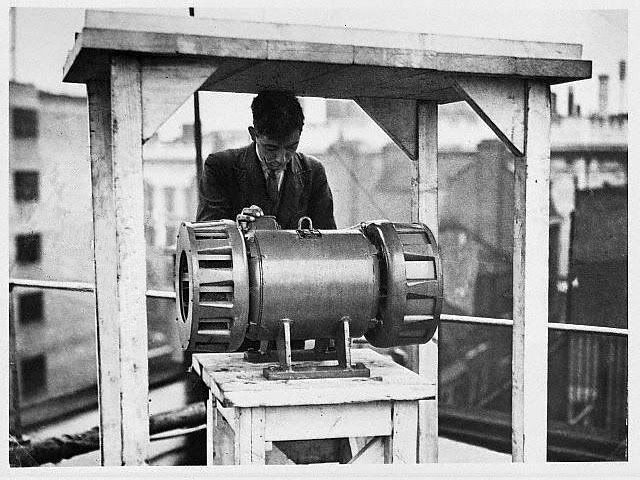
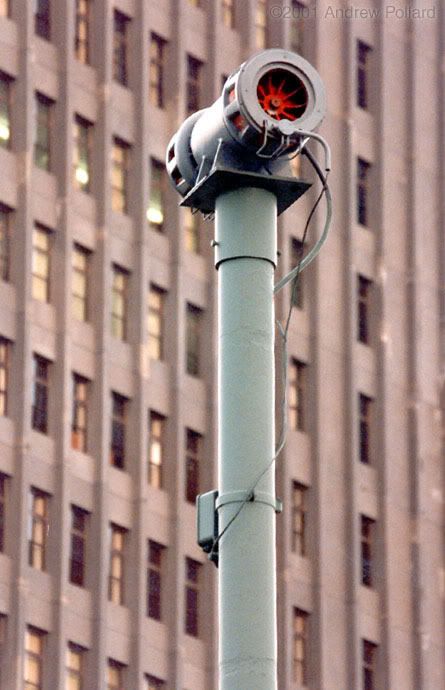
Both the Carter and the Federal are dwarfed by the apotheosis of all sirens, the ridiculous, majestic, and rather scary Chrysler Air Raid Siren. VictorySiren.com has a lot more information about this behemoth, but I shall outline a few of the more salient details for you, because it is just absolutely unbelievable:
This siren is powered by a 180-hp V8 hemi from Chrysler’s industrial engine line. It runs a compressor capable of pushing 2610 cubic feet of air a minute through a rotor spinning at a maximum of 4600 rpm and forcing it out of its six aluminum throats at four hundred miles an hour. Under optimum conditions it can be heard more than thirty miles away. At one hundred feet from the monster its output is 138 dB. It is the loudest sound signaling device ever built. It is also the size of a car and weighs over five thousand pounds.
Looking at the Chrysler siren and listening to clips of it being run is looking into another era. I can’t think of another object that exemplifies the American approach to the Cold War: it’s huge, massively powerful, well-designed, and completely paranoid.
And I want one.
Image credits: airraidsirens.com & Anthony Pollard on airraidsirens.com
Friday, June 5, 2009
Death in a cloud: the Bhopal disaster
Even a brief foray into researching the causes, immediate consequences, and long-term repercussions of the gas disaster at Bhopal in 1984 quickly demonstrates that in order to cover all the aspects of the event fully one would need to write a book, not a blog post. Since other people with access to primary sources have already done this for me, and I refer here to Ingrid Eckerman's fantastic The Bhopal Saga, I will try to avoid doing so, although this is going to be long.
Bhopal is the capital of the Indian state of Madhya Pradesh, located more or less in the middle of the country. It's the second-biggest city in the state, and is--or was--known as the City of Lakes for the multiple natural and man-made lakes in and around the city itself. Union Carbide India Limited (UCIL) had built a chemical manufacturing plant in East Bhopal City in 1969, the same year the ValuJet DC-9 plane was built, which was owned partly by Union Carbide Corporation (UCC) and partly by Indian authorities, although Union Carbide owned all the designs and processes used at the site.
UCIL Bhopal's main product was the insecticide carbaryl. Sold under the trademark Sevin, carbaryl is one of a group of chemicals called carbamates which happen to be cholinesterase inhibitors, meaning that they prevent the enzyme cholinesterase from breaking down the neurotransmitter acetylcholine and therefore do extremely unkind things to the human nervous system; without cholinesterase getting rid of the acetylcholine sitting around in synaptic clefts, the nerves controlling our muscles don't stop firing, causing neuromuscular paralysis and eventual death. So we can see that carbaryl and its relatives aren't necessarily something you want large quantities of in your back yard; however, much like methamphetamine, the process used to make this nasty substance is even more dangerous and poisonous than the substance itself. One particular compound required to make carbaryl at the Bhopal plant is methyl isocyanate, or MIC. MIC killed an unknown number of people, probably between 8,000 and 10,000, in and around Bhopal on the night of December 2-3, 1984--and continues to claim victims today, as survivors of the Bhopal disaster slowly succumb to exposure-related illnesses.
I cannot emphasize enough how absolutely nightmarish the Bhopal plant was--and is to this day--in terms of toxic chemicals. MIC will kill you, but so will chlorine, phosphene, methyl carbamyl chloride, monomethylamine, cyanuric acid, hydrogen chloride, and all the other multisyllabic substances involved in and resulting from the production of carbaryl. Over here in the States when we think of toxic chemicals Woburn and Love Canal and Valley of the Drums and Hinkley come to mind: what happened at Bhopal casts all the chemical accidents in the US far into the shade. Here was not a royal fellowship of death, but a treasure-house of it; an Aladdin's cave of substances inimical to human life and health, all sitting within a hundred yards of the poorest shanties of Bhopal.
In order to make Sevin, you need to combine chlorine and carbon monoxide to form phosgene, then combine that with monomethylamine and chloroform to produce methyl carbamyl chloride (and hydrogen chloride gas). You then break down the methyl carbamyl chloride into methyl isocyanate, which you react with alpha-naphthol and carbon tetrachloride to finally produce carbaryl. There is a separate process by which you can make carbaryl without using MIC, but it costs more, so it wasn't an option.
Now do that on an industrial scale with profit as the priority, with poorly maintained equipment, poorly trained or untrained workers, poorly trained or untrained supervisors ignorant of the physiological effects of the substances they were handling, and set your manufacturing plant within pebble-throwing distance of residential neighborhoods without telling the inhabitants what your process involves or what to do in a chemical-release emergency (other than that you make "medicine" for crops), and you’ve got UCIL’s operation at Bhopal to a T. UCIL did provide Bhopal hospitals with some resuscitation equipment, but provided no emergency procedures for gas-release incidents.
MIC, as a crucial ingredient in the carbaryl manufacturing process, was required in large amounts on the site. When the plant was built, UCIL only manufactured carbamate pesticides from concentrated ingredients shipped in from the US: however, in 1980, UCIL equipped the Bhopal plant with the necessary setup to manufacture it from chlorine (brought in from external suppliers) and carbon monoxide produced on-site. MIC was stored in two of three main tanks, designated 610, 611, and 619; the Union Carbide manual stated that only two of the tanks were to be used for storage at any given time, that the tanks' contents be refrigerated to five degrees centigrade or below and kept under a controlled pressure of nitrogen gas, and that the tanks and fittings should be made out of stainless steel and not any other alloy (including carbon steel).
The tanks were designed with a relief valve vent header (RVVH) which led directly to a vent gas scrubber (VGH) which bubbled the escaping gas through a solution of lye to neutralize it before burning it off from the plant's flare tower or releasing it from the stack. In the event of a tank reaching its pressurization limit (40 pounds per square inch over atmospheric pressure, or psig), a rupture disk would burst, a relief valve would open, and the gas would be released to the vent scrubber. As MIC reacts with water, a nitrogen pressurization system was built in to ensure the dry nitrogen atmosphere inside the tanks wouldn't become contaminated with moisture from the air: if a tank's pressure fell below 2 psig, nitrogen would be pumped into the tank through a connector to a second line running from tank to scrubber, the process vent header (PVH). We have at this point two main routes for gas to escape from any one of the three MIC storage tanks: the RVVH and the PVH.
Piping in the plant was prone to developing clogs due to corrosion or deposited salts from the chemicals running through them, and washing out of the pipes with water was a commonplace task. A barrier, called a slip-bind or slip-blind depending on your source, should have been inserted into the pipes in question to ensure water didn't escape the section being washed out. This very important safety procedure was apparently left out of the written instructions provided to workers for washing out the pipes, according to Eckerman, who cites the Union Research Group of Mumbai (Bombay)'s 1985 report, The role of management practices in the Bhopal gas leak disaster.
In addition to the incomplete procedure instructions, the Bhopal plant lacked a rather damning number of security measures that a similarly purposed US Union Carbide plant considered necessary for operation, contrary to UCC's initial insistence that Bhopal was run to the same standard as its stateside plants. Eckerman offers a table of the security features at UCC's plant in Virginia that were not available/implemented in Bhopal, including:
--Non-MIC carbaryl production process (patented by UCC)
--Storage of MIC only in small quantities, in small vessels, for short times
--Fully-computerized four-stage alarm system
--Monitoring of chemical inventory
--"Knock-down" tank to handle MIC overflows before they could be released
--Emergency VGS with extra capacity
--VGS and flare tower available at all times, not just when MIC was being produced
--Refrigeration with backup refrigeration system to keep MIC at -10 degrees C
--Exclusive stainless steel construction
--Location downwind, outside of town
--Siren/alarm system pointed outward and capable of alerting residents of town
In the initial years of the Bhopal plant's self-sufficient MIC/carbaryl production era, it was run by an American engineer who was committed to safety. In 1982, he was replaced with an Indian engineer educated in the States, directly subordinate to a financial controller most interested in reducing/controlling the company's losses. This is when it started down the garden path to hell, and the first few steps along that path were to screw up staffing/hiring policies for the MIC plant and fire a bunch of employees, as well as cutting down training from 6 months to 8 weeks--which, according to some of the workers, were barely sufficient to give them the necessary skills. When one worker complained about being asked to take on the role of a full-fledged operator after 5 weeks of training, he was apparently allowed to complete the final three.
On the night of the disaster, there were no trained engineers on the site. And this is not making Play-Doh or putting the lids on pies, this is life-and-death stuff they're dealing with.
Eckerman's list of malfunctioning, disconnected, or nonexistent safety systems at Bhopal reads like a disaster movie's build-up stage. Surely no one could have let this go on in real life? Surely all these systems could not be malfunctioning this badly at once? Didn't anyone care?
Probably they did, but it was more than their jobs were worth to complain. The Bhopal plant had been granted a license to produce something like 5,000 tons of pesticide a year. In point of fact they were selling around 2,000. People who knew the Indian market had asked that a smaller plant be built, but this had been bulldozed over by UCC, with the predictable result that Bhopal was run at a loss and the UCIL management was constantly trying to cut costs and raise profits: thus the staffing cuts, thus the replacement of stainless valving and pipes with carbon steel, thus the draining of the MIC refrigeration unit and the use of the system's freon in other plant operations. One after one after one, the systems that should have prevented Bhopal's disaster were deliberately shut down, either to save money or because they just weren't working right.
Unsurprisingly, there had been "warning" accidents in the months leading up to December 84. MIC exposure accidents, leaks of MIC, chlorine, monomethylamine, phosgene, and carbon tetrachloride (sometimes in combination); rather dreadfully, Eckerman mentions that "a journalist...had listened to the workers' discussions about the dangers at the factory--toxic gases, deadly leaks, and the likelihood of explosions. After having done some research, he started to write articles in the local press, warning of the hazards associated with the plant. His final article, which appeared just five months before the disaster, was titled 'Bhopal on the Brink of a Disaster.' No one took any notice. He also sent letters where he summarized the findings of his investigations to the Chief Minister and the Chief Justice of the Supreme Court, and requested them to close down the factory. He got no answer."
Tank 610, which would eventually kill something more than twenty thousand people, was causing problems long before the accident itself. Eckerman writes that on October 21, 1984, less than two months before the disaster, it could not be pressurized; managers switched to tank 611, more biddable, to continue Sevin production. Nobody bothered to find out why 610 misbehaved. On November 30 (or 26, depending on sources) nitro pressure in 611 fell, making them wonder what the hell was wrong with these here tanks in this here plant and causing an investigation that ended with the replacement of a faulty valve on tank 611--and the abandonment of 610. "Operators later told journalists that every time nitrogen was pumped in [to tank 610], it leaked out again through an unknown route."
Let's skip ahead, shall we? Tanks 619, 611 and the recalcitrant 610 are entombed in a concrete mound some distance from the Sevin unit and flare stack. On the night of the accident, the following conditions existed:
1) Tank temperatures were not being logged
2) The vent gas scrubber (VGS) was not in use (this does not entirely fit with some reports of the sodium hydroxide scrubber solution registering a temperature, on the morning after the accident, that indicated a reaction had taken place)
3) The refrigeration system on the MIC tanks was not in use and could not be activated as its refrigerant had been nicked for use elsewhere onsite
4) A slip bind was not used when the pipes were being washed
5) The concentration of chloroform in 610 was too high
6) The tank was not pressurized with nitrogen (or anything else)
7) The tank's high-temp alarm was not functioning
8) The evacuation tank (619) was not empty
There are several major reports covering the incident itself, which most people agree began with water washing of some of the pipelines of the plant. Supervisors on duty at the time were not familiar with the factory's complex maintenance procedures, and knew nothing about MIC or phosgene: in fact the supervisor was convinced that there could not be a leak when production of MIC had been stopped.
The 1988 Arthur D. Little Inc. report, which UCC used to support the sabotage theory, states the following:
"Shortly before the end of the second shift, at 10:20 p.m., the pressure in Tank 610 was reported to be at 2 psig. The shift change occurred at 10:45 p.m., and everything was normal until 11:30 p.m., at which time a small leak was reported downwind and in the area of the MIC production unit. The MIC supervisor said that he would deal with the leak after tea, which began at 12:15 a.m. The tea lasted until 12:40 a.m. at which time all was normal. At that point, the control room operator observed the pressure rise suddenly in Tank 610, and within minutes the indicator was off the gauge's scale. At 12:45 a.m., the safety valve on the tank opened, and gas came out of the stack of the vent gas scrubber. The operators ran to the tank and found it rumbling, and the concrete over the tank was cracking. The fire squad sprayed the stack to knock down the gas, and the reaction subsided an hour or so later. The workers claimed to have no idea as to why the pressure rose in the first instance. According to this account, the incident occurred suddenly and inexplicably."
This is at best disingenuous. Water--a considerable amount of it, thousands of pounds--entered tank 610, and there was evidence of an MIC leak before the main catastrophe that was going to be dealt with "after tea." The boy whose job it was to bring the control room operators their nice tea for their break noted that there was a seriously taut atmosphere and nobody for some reason actually took him up on his tea offer. This was uncharacteristic.
The thing about water and MIC is that they react like eighties movie teenagers and produce a hell of a lot of heat. They produce even more heat in the presence of iron, which would have been present in the contaminant water due to pipe corrosion (carbon steel was used in place of stainless to keep costs down). MIC is such an unstable chemical that it reacts with itself under the right circumstances, and in tank 610, it was gleefully doing so in an exothermic sort of way, creating more heat with every single atom undergoing change, and in a very short time this pressure exceeded the 40 psig tank rupture disk, releasing MIC and a bunch of other chemicals directly to the vent gas scrubber. Which would have meant something, had the VGS a) been working or b) been capable of handling a release of this magnitude.
Times for the various events occurring during the disaster vary. Here's a summary from Eckerman directly off Google Books, which contradicts the timeline Wikipedia presents:
20:30 (8:30 PM): Press in 610 noted as 2 psig. Operator told to wash out lines close to MIC tank(s). Presumably, not provably, operators failed to install slip-binds (due to incomplete instructions) and allowed water to flow freely through the piping of the relief valve vent header and/or the process valve vent header. Various accounts state that operators did not use slip-binds, that they noticed water was not coming out of bleeder lines and shut off the water flow, and that supervisors then ordered them to resume the flow.
22:00 (10:00 PM): Approximate time when water began to enter (presumably unpressurized) tank containing 42 tonnes of MIC minus refrigeration. Reaction begins.
22:30 (10:30 PM): one report states that workers told to use water to continue to clean lines (i.e. keep tap running) and that night shift would turn it off; new operators came on duty, poor bastards, and logged 610's pressure as 2 psi. Alternate reports state that shift change occurred at 10:45 or 11. Some reports mention throat and eye irritation from a MIC leak close to the area where the lines were being washed around 10:45.
23:00 (11:00 PM) One report marks the first report of an MIC leak by a field operator by the VGS; operator said later that the press was 2 psi, but in other reports is mentioned as saying that the 2 psi reading was 3 hours old.
23:30 (11:30 PM) Last transfer of MIC to the Sevin unit. Seems to have come from tank 610 not 611. In addition:
-'The operators on ground level noticed dirty water spilling from a higher level in the MIC structure and MIC in the atmosphere. The MIC and dirty water were coming out of a branch of the RVVH. The pressure safety valve had been removed and the open end of the RVVH branch line was not blinded.'
-'The operators found brownish water and steam coming out from a drain-cock eight yards off the ground. The supervisor recommended turning off the taps after the tea break. The team left for the staff cafeteria.'
The really telling point is 12:15 PM, when the transfer of MIC from tank 611 to the Sevin unit occurred, which UCC investigators concluded to be an attempt by MIC operators to remove water from the tank. We don't know how the water got in there: we just know it did, and while the Arthur D. Little company and UCC continue to maintain it was due to one or more disgruntled operators squirting water into the MIC tank (despite the fact that doing this would most likely kill him or her very horribly) rather than sheer incompetence, there is no conclusive evidence for the sabotage.
All the reports seem to agree that 12:15 is when things started to go very badly wrong. Pressure in tank 610 was rising through 30 psig and off the scale, which pegged at 55; when control room operators and supervisors ran to have a look at it, they found the tank moving, rumbling, cracking the concrete over it with its vibration and heat expansion, and so hot as to flash cooling water off into steam. One report states that the tank stood on end and fell back again, but did not burst. They ran like hell back to the control room and turned on the VGS system, but couldn't verify that it was working.
It was now 12:30, and clouds of lethal gas were spewing from the plant stack and spreading rapidly through Bhopal. Accounts differ on when the siren was sounded, anywhere from 12:15 to 1 AM, but it was shut off shortly thereafter. Attempts were made to knock down the gas release by spraying water at it, but the sprays couldn't reach high enough to make a difference. One worker was killed when he tried to climb the stack assembly and somehow shut off the release; he was almost immediately overcome by the gas and fell off, breaking several bones. By 1:30, workers were running for their lives: people who lived close to the plant were already dying.
Tank 610 continued to pour MIC and a host of other toxins into the night air until it was empty; some reports mention that the safety valve reclosed (as the pressure fell below 40 psig) around 2:30, and the emission stopped. By now 42 tonnes of deadly gas were flowing through Bhopal, blinding and choking people in their beds.
MIC is heavier than air; it hugs the ground, rolling downhill. The weather conditions on the night of the accident were as bad as they could be: a temperature inversion trapped the gases close to the ground, and there wasn't enough wind to blow the cloud away. There's been considerable controversy over the role played by hydrogen cyanide (HCN) in the deaths at Bhopal: MIC breaks down into HCN at high temperatures, and tank 610 may have reached sufficient temperatures to allow this reaction. Cyanide was found in the bodies of some Bhopal victims, and scientists have merrily argued about which of the many gases making up the lethal cloud was responsible for the deaths, which strikes me as missing the point.
The people of Bhopal were awakened by acute pain in their eyes, noses, and throats; coughing uncontrollably, blinded by tears, vomiting, they fled into the streets to escape. People were trampled to death in the rush to evacuate. Mothers lost their babies when they were literally pulled from their arms by the force of people struggling to push through the crowd. Because MIC is so heavy, concentrations of it were worst right over the ground; the shortest people--children--got the heaviest doses. Many of those who did not die at once succumbed at the grossly unprepared hospitals, drowning as pulmonary edema filled their lungs with fluid or suffocating as their devastated bronchi went into intractable spasm. Doctors had no idea what was responsible for the injuries; eye drops and cough medicine were handed out and glucose drips set up. Bodies were everywhere, piled on one another, littering the streets.
Dawn brought with it evidence of the extent of the disaster. Thousands of bodies--of livestock as well as people--lay where they had fallen. Within a few days every tree in Bhopal lost its leaves, and the grass turned yellow: a blight of biblical proportions. Police trucks carried bodies to be dumped in the river; others were stacked into funeral pyres. Official procedure for identifying the dead was left behind in the rush to clear the city of the dead; we don't know how many people died that night, but initial reports listed the death toll at over two thousand. That figure jumped to 8,000 and then to 10,000 as more and more died of their injuries. All in all, UCIL killed more than twenty thousand people with one accident.
In the wake of the disaster, UCC was faced not only with attempting to address the devastating leak that had occurred, but with preventing another leak. Tonnes of MIC still remained in the other holding tanks, and it was determined that the thing to do was to convert this into Sevin as soon as possible. "Operation Faith" was conducted on December 16, but this time rigorous safety measures were in place and the inhabitants--remaining inhabitants--of Bhopal were evacuated prior to the procedure. Bhopal residents had absolutely no trust left for the authorities; everyone who could fled the city with all their belongings.
It is beyond the scope of this write-up to cover the reaction to Bhopal, or the years which followed. Suffice it to say that this must not be forgotten, that the rest of the world must know about it, tell the next generation what happened. Those who died at Bhopal mattered, and the grossly negligent maintenance and staffing of the UCIL plant that killed them also matters. Remembering Bhopal is remembering that accidents like this can happen, and that the corporations responsible for accidents must make preventing such accidents their priority; that profit does not trump human lives, and that decisions made in a boardroom affect the everyday existence of hundreds of thousands on the other side of the world.
And that's what went wrong.
Information in this post was taken from the following sources:
Eckerman, Ingrid (2004). The Bhopal Saga — Causes and Consequences of the World's Largest Industrial Disaster. India: Universities Press. ISBN 81-7371-515-7. Available via Google Books.
Kalelkar AS, Little AD. (1998) Investigation of Large-magnitude incidents: Bhopal as a Case Study..PDF available. London: The Institution of Chemical Engineers Conference on Preventing Major Chemical Accidents (Arthur D. Little Report)
Labunska I, Stephenson A, Brigden K, Stringer R, Santillo D, Johnston P.A. (1999). The Bhopal Legacy. Toxic contaminants at the former Union Carbide factory site,Bhopal, India: 15 years after the Bhopal accident. PDF available. Greenpeace Research Laboratories, Department of Biological Sciences, University of Exeter, Exeter UK
Stringer R, Labunska I, Brigden K, Santillo D. (2002). "Chemical Stockpiles at Union Carbide India Limited in Bhopal: An investigation". Greenpeace Research Laboratories. PDF available.
Bhopal is the capital of the Indian state of Madhya Pradesh, located more or less in the middle of the country. It's the second-biggest city in the state, and is--or was--known as the City of Lakes for the multiple natural and man-made lakes in and around the city itself. Union Carbide India Limited (UCIL) had built a chemical manufacturing plant in East Bhopal City in 1969, the same year the ValuJet DC-9 plane was built, which was owned partly by Union Carbide Corporation (UCC) and partly by Indian authorities, although Union Carbide owned all the designs and processes used at the site.
UCIL Bhopal's main product was the insecticide carbaryl. Sold under the trademark Sevin, carbaryl is one of a group of chemicals called carbamates which happen to be cholinesterase inhibitors, meaning that they prevent the enzyme cholinesterase from breaking down the neurotransmitter acetylcholine and therefore do extremely unkind things to the human nervous system; without cholinesterase getting rid of the acetylcholine sitting around in synaptic clefts, the nerves controlling our muscles don't stop firing, causing neuromuscular paralysis and eventual death. So we can see that carbaryl and its relatives aren't necessarily something you want large quantities of in your back yard; however, much like methamphetamine, the process used to make this nasty substance is even more dangerous and poisonous than the substance itself. One particular compound required to make carbaryl at the Bhopal plant is methyl isocyanate, or MIC. MIC killed an unknown number of people, probably between 8,000 and 10,000, in and around Bhopal on the night of December 2-3, 1984--and continues to claim victims today, as survivors of the Bhopal disaster slowly succumb to exposure-related illnesses.
I cannot emphasize enough how absolutely nightmarish the Bhopal plant was--and is to this day--in terms of toxic chemicals. MIC will kill you, but so will chlorine, phosphene, methyl carbamyl chloride, monomethylamine, cyanuric acid, hydrogen chloride, and all the other multisyllabic substances involved in and resulting from the production of carbaryl. Over here in the States when we think of toxic chemicals Woburn and Love Canal and Valley of the Drums and Hinkley come to mind: what happened at Bhopal casts all the chemical accidents in the US far into the shade. Here was not a royal fellowship of death, but a treasure-house of it; an Aladdin's cave of substances inimical to human life and health, all sitting within a hundred yards of the poorest shanties of Bhopal.
In order to make Sevin, you need to combine chlorine and carbon monoxide to form phosgene, then combine that with monomethylamine and chloroform to produce methyl carbamyl chloride (and hydrogen chloride gas). You then break down the methyl carbamyl chloride into methyl isocyanate, which you react with alpha-naphthol and carbon tetrachloride to finally produce carbaryl. There is a separate process by which you can make carbaryl without using MIC, but it costs more, so it wasn't an option.
Now do that on an industrial scale with profit as the priority, with poorly maintained equipment, poorly trained or untrained workers, poorly trained or untrained supervisors ignorant of the physiological effects of the substances they were handling, and set your manufacturing plant within pebble-throwing distance of residential neighborhoods without telling the inhabitants what your process involves or what to do in a chemical-release emergency (other than that you make "medicine" for crops), and you’ve got UCIL’s operation at Bhopal to a T. UCIL did provide Bhopal hospitals with some resuscitation equipment, but provided no emergency procedures for gas-release incidents.
MIC, as a crucial ingredient in the carbaryl manufacturing process, was required in large amounts on the site. When the plant was built, UCIL only manufactured carbamate pesticides from concentrated ingredients shipped in from the US: however, in 1980, UCIL equipped the Bhopal plant with the necessary setup to manufacture it from chlorine (brought in from external suppliers) and carbon monoxide produced on-site. MIC was stored in two of three main tanks, designated 610, 611, and 619; the Union Carbide manual stated that only two of the tanks were to be used for storage at any given time, that the tanks' contents be refrigerated to five degrees centigrade or below and kept under a controlled pressure of nitrogen gas, and that the tanks and fittings should be made out of stainless steel and not any other alloy (including carbon steel).
The tanks were designed with a relief valve vent header (RVVH) which led directly to a vent gas scrubber (VGH) which bubbled the escaping gas through a solution of lye to neutralize it before burning it off from the plant's flare tower or releasing it from the stack. In the event of a tank reaching its pressurization limit (40 pounds per square inch over atmospheric pressure, or psig), a rupture disk would burst, a relief valve would open, and the gas would be released to the vent scrubber. As MIC reacts with water, a nitrogen pressurization system was built in to ensure the dry nitrogen atmosphere inside the tanks wouldn't become contaminated with moisture from the air: if a tank's pressure fell below 2 psig, nitrogen would be pumped into the tank through a connector to a second line running from tank to scrubber, the process vent header (PVH). We have at this point two main routes for gas to escape from any one of the three MIC storage tanks: the RVVH and the PVH.
Piping in the plant was prone to developing clogs due to corrosion or deposited salts from the chemicals running through them, and washing out of the pipes with water was a commonplace task. A barrier, called a slip-bind or slip-blind depending on your source, should have been inserted into the pipes in question to ensure water didn't escape the section being washed out. This very important safety procedure was apparently left out of the written instructions provided to workers for washing out the pipes, according to Eckerman, who cites the Union Research Group of Mumbai (Bombay)'s 1985 report, The role of management practices in the Bhopal gas leak disaster.
In addition to the incomplete procedure instructions, the Bhopal plant lacked a rather damning number of security measures that a similarly purposed US Union Carbide plant considered necessary for operation, contrary to UCC's initial insistence that Bhopal was run to the same standard as its stateside plants. Eckerman offers a table of the security features at UCC's plant in Virginia that were not available/implemented in Bhopal, including:
--Non-MIC carbaryl production process (patented by UCC)
--Storage of MIC only in small quantities, in small vessels, for short times
--Fully-computerized four-stage alarm system
--Monitoring of chemical inventory
--"Knock-down" tank to handle MIC overflows before they could be released
--Emergency VGS with extra capacity
--VGS and flare tower available at all times, not just when MIC was being produced
--Refrigeration with backup refrigeration system to keep MIC at -10 degrees C
--Exclusive stainless steel construction
--Location downwind, outside of town
--Siren/alarm system pointed outward and capable of alerting residents of town
In the initial years of the Bhopal plant's self-sufficient MIC/carbaryl production era, it was run by an American engineer who was committed to safety. In 1982, he was replaced with an Indian engineer educated in the States, directly subordinate to a financial controller most interested in reducing/controlling the company's losses. This is when it started down the garden path to hell, and the first few steps along that path were to screw up staffing/hiring policies for the MIC plant and fire a bunch of employees, as well as cutting down training from 6 months to 8 weeks--which, according to some of the workers, were barely sufficient to give them the necessary skills. When one worker complained about being asked to take on the role of a full-fledged operator after 5 weeks of training, he was apparently allowed to complete the final three.
On the night of the disaster, there were no trained engineers on the site. And this is not making Play-Doh or putting the lids on pies, this is life-and-death stuff they're dealing with.
Eckerman's list of malfunctioning, disconnected, or nonexistent safety systems at Bhopal reads like a disaster movie's build-up stage. Surely no one could have let this go on in real life? Surely all these systems could not be malfunctioning this badly at once? Didn't anyone care?
Probably they did, but it was more than their jobs were worth to complain. The Bhopal plant had been granted a license to produce something like 5,000 tons of pesticide a year. In point of fact they were selling around 2,000. People who knew the Indian market had asked that a smaller plant be built, but this had been bulldozed over by UCC, with the predictable result that Bhopal was run at a loss and the UCIL management was constantly trying to cut costs and raise profits: thus the staffing cuts, thus the replacement of stainless valving and pipes with carbon steel, thus the draining of the MIC refrigeration unit and the use of the system's freon in other plant operations. One after one after one, the systems that should have prevented Bhopal's disaster were deliberately shut down, either to save money or because they just weren't working right.
Unsurprisingly, there had been "warning" accidents in the months leading up to December 84. MIC exposure accidents, leaks of MIC, chlorine, monomethylamine, phosgene, and carbon tetrachloride (sometimes in combination); rather dreadfully, Eckerman mentions that "a journalist...had listened to the workers' discussions about the dangers at the factory--toxic gases, deadly leaks, and the likelihood of explosions. After having done some research, he started to write articles in the local press, warning of the hazards associated with the plant. His final article, which appeared just five months before the disaster, was titled 'Bhopal on the Brink of a Disaster.' No one took any notice. He also sent letters where he summarized the findings of his investigations to the Chief Minister and the Chief Justice of the Supreme Court, and requested them to close down the factory. He got no answer."
Tank 610, which would eventually kill something more than twenty thousand people, was causing problems long before the accident itself. Eckerman writes that on October 21, 1984, less than two months before the disaster, it could not be pressurized; managers switched to tank 611, more biddable, to continue Sevin production. Nobody bothered to find out why 610 misbehaved. On November 30 (or 26, depending on sources) nitro pressure in 611 fell, making them wonder what the hell was wrong with these here tanks in this here plant and causing an investigation that ended with the replacement of a faulty valve on tank 611--and the abandonment of 610. "Operators later told journalists that every time nitrogen was pumped in [to tank 610], it leaked out again through an unknown route."
Let's skip ahead, shall we? Tanks 619, 611 and the recalcitrant 610 are entombed in a concrete mound some distance from the Sevin unit and flare stack. On the night of the accident, the following conditions existed:
1) Tank temperatures were not being logged
2) The vent gas scrubber (VGS) was not in use (this does not entirely fit with some reports of the sodium hydroxide scrubber solution registering a temperature, on the morning after the accident, that indicated a reaction had taken place)
3) The refrigeration system on the MIC tanks was not in use and could not be activated as its refrigerant had been nicked for use elsewhere onsite
4) A slip bind was not used when the pipes were being washed
5) The concentration of chloroform in 610 was too high
6) The tank was not pressurized with nitrogen (or anything else)
7) The tank's high-temp alarm was not functioning
8) The evacuation tank (619) was not empty
There are several major reports covering the incident itself, which most people agree began with water washing of some of the pipelines of the plant. Supervisors on duty at the time were not familiar with the factory's complex maintenance procedures, and knew nothing about MIC or phosgene: in fact the supervisor was convinced that there could not be a leak when production of MIC had been stopped.
The 1988 Arthur D. Little Inc. report, which UCC used to support the sabotage theory, states the following:
"Shortly before the end of the second shift, at 10:20 p.m., the pressure in Tank 610 was reported to be at 2 psig. The shift change occurred at 10:45 p.m., and everything was normal until 11:30 p.m., at which time a small leak was reported downwind and in the area of the MIC production unit. The MIC supervisor said that he would deal with the leak after tea, which began at 12:15 a.m. The tea lasted until 12:40 a.m. at which time all was normal. At that point, the control room operator observed the pressure rise suddenly in Tank 610, and within minutes the indicator was off the gauge's scale. At 12:45 a.m., the safety valve on the tank opened, and gas came out of the stack of the vent gas scrubber. The operators ran to the tank and found it rumbling, and the concrete over the tank was cracking. The fire squad sprayed the stack to knock down the gas, and the reaction subsided an hour or so later. The workers claimed to have no idea as to why the pressure rose in the first instance. According to this account, the incident occurred suddenly and inexplicably."
This is at best disingenuous. Water--a considerable amount of it, thousands of pounds--entered tank 610, and there was evidence of an MIC leak before the main catastrophe that was going to be dealt with "after tea." The boy whose job it was to bring the control room operators their nice tea for their break noted that there was a seriously taut atmosphere and nobody for some reason actually took him up on his tea offer. This was uncharacteristic.
The thing about water and MIC is that they react like eighties movie teenagers and produce a hell of a lot of heat. They produce even more heat in the presence of iron, which would have been present in the contaminant water due to pipe corrosion (carbon steel was used in place of stainless to keep costs down). MIC is such an unstable chemical that it reacts with itself under the right circumstances, and in tank 610, it was gleefully doing so in an exothermic sort of way, creating more heat with every single atom undergoing change, and in a very short time this pressure exceeded the 40 psig tank rupture disk, releasing MIC and a bunch of other chemicals directly to the vent gas scrubber. Which would have meant something, had the VGS a) been working or b) been capable of handling a release of this magnitude.
Times for the various events occurring during the disaster vary. Here's a summary from Eckerman directly off Google Books, which contradicts the timeline Wikipedia presents:
20:30 (8:30 PM): Press in 610 noted as 2 psig. Operator told to wash out lines close to MIC tank(s). Presumably, not provably, operators failed to install slip-binds (due to incomplete instructions) and allowed water to flow freely through the piping of the relief valve vent header and/or the process valve vent header. Various accounts state that operators did not use slip-binds, that they noticed water was not coming out of bleeder lines and shut off the water flow, and that supervisors then ordered them to resume the flow.
22:00 (10:00 PM): Approximate time when water began to enter (presumably unpressurized) tank containing 42 tonnes of MIC minus refrigeration. Reaction begins.
22:30 (10:30 PM): one report states that workers told to use water to continue to clean lines (i.e. keep tap running) and that night shift would turn it off; new operators came on duty, poor bastards, and logged 610's pressure as 2 psi. Alternate reports state that shift change occurred at 10:45 or 11. Some reports mention throat and eye irritation from a MIC leak close to the area where the lines were being washed around 10:45.
23:00 (11:00 PM) One report marks the first report of an MIC leak by a field operator by the VGS; operator said later that the press was 2 psi, but in other reports is mentioned as saying that the 2 psi reading was 3 hours old.
23:30 (11:30 PM) Last transfer of MIC to the Sevin unit. Seems to have come from tank 610 not 611. In addition:
-'The operators on ground level noticed dirty water spilling from a higher level in the MIC structure and MIC in the atmosphere. The MIC and dirty water were coming out of a branch of the RVVH. The pressure safety valve had been removed and the open end of the RVVH branch line was not blinded.'
-'The operators found brownish water and steam coming out from a drain-cock eight yards off the ground. The supervisor recommended turning off the taps after the tea break. The team left for the staff cafeteria.'
The really telling point is 12:15 PM, when the transfer of MIC from tank 611 to the Sevin unit occurred, which UCC investigators concluded to be an attempt by MIC operators to remove water from the tank. We don't know how the water got in there: we just know it did, and while the Arthur D. Little company and UCC continue to maintain it was due to one or more disgruntled operators squirting water into the MIC tank (despite the fact that doing this would most likely kill him or her very horribly) rather than sheer incompetence, there is no conclusive evidence for the sabotage.
All the reports seem to agree that 12:15 is when things started to go very badly wrong. Pressure in tank 610 was rising through 30 psig and off the scale, which pegged at 55; when control room operators and supervisors ran to have a look at it, they found the tank moving, rumbling, cracking the concrete over it with its vibration and heat expansion, and so hot as to flash cooling water off into steam. One report states that the tank stood on end and fell back again, but did not burst. They ran like hell back to the control room and turned on the VGS system, but couldn't verify that it was working.
It was now 12:30, and clouds of lethal gas were spewing from the plant stack and spreading rapidly through Bhopal. Accounts differ on when the siren was sounded, anywhere from 12:15 to 1 AM, but it was shut off shortly thereafter. Attempts were made to knock down the gas release by spraying water at it, but the sprays couldn't reach high enough to make a difference. One worker was killed when he tried to climb the stack assembly and somehow shut off the release; he was almost immediately overcome by the gas and fell off, breaking several bones. By 1:30, workers were running for their lives: people who lived close to the plant were already dying.
Tank 610 continued to pour MIC and a host of other toxins into the night air until it was empty; some reports mention that the safety valve reclosed (as the pressure fell below 40 psig) around 2:30, and the emission stopped. By now 42 tonnes of deadly gas were flowing through Bhopal, blinding and choking people in their beds.
MIC is heavier than air; it hugs the ground, rolling downhill. The weather conditions on the night of the accident were as bad as they could be: a temperature inversion trapped the gases close to the ground, and there wasn't enough wind to blow the cloud away. There's been considerable controversy over the role played by hydrogen cyanide (HCN) in the deaths at Bhopal: MIC breaks down into HCN at high temperatures, and tank 610 may have reached sufficient temperatures to allow this reaction. Cyanide was found in the bodies of some Bhopal victims, and scientists have merrily argued about which of the many gases making up the lethal cloud was responsible for the deaths, which strikes me as missing the point.
The people of Bhopal were awakened by acute pain in their eyes, noses, and throats; coughing uncontrollably, blinded by tears, vomiting, they fled into the streets to escape. People were trampled to death in the rush to evacuate. Mothers lost their babies when they were literally pulled from their arms by the force of people struggling to push through the crowd. Because MIC is so heavy, concentrations of it were worst right over the ground; the shortest people--children--got the heaviest doses. Many of those who did not die at once succumbed at the grossly unprepared hospitals, drowning as pulmonary edema filled their lungs with fluid or suffocating as their devastated bronchi went into intractable spasm. Doctors had no idea what was responsible for the injuries; eye drops and cough medicine were handed out and glucose drips set up. Bodies were everywhere, piled on one another, littering the streets.
Dawn brought with it evidence of the extent of the disaster. Thousands of bodies--of livestock as well as people--lay where they had fallen. Within a few days every tree in Bhopal lost its leaves, and the grass turned yellow: a blight of biblical proportions. Police trucks carried bodies to be dumped in the river; others were stacked into funeral pyres. Official procedure for identifying the dead was left behind in the rush to clear the city of the dead; we don't know how many people died that night, but initial reports listed the death toll at over two thousand. That figure jumped to 8,000 and then to 10,000 as more and more died of their injuries. All in all, UCIL killed more than twenty thousand people with one accident.
In the wake of the disaster, UCC was faced not only with attempting to address the devastating leak that had occurred, but with preventing another leak. Tonnes of MIC still remained in the other holding tanks, and it was determined that the thing to do was to convert this into Sevin as soon as possible. "Operation Faith" was conducted on December 16, but this time rigorous safety measures were in place and the inhabitants--remaining inhabitants--of Bhopal were evacuated prior to the procedure. Bhopal residents had absolutely no trust left for the authorities; everyone who could fled the city with all their belongings.
It is beyond the scope of this write-up to cover the reaction to Bhopal, or the years which followed. Suffice it to say that this must not be forgotten, that the rest of the world must know about it, tell the next generation what happened. Those who died at Bhopal mattered, and the grossly negligent maintenance and staffing of the UCIL plant that killed them also matters. Remembering Bhopal is remembering that accidents like this can happen, and that the corporations responsible for accidents must make preventing such accidents their priority; that profit does not trump human lives, and that decisions made in a boardroom affect the everyday existence of hundreds of thousands on the other side of the world.
And that's what went wrong.
Information in this post was taken from the following sources:
Eckerman, Ingrid (2004). The Bhopal Saga — Causes and Consequences of the World's Largest Industrial Disaster. India: Universities Press. ISBN 81-7371-515-7. Available via Google Books.
Kalelkar AS, Little AD. (1998) Investigation of Large-magnitude incidents: Bhopal as a Case Study..PDF available. London: The Institution of Chemical Engineers Conference on Preventing Major Chemical Accidents (Arthur D. Little Report)
Labunska I, Stephenson A, Brigden K, Stringer R, Santillo D, Johnston P.A. (1999). The Bhopal Legacy. Toxic contaminants at the former Union Carbide factory site,Bhopal, India: 15 years after the Bhopal accident. PDF available. Greenpeace Research Laboratories, Department of Biological Sciences, University of Exeter, Exeter UK
Stringer R, Labunska I, Brigden K, Santillo D. (2002). "Chemical Stockpiles at Union Carbide India Limited in Bhopal: An investigation". Greenpeace Research Laboratories. PDF available.
Wednesday, June 3, 2009
What warning label where? ValuJet Flight 592
Unless you spend a great deal of time in a chemistry lab or dabble in rocket propulsion, the concept of oxygen as a dangerous substance may not be immediately self-evident. Nor does the word “oxidizer” carry the same weight as, say, “explosive.”
Pressurized pure oxygen was responsible for the vicious rapidity of the flame propagation in the Apollo 1 launchpad fire. More recently, oxygen and the chemical reaction responsible for producing it killed a hundred and ten people and dug a crater in the bedrock of the Florida Everglades.
I was sixteen when ValuJet Flight 592 slammed into the swamp at over five hundred miles an hour. I remember hearing about it, and watching the pictures of the recovery effort on the news. They didn’t find many big pieces of anything, including people; a small amount of human tissue was strongly suspected of belonging to the first officer, but it wasn’t in any condition to provide proof. Eventually 68 of the 110 people aboard were identified. They’re still there, the victims of Flight 592. They’re in the mud, in the cracks in the bedrock, in the murky water.
ValuJet was one of the first low-cost airlines offering cheap fares with no frills, and its fleet was made up of aging McDonnell-Douglas DC-9 and MD-80 jets. It had a contract with several maintenance and repair facilities around the country to perform service and overhauls on its planes, three of which were qualified to provide heavy maintenance. One of these, located in Miami, was SabreTech.
The accident itself
On the afternoon of May 11, 1996, a Douglas DC-9-32, N904VJ, owned and operated by ValuJet Airlines, Inc. as flight 592, took off from Miami International Airport on a flight to William B. Hartsfield Atlanta International. Six minutes later, the crew requested an immediate return to Miami due to smoke in the cockpit and cabin. The interphone connecting the cabin and cockpit wasn’t working (one of many equipment failures plaguing ValuJet planes); contrary to regulations, the flight attendants had to open the door to communicate with the pilots, introducing smoke to the cockpit. Shouts in the background of “fire, fire, fire, fire” can be heard on the recording, coming from the cabin. Just before 2:14 PM, ten minutes after takeoff, the plane vanished from Miami radar.
When emergency personnel arrived at the scene they faced considerable challenges: the wreck site was a quarter-mile from the nearest road, located in a seven-foot-deep swamp in which visibility was approximately nil, and the plane had hit the ground with such force as to render it into lots of tiny little bits, surrounded by mud, sawgrass, and alligators. Nevertheless, through a very great deal of hard work on the part of a large number of searchers and the cooperation of various law enforcement agencies, enough fragments of wreckage were found, identified, and reassembled into a model of the accident aircraft to begin to offer some answers into the cause of the wreck.
Investigators knew that a fire had played some part in the disaster, although where it was located or what had caused it was still unknown. As they pieced together the shreds of the DC-9 fire damage began to appear, located in what had been the forward cargo bay of the plane. Wiring controlling the aircraft’s flight surfaces and engine thrust was burnt through, indicating that the crew had most likely lost control of the plane as the systems died. When the CVR and FDR were finally recovered, the data indicated that progressive control system failure following an initial anomaly had occurred, and this was corroborated by the discovery that the left-side floorboards had melted and collapsed, affecting the captain’s control cables.
Checking with SabreTech and ValuJet records, they found that the forward cargo bay on the accident flight had contained five boxes of "company materials" (COMAT) and a couple of landing-gear wheels, none of which theoretically should have started a fire; however, further investigation revealed that the contents of the COMAT boxes were listed as "Oxy Cannisters [sic] 'Empty'," at which point they began to realize that in all likelihood this had been a completely preventable tragedy.
Emergency oxygen on board commercial passenger airliners is provided not by pressurized oxygen tanks but by chemical oxygen generators. These are cylinders about the size of a tennis-ball can, containing a mixture of sodium chlorate, barium peroxide, and potassium perchlorate. If the cabin loses pressure the compartments holding these things will open, dropping those dinky plastic oxygen masks over the passengers’ heads; pulling on the masks tugs on a lanyard attached to the oxygen generator’s firing pin, setting off a little percussion cap. This produces enough energy to trigger the chemical reaction within the generator core whereby the sodium chlorate is reduced to sodium chloride and oxygen is given off in gas form; it’s a nice, elegant little reaction which does away with the need to carry dangerous pressurized tanks over passengers’ heads and allows the oxygen system to take up very little space.
However, this reaction is exothermic. Powerfully so. An activated oxygen generator is capable of reaching temperatures of five hundred degrees while it’s working; for this reason it is vitally important that when you are carrying these things around or storing them you put a safety cap over the firing pin, preventing them from being triggered by mistake. This would seem to be common sense.
The investigation into ValuJet’s and SabreTech’s shipping and labeling policies and history revealed that not only were the oxygen generators being carried in the accident aircraft’s forward cargo bay not empty or secured for transportation, they were also not appropriately marked, had not been identified as hazardous materials, and were in fact not recognized by maintenance personnel as dangerous. They had been stacked in the cardboard boxes without safety caps, covered with a layer of bubble wrap, and shoved into the cargo bay along with the spare wheels. Apparently these generators had been removed from ValuJet planes when they passed their expiration dates, then left sitting around minus safety caps for several weeks until personnel were told to clean up the storage rooms for an upcoming site visit/audit, whereupon they were packed into boxes–still sans safety caps, as apparently these were unavailable–and sat around some more until someone finally asked if he should send them to Atlanta and was told “okay, that sounds good to me.”
According to the stock clerk, he identified the generators as “empty canisters” because none of the mechanics had talked with him about what they were or what state they were in, and that he had just found the boxes sitting on the floor of the hold area one morning. He said he did not know what the items were. Nobody had bothered to read the ‘reason for removal’ tags on the generators.
Tests on similar oxygen generators in a mockup of the DC-9’s forward cargo bay demonstrated that not only was an activated generator in a cardboard box capable of starting a fire, within ten minutes of ignition the temperature on the ceiling of the cargo bay was reaching temperatures over 3,000 degrees F. Aluminum’s melting point is around 1,220 F, higher or lower depending on the alloy. There was no way the floor of the passenger compartment could withstand this kind of fire.
The forward cargo bay was supposedly fire-resistant due to its lack of ventilation, which would cause a standard fire to use up the available oxygen and burn out fairly quickly. However, not only did the oxygen generators reach ignition temperature, they also, well, generated oxygen, which fed the fire. Regulations didn’t require smoke/fire detection systems in cargo compartments of this type, nor any kind of fire suppression systems.
Going back to the battered black boxes, investigators found that at 2:10 pm, six minutes after takeoff and right before all the electrical systems went to hell, an unidentified sound was recorded on the CVR. According to the FDR, just before the sound, the airplane was climbing through 10,634 feet at 260 knots indicated airspeed. Simultaneous with the noise on the CVR, the FDR recorded a 33-knot decrease in indicated airspeed and a pressure altitude drop of 817 feet. The FDR airspeed and altitude data returned to normal values within 4 seconds. Altitude and speed data recorded on the FDR are based on readings from the static port on the left-hand side of the DC-9 (a small port open to the atmosphere, which registers the pressure of the outside air on the plane as it moves).
An increase of 69 pounds per square foot (psf) sensed by a static pressure sensor on the airplane would result in an 817-foot decrease in altitude (as recorded by the FDR). Further, an increase of 69 psf in static pressure would result in a decrease in airspeed of about 40 knots, which is consistent with a curve fit of the airspeed decrease recorded on the FDR. The brief anomaly in the readings is, therefore, consistent with a momentary jump in the static system pressure. What would cause this sudden pressure increase?
How about a bursting landing-gear tire in the forward cargo bay?
Tests showed that in fact one of the tires recovered from the crash site which was torn open could have produced this level of pressure increase as it blew during the fire. By calculating the length of time it took for the fire to heat up the tire to bursting point in a recreation of the cargo bay, investigators could work out roughly when the fire began–possibly as late as during the airplane’s takeoff roll. Almost immediately after the tire blew, the wiring bundles running under the cabin floor burned through and the crew began to lose control of the plane, as the fire ate its way into the passenger compartment.
Imagine it. You’re in a plane that was built the year Neil Armstrong walked on the moon, bound for Atlanta on a sunny afternoon in May. You’ve been delayed in departure for over an hour and you are probably overjoyed when the damn thing takes off; as usual, you’re looking out the window at the runway flashing by and wondering if the plane is going to make it into the air at all–and, as usual, it does, and the vast hand of inertia presses your butt into your seat as the captain climbs through two thousand feet and begins to bank left. If you’re on the left side of the cabin you can look down and see Miami lazily baking in the afternoon sun.
Then you smell something funny. Something burning. It’s coming from the front of the cabin, and it’s getting worse. People are starting to sound panicky up there, and now there’s flames, visible flames dancing on the floor, and you are in an airplane that is on fire. Perhaps the floor’s gone soft and is beginning to sag, too hot to touch; the carpet’s melting. Flames lick at the seats, and people have begun to scream; and now there’s smoke, black smoke rolling along the ceiling. You can’t get out: there’s nowhere to go. The flight attendants try to alert the cockpit, but the interphone isn’t working. They bang on the door and finally open it–which you absolutely must not do in a case of smoke in the cabin. The oxygen masks have not dropped. By now the crew are losing control and have radioed for an emergency return to Miami, and people are burning alive as the fire spreads and the temperature in the cabin soars. Without control over the engines, flaps, slats, ailerons, or rudder, Flight 592 is helplessly plummeting toward the ground.
Probably the passengers and crew were unconscious by the time of impact, overcome by heat and toxic fumes. Probably none of them were able to see the ground rushing up at them, or feel themselves blown apart by the force of the crash. Had any number of people done their jobs right, it wouldn’t have happened at all; had the SabreTech mechanics properly labeled the generators when they removed them from the aircraft, had they activated them and safely expended the cores as the manufacturer’s and other airlines’ procedures required before shipping them as hazardous materials, this would not have happened. ValuJet and SabreTech had received several warnings as a result of negligent or insufficient safety oversight, and despite the obvious necessity had not made changes to their operating procedures that would have prevented the accident from occurring.
ValuJet never recovered from the crash. In 1997 it merged with low-cost carrier AirTran Airways, and discarded the ValuJet name entirely. Today AirTran’s fleet is among the youngest in the field, with an average age of less than 4 years; in July 09 it will be serving 62 locations in the States. Since ValuJet bought AirTran and took on the AirTran name, the airline has not experienced any fatal accidents and is generally considered among the safest commercial airlines in the country. Lessons learned from the crash wrote new rules regarding oxygen generator disposal, COMAT and hazardous material transportation, compliance inspections, fire detection and suppression systems, and cargo bay design. Flight 592 could have been prevented; the changes made in the industry as a result of the tragedy will hopefully prevent anything like it from happening again.
Information in this post is taken from the official NTSB report.
Pressurized pure oxygen was responsible for the vicious rapidity of the flame propagation in the Apollo 1 launchpad fire. More recently, oxygen and the chemical reaction responsible for producing it killed a hundred and ten people and dug a crater in the bedrock of the Florida Everglades.
I was sixteen when ValuJet Flight 592 slammed into the swamp at over five hundred miles an hour. I remember hearing about it, and watching the pictures of the recovery effort on the news. They didn’t find many big pieces of anything, including people; a small amount of human tissue was strongly suspected of belonging to the first officer, but it wasn’t in any condition to provide proof. Eventually 68 of the 110 people aboard were identified. They’re still there, the victims of Flight 592. They’re in the mud, in the cracks in the bedrock, in the murky water.
ValuJet was one of the first low-cost airlines offering cheap fares with no frills, and its fleet was made up of aging McDonnell-Douglas DC-9 and MD-80 jets. It had a contract with several maintenance and repair facilities around the country to perform service and overhauls on its planes, three of which were qualified to provide heavy maintenance. One of these, located in Miami, was SabreTech.
The accident itself
On the afternoon of May 11, 1996, a Douglas DC-9-32, N904VJ, owned and operated by ValuJet Airlines, Inc. as flight 592, took off from Miami International Airport on a flight to William B. Hartsfield Atlanta International. Six minutes later, the crew requested an immediate return to Miami due to smoke in the cockpit and cabin. The interphone connecting the cabin and cockpit wasn’t working (one of many equipment failures plaguing ValuJet planes); contrary to regulations, the flight attendants had to open the door to communicate with the pilots, introducing smoke to the cockpit. Shouts in the background of “fire, fire, fire, fire” can be heard on the recording, coming from the cabin. Just before 2:14 PM, ten minutes after takeoff, the plane vanished from Miami radar.
When emergency personnel arrived at the scene they faced considerable challenges: the wreck site was a quarter-mile from the nearest road, located in a seven-foot-deep swamp in which visibility was approximately nil, and the plane had hit the ground with such force as to render it into lots of tiny little bits, surrounded by mud, sawgrass, and alligators. Nevertheless, through a very great deal of hard work on the part of a large number of searchers and the cooperation of various law enforcement agencies, enough fragments of wreckage were found, identified, and reassembled into a model of the accident aircraft to begin to offer some answers into the cause of the wreck.
Investigators knew that a fire had played some part in the disaster, although where it was located or what had caused it was still unknown. As they pieced together the shreds of the DC-9 fire damage began to appear, located in what had been the forward cargo bay of the plane. Wiring controlling the aircraft’s flight surfaces and engine thrust was burnt through, indicating that the crew had most likely lost control of the plane as the systems died. When the CVR and FDR were finally recovered, the data indicated that progressive control system failure following an initial anomaly had occurred, and this was corroborated by the discovery that the left-side floorboards had melted and collapsed, affecting the captain’s control cables.
Checking with SabreTech and ValuJet records, they found that the forward cargo bay on the accident flight had contained five boxes of "company materials" (COMAT) and a couple of landing-gear wheels, none of which theoretically should have started a fire; however, further investigation revealed that the contents of the COMAT boxes were listed as "Oxy Cannisters [sic] 'Empty'," at which point they began to realize that in all likelihood this had been a completely preventable tragedy.
Emergency oxygen on board commercial passenger airliners is provided not by pressurized oxygen tanks but by chemical oxygen generators. These are cylinders about the size of a tennis-ball can, containing a mixture of sodium chlorate, barium peroxide, and potassium perchlorate. If the cabin loses pressure the compartments holding these things will open, dropping those dinky plastic oxygen masks over the passengers’ heads; pulling on the masks tugs on a lanyard attached to the oxygen generator’s firing pin, setting off a little percussion cap. This produces enough energy to trigger the chemical reaction within the generator core whereby the sodium chlorate is reduced to sodium chloride and oxygen is given off in gas form; it’s a nice, elegant little reaction which does away with the need to carry dangerous pressurized tanks over passengers’ heads and allows the oxygen system to take up very little space.
However, this reaction is exothermic. Powerfully so. An activated oxygen generator is capable of reaching temperatures of five hundred degrees while it’s working; for this reason it is vitally important that when you are carrying these things around or storing them you put a safety cap over the firing pin, preventing them from being triggered by mistake. This would seem to be common sense.
The investigation into ValuJet’s and SabreTech’s shipping and labeling policies and history revealed that not only were the oxygen generators being carried in the accident aircraft’s forward cargo bay not empty or secured for transportation, they were also not appropriately marked, had not been identified as hazardous materials, and were in fact not recognized by maintenance personnel as dangerous. They had been stacked in the cardboard boxes without safety caps, covered with a layer of bubble wrap, and shoved into the cargo bay along with the spare wheels. Apparently these generators had been removed from ValuJet planes when they passed their expiration dates, then left sitting around minus safety caps for several weeks until personnel were told to clean up the storage rooms for an upcoming site visit/audit, whereupon they were packed into boxes–still sans safety caps, as apparently these were unavailable–and sat around some more until someone finally asked if he should send them to Atlanta and was told “okay, that sounds good to me.”
According to the stock clerk, he identified the generators as “empty canisters” because none of the mechanics had talked with him about what they were or what state they were in, and that he had just found the boxes sitting on the floor of the hold area one morning. He said he did not know what the items were. Nobody had bothered to read the ‘reason for removal’ tags on the generators.
Tests on similar oxygen generators in a mockup of the DC-9’s forward cargo bay demonstrated that not only was an activated generator in a cardboard box capable of starting a fire, within ten minutes of ignition the temperature on the ceiling of the cargo bay was reaching temperatures over 3,000 degrees F. Aluminum’s melting point is around 1,220 F, higher or lower depending on the alloy. There was no way the floor of the passenger compartment could withstand this kind of fire.
The forward cargo bay was supposedly fire-resistant due to its lack of ventilation, which would cause a standard fire to use up the available oxygen and burn out fairly quickly. However, not only did the oxygen generators reach ignition temperature, they also, well, generated oxygen, which fed the fire. Regulations didn’t require smoke/fire detection systems in cargo compartments of this type, nor any kind of fire suppression systems.
Going back to the battered black boxes, investigators found that at 2:10 pm, six minutes after takeoff and right before all the electrical systems went to hell, an unidentified sound was recorded on the CVR. According to the FDR, just before the sound, the airplane was climbing through 10,634 feet at 260 knots indicated airspeed. Simultaneous with the noise on the CVR, the FDR recorded a 33-knot decrease in indicated airspeed and a pressure altitude drop of 817 feet. The FDR airspeed and altitude data returned to normal values within 4 seconds. Altitude and speed data recorded on the FDR are based on readings from the static port on the left-hand side of the DC-9 (a small port open to the atmosphere, which registers the pressure of the outside air on the plane as it moves).
An increase of 69 pounds per square foot (psf) sensed by a static pressure sensor on the airplane would result in an 817-foot decrease in altitude (as recorded by the FDR). Further, an increase of 69 psf in static pressure would result in a decrease in airspeed of about 40 knots, which is consistent with a curve fit of the airspeed decrease recorded on the FDR. The brief anomaly in the readings is, therefore, consistent with a momentary jump in the static system pressure. What would cause this sudden pressure increase?
How about a bursting landing-gear tire in the forward cargo bay?
Tests showed that in fact one of the tires recovered from the crash site which was torn open could have produced this level of pressure increase as it blew during the fire. By calculating the length of time it took for the fire to heat up the tire to bursting point in a recreation of the cargo bay, investigators could work out roughly when the fire began–possibly as late as during the airplane’s takeoff roll. Almost immediately after the tire blew, the wiring bundles running under the cabin floor burned through and the crew began to lose control of the plane, as the fire ate its way into the passenger compartment.
Imagine it. You’re in a plane that was built the year Neil Armstrong walked on the moon, bound for Atlanta on a sunny afternoon in May. You’ve been delayed in departure for over an hour and you are probably overjoyed when the damn thing takes off; as usual, you’re looking out the window at the runway flashing by and wondering if the plane is going to make it into the air at all–and, as usual, it does, and the vast hand of inertia presses your butt into your seat as the captain climbs through two thousand feet and begins to bank left. If you’re on the left side of the cabin you can look down and see Miami lazily baking in the afternoon sun.
Then you smell something funny. Something burning. It’s coming from the front of the cabin, and it’s getting worse. People are starting to sound panicky up there, and now there’s flames, visible flames dancing on the floor, and you are in an airplane that is on fire. Perhaps the floor’s gone soft and is beginning to sag, too hot to touch; the carpet’s melting. Flames lick at the seats, and people have begun to scream; and now there’s smoke, black smoke rolling along the ceiling. You can’t get out: there’s nowhere to go. The flight attendants try to alert the cockpit, but the interphone isn’t working. They bang on the door and finally open it–which you absolutely must not do in a case of smoke in the cabin. The oxygen masks have not dropped. By now the crew are losing control and have radioed for an emergency return to Miami, and people are burning alive as the fire spreads and the temperature in the cabin soars. Without control over the engines, flaps, slats, ailerons, or rudder, Flight 592 is helplessly plummeting toward the ground.
Probably the passengers and crew were unconscious by the time of impact, overcome by heat and toxic fumes. Probably none of them were able to see the ground rushing up at them, or feel themselves blown apart by the force of the crash. Had any number of people done their jobs right, it wouldn’t have happened at all; had the SabreTech mechanics properly labeled the generators when they removed them from the aircraft, had they activated them and safely expended the cores as the manufacturer’s and other airlines’ procedures required before shipping them as hazardous materials, this would not have happened. ValuJet and SabreTech had received several warnings as a result of negligent or insufficient safety oversight, and despite the obvious necessity had not made changes to their operating procedures that would have prevented the accident from occurring.
ValuJet never recovered from the crash. In 1997 it merged with low-cost carrier AirTran Airways, and discarded the ValuJet name entirely. Today AirTran’s fleet is among the youngest in the field, with an average age of less than 4 years; in July 09 it will be serving 62 locations in the States. Since ValuJet bought AirTran and took on the AirTran name, the airline has not experienced any fatal accidents and is generally considered among the safest commercial airlines in the country. Lessons learned from the crash wrote new rules regarding oxygen generator disposal, COMAT and hazardous material transportation, compliance inspections, fire detection and suppression systems, and cargo bay design. Flight 592 could have been prevented; the changes made in the industry as a result of the tragedy will hopefully prevent anything like it from happening again.
Information in this post is taken from the official NTSB report.
Monday, June 1, 2009
Welcome and introductions
This blog is the result of a long-standing interest in the whys and wherefores of disaster, both manmade and natural. I enjoy researching how things happened, what cascade of coincidences had led up to the circumstances under which disaster was inevitable, and what the investigations into these events have taught us for the future. Documentary series such as Seconds from Disaster are fantastic resources for the casual investigator; however, digging around the web can often provide official disaster investigation reports, which give a more in-depth understanding of the sequence of events.
Enjoy, and do let me know if you have a favourite disaster you'd like to have presented.
Enjoy, and do let me know if you have a favourite disaster you'd like to have presented.
Let's start this out with a bang, not a whimper: what went wrong at the King's Cross tube fire.
Only last night I found myself lost
By the station called King's Cross
Dead and wounded on either side
You know it's only a matter of time
--Pet Shop Boys
I used to smoke. I smoked until the end of October of last year, and for the most part while I was doing it I damn well enjoyed it and wanted to be doing it. When I stopped wanting to smoke, I stopped smoking.
Since then I’ve managed to stay on the wagon except for one experimental pack, and I didn’t enjoy that enough to consider taking it up again. But even when I was a confirmed smoker, I made sure my damn matches were out when I put them in the ashtray or dropped them to the tarmac. I lit with a lighter if possible, but if I used matches I shook them out.
Imagine knowing you killed thirty-one people because you didn’t bother to shake out your match. Imagine turning on the telly once you got home and realized that it could have been your match that started one of the worst underground fires since the Couronnes disaster in 1903. Imagine the feeling of that realization.
I wonder who it was, and whether they ever knew they had been responsible.
On the evening of November 18, 1987, the disaster began with very little drama. Far beyond the point where any action could have saved the station, the scope of the conflagration was not understood: only after a little “cardboard-box-sized” fire roared into flashover and incinerated people where they stood in the King’s Cross tube ticket hall did anyone have the slightest idea just how bad an escalator fire could get.
To begin at the beginning it is important to understand the layout of King’s Cross-St. Pancras station. This is one of the great spaghetti junctions of subterranean London, connecting the British Rail stations of King’s Cross and St. Pancras with the Piccadilly, Victoria, Metropolitan & Circle, and Northern tube lines. Building this thing must have been an incredible engineering feat; in the tube line ticket hall model we can see some of the complexity of the station design, and in the money shot we can get a comprehensive look at just what a warren of tubes and tunnels and escalators and shafts this place presented.
We must remember that a lot of the technology in the Tube stations dated back to the beginning of World War II. On the night of November 18, 1987, the escalators leading from the Piccadilly Line to the King’s Cross tube ticket hall were—like all the other escalators in the system—largely made of wood. Varnished wood. Thin, worn, varnished wood, under which ran a ceaseless procession of metal chain wheels and track wheels lubricated with grease that had not been inspected or changed since before the cabbage crates came over the briny. In the intervening decades, grime and dirt and dust and bits of paper and sweetie wrappers and hair and rat fur and more grime and more dirt and more dust had settled into this grease, stirred in by the ceaseless wheels, forming a dark pudding of lubricant and matter.
Some time before 7:30 P.M., somebody, presumably a passenger leaving the Piccadilly Line platforms via escalator 4 to the main tube ticket hall, stood on the right side of the escalator and lit a cigarette with a match. He or she dropped the match without making sure it was out, and it fell between the side of the escalator and the running track. Underneath the wooden steps, this match landed in the highly flammable grease mixture. This sludge caught on fire, and continued to burn merrily, lighting the undersides of the steps on fire and causing tongues of flame to lick up on the right-hand side of the escalator about halfway up. The ignition of the grease wasn’t noticed at once. Around 7:30, a passenger reported seeing small flames and wispy white smoke to authorities in the tube ticket hall.
The staff on duty that night were unfamiliar with the King's Cross station. Several staff members were off duty or on limited duty due to illness. Passengers were told, as the fire seemed to be small and not dangerous, to leave the station via the Victoria Line escalators nearby. Trains continued to stop at the station and passengers continued to disembark. Just before the first fire engines had arrived at the station, at 7:43 pm, trains were first warned not to stop at King’s Cross.
At this point nobody, not the firemen investigating the situation nor the passengers moving through the station, was aware of what would happen next. The fire in the Piccadilly Line escalator shaft was growing out of all proportion, consuming the paint on the walls and ceiling as it expanded. At 7:45 pm—-we know exactly when, because the digital clock in the ticket hall stopped working as its wires were burnt through-—the flames roaring up the Piccadilly Line shaft exploded into the ticket hall in a violent flashover, igniting every surface in the room. Passengers who had been directed to bypass the Piccadilly escalators via the Victoria escalators found themselves arriving in a chamber suddenly filled with a floor-to-ceiling blowlamp flame roaring from the shaft to their right. Paint and synthetic materials in the room, burning, gave off intensely toxic fumes that asphyxiated those who were not burnt to death.
Firemen had arrived at King’s Cross about two minutes prior to the flashover. During this period various firefighting teams became separated from one another, unable to communicate by radio as these units did not work underground, and unable to reach one another visually due to the thick black smoke. Disoriented and suffering from the intense heat, firefighters and passengers alike struggled to find exits.
At the time of the flashover several transport policemen were still directing passengers to leave the station via the Victoria Line escalators, unaware of the danger. Once they realized the ticket hall above was in flames, these officers did their best to rescue injured passengers and evacuate them from the station via alternate exit routes, but found several of these locked off. It’s possible that more people could have been saved if the exits to the station had all been clear. When the fire was finally contained and extinguished, at 1:46 the next morning, thirty passengers and one fireman were dead.
With a disaster of this magnitude the public was extremely vehement in its demands for answers and solutions. Obviously, the fact that the escalators were made of flammable wood had played a major part in the fire, but was the wood itself solely to blame? Investigators examined the unburnt parts of Piccadilly Line escalator #4, where the fire had begun, and found some disturbing results. The fire of November 18 had not been the first such incident on this escalator: multiple scorch marks in the paint on the undercarriage of the escalator frame indicated that small fires had started many times under this particular escalator, and had-—by sheer luck—-not propagated further. The possibility of arson was investigated and dropped. When the state of the grease and filth under the escalator tracks was discovered, investigators tested this sludge to see whether a carelessly dropped match could ignite it, and on the first attempt managed to cause a fire that licked up through the escalator steps and grew until seven or eight minutes later it was extinguished.
They knew how the fire had started, now. After a fire at Oxford Circus station some little time before, smoking had been prohibited in Underground stations. However, passengers ignored the ban and routinely lit up on the escalators on their way out of the station. Burnt matches and smoker’s materials were found under the right side of the elevators leading out of King’s Cross. It was most likely a discarded match that had sparked the blaze.
But why had a fire that had seemed at first to be nothing more than a couple of little flames and some wispy smoke turned into an inferno capable of killing thirty-one people? Investigators turned to Oxford University to request a computer model of the fire and its propagation. What they found seemed so incredible they asked if the computer scientists hadn’t forgotten a major variable such as gravity: the model showed the flames from the burning escalator steps lying down as they crept up the incline, flowing along the level of the steps and scarcely peeking above the handrails-—effectively hiding the magnitude of the fire from anyone looking at it from an angle. This would later become known as the “trench” effect. The model showed the hot gases from this flame path spiraling up and clockwise round the top of the tunnel, blasting out into the ticket hall with lethal force.
Despite skepticism, investigators created a scale model of the escalator involved in the fire. Under controlled conditions, they lit the model on fire and observed how the flames behaved. Surprisingly enough, the model fire behaved exactly as the computer had predicted, with the fire lying down along the trench of the escalator and erupting with considerable violence into the model ticket hall above.
Eventually, it was concluded that the fire progressed along the following lines. Beginning with the accidental ignition of grease and dirt below escalator 4 approximately halfway up, the fire burned for some little time and apparently did not appear particularly serious or dangerous to police and fire personnel on the scene. However, it quickly began to spread up the escalator, lying along the level of the steps as per the “trench effect,” until the heat it produced plus the pyrolyzates resulting from heat damage to paints, varnishes, and other substances formed sufficient hot gases to flow violently upward into the ticket hall in a sudden burst of flame generally termed a flashover.
Could the thirty-one people who died in King’s Cross have been saved had any one of a number of key individuals acted differently? Perhaps. But as a result of the King’s Cross fire, not only were wooden escalators throughout the Underground required to be replaced with metal, but communications strategies between station personnel, police, and emergency response teams were clarified and streamlined; fire-suppression sprinkler systems in Underground machinery were required to upgrade to meet new regulations; and firefighting theory the world over gained a new and important understanding of flame progression up an inclined plane in an enclosed environment.
Perhaps they didn’t die entirely in vain. But can you imagine what it must be like to have been one of the people to discard a lit match on Piccadilly Line Escalator 4 the night of November 18, and to realize that it might have been your match to blame for all those deaths? Can you imagine what that must feel like?
I have to wonder who that was, and whether they knew, and whether they’re alive now—and what they feel, every time the anniversary comes round.
All images are borrowed without permission and transferred to my own hosting from the official investigation into the disaster. Read it; it’s a fascinating document and well capable of wasting a lunch hour or two.
By the station called King's Cross
Dead and wounded on either side
You know it's only a matter of time
--Pet Shop Boys
I used to smoke. I smoked until the end of October of last year, and for the most part while I was doing it I damn well enjoyed it and wanted to be doing it. When I stopped wanting to smoke, I stopped smoking.
Since then I’ve managed to stay on the wagon except for one experimental pack, and I didn’t enjoy that enough to consider taking it up again. But even when I was a confirmed smoker, I made sure my damn matches were out when I put them in the ashtray or dropped them to the tarmac. I lit with a lighter if possible, but if I used matches I shook them out.
Imagine knowing you killed thirty-one people because you didn’t bother to shake out your match. Imagine turning on the telly once you got home and realized that it could have been your match that started one of the worst underground fires since the Couronnes disaster in 1903. Imagine the feeling of that realization.
I wonder who it was, and whether they ever knew they had been responsible.
On the evening of November 18, 1987, the disaster began with very little drama. Far beyond the point where any action could have saved the station, the scope of the conflagration was not understood: only after a little “cardboard-box-sized” fire roared into flashover and incinerated people where they stood in the King’s Cross tube ticket hall did anyone have the slightest idea just how bad an escalator fire could get.
To begin at the beginning it is important to understand the layout of King’s Cross-St. Pancras station. This is one of the great spaghetti junctions of subterranean London, connecting the British Rail stations of King’s Cross and St. Pancras with the Piccadilly, Victoria, Metropolitan & Circle, and Northern tube lines. Building this thing must have been an incredible engineering feat; in the tube line ticket hall model we can see some of the complexity of the station design, and in the money shot we can get a comprehensive look at just what a warren of tubes and tunnels and escalators and shafts this place presented.
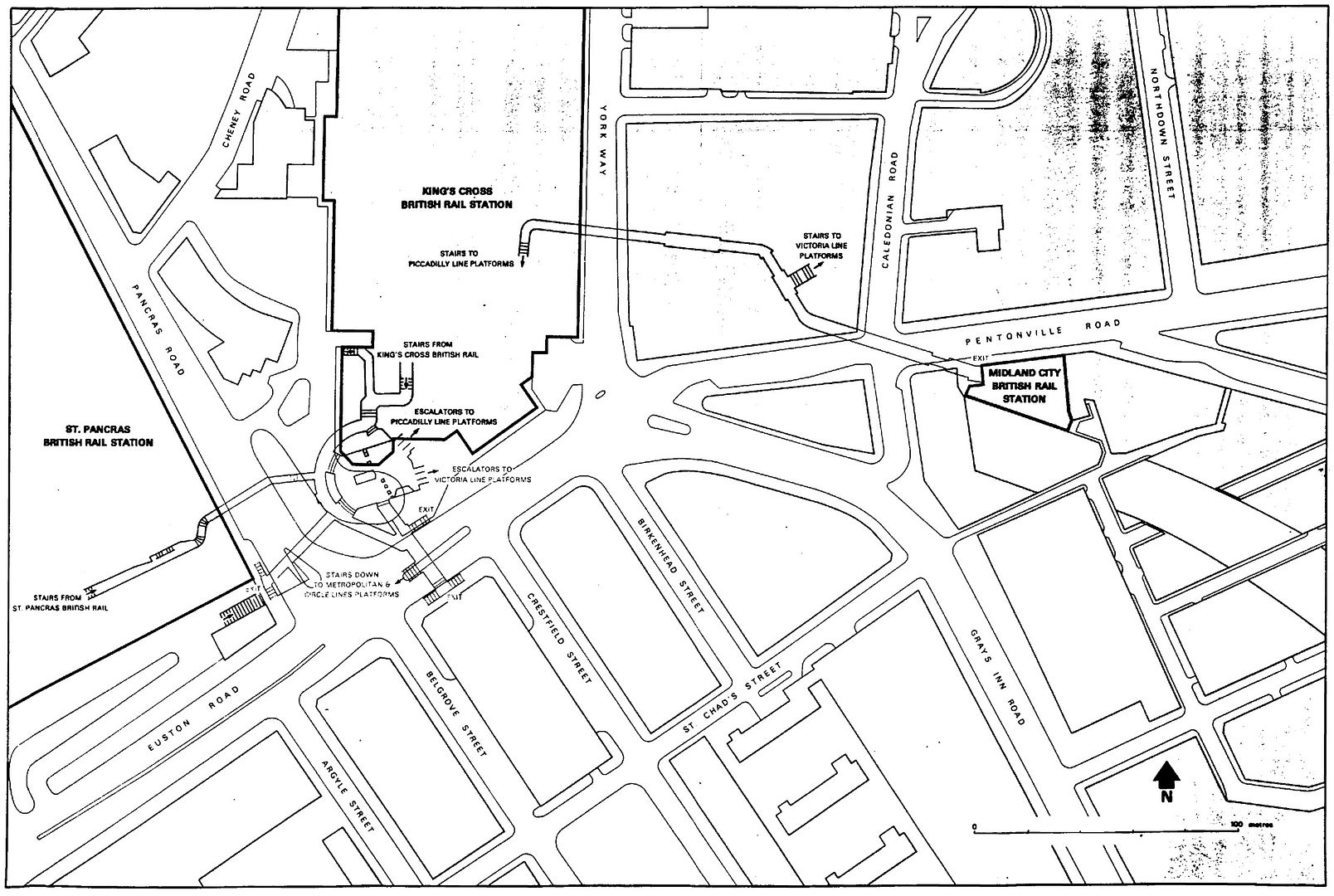
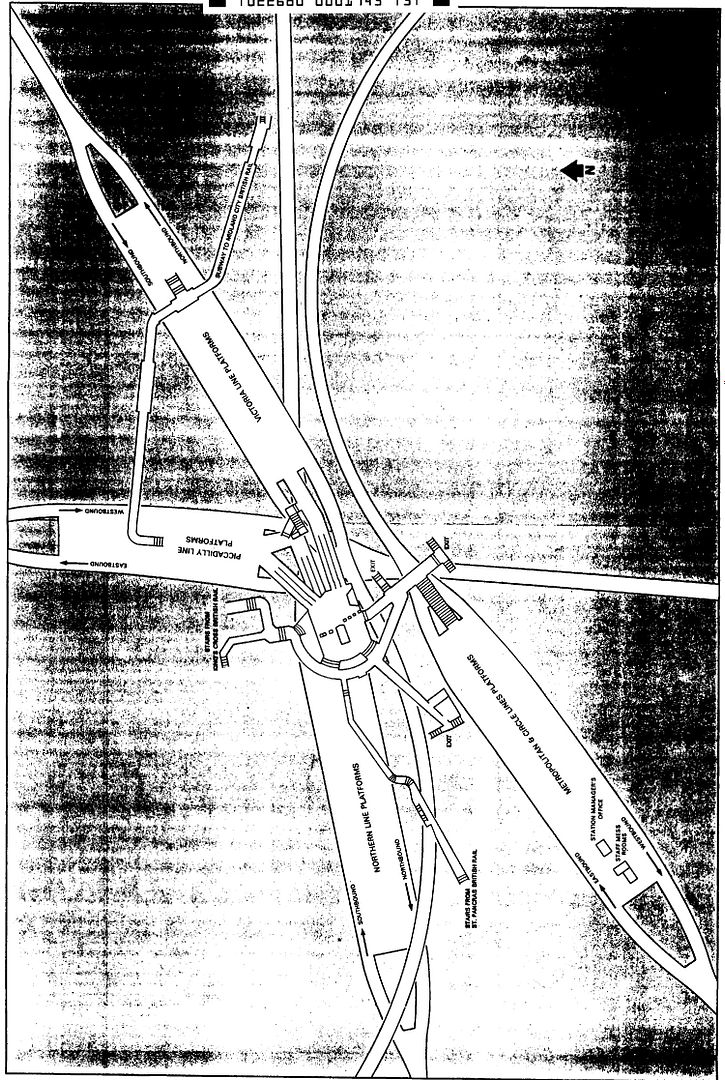
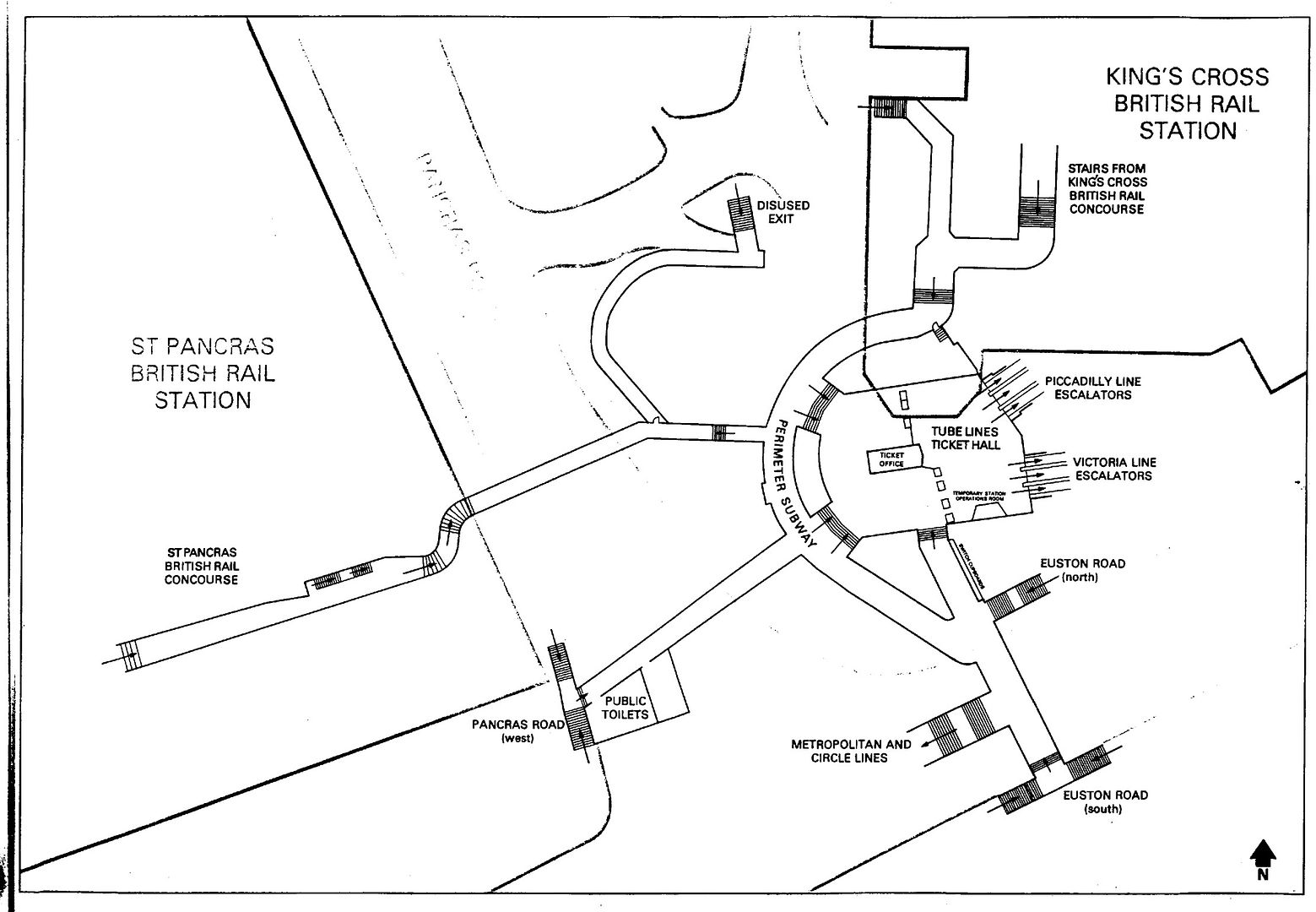
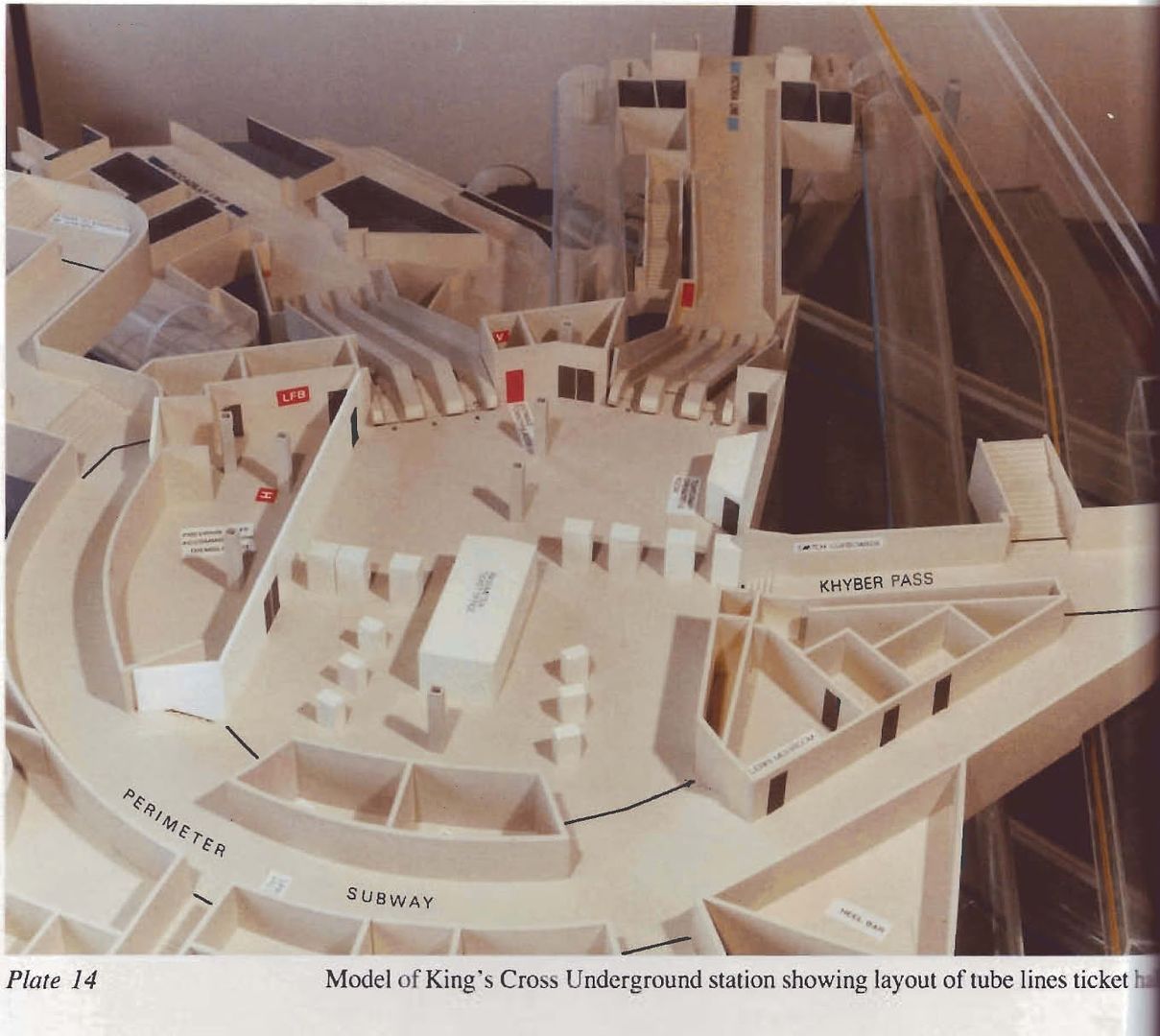
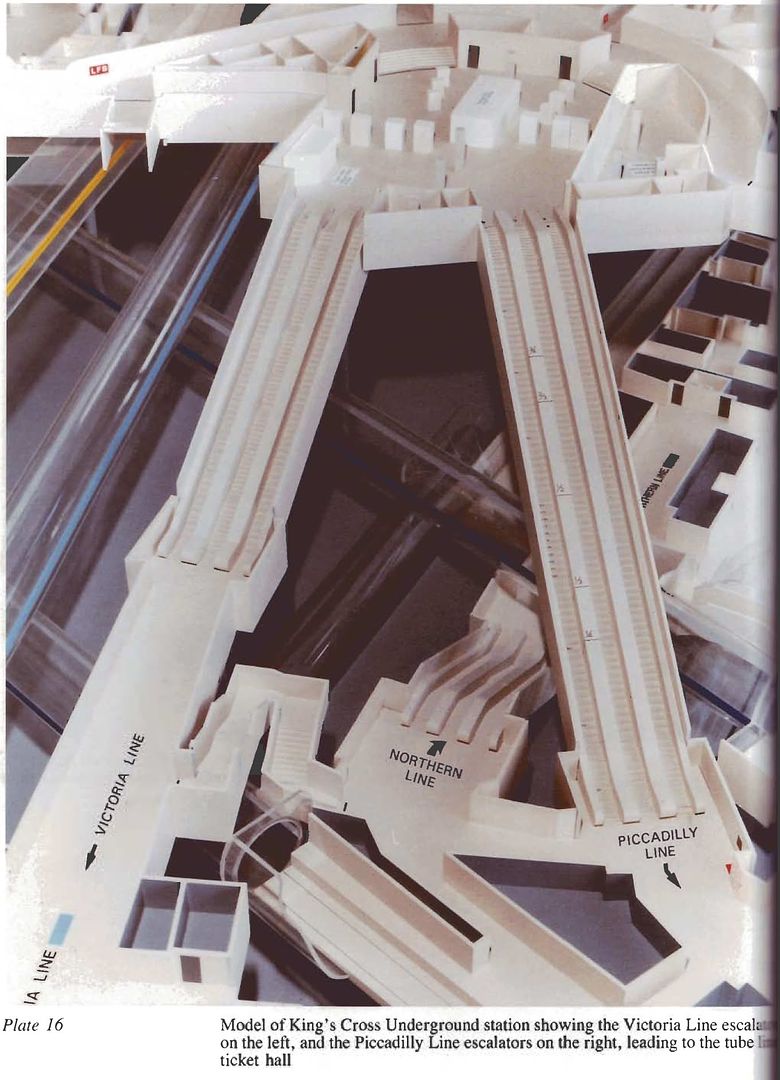

We must remember that a lot of the technology in the Tube stations dated back to the beginning of World War II. On the night of November 18, 1987, the escalators leading from the Piccadilly Line to the King’s Cross tube ticket hall were—like all the other escalators in the system—largely made of wood. Varnished wood. Thin, worn, varnished wood, under which ran a ceaseless procession of metal chain wheels and track wheels lubricated with grease that had not been inspected or changed since before the cabbage crates came over the briny. In the intervening decades, grime and dirt and dust and bits of paper and sweetie wrappers and hair and rat fur and more grime and more dirt and more dust had settled into this grease, stirred in by the ceaseless wheels, forming a dark pudding of lubricant and matter.


Some time before 7:30 P.M., somebody, presumably a passenger leaving the Piccadilly Line platforms via escalator 4 to the main tube ticket hall, stood on the right side of the escalator and lit a cigarette with a match. He or she dropped the match without making sure it was out, and it fell between the side of the escalator and the running track. Underneath the wooden steps, this match landed in the highly flammable grease mixture. This sludge caught on fire, and continued to burn merrily, lighting the undersides of the steps on fire and causing tongues of flame to lick up on the right-hand side of the escalator about halfway up. The ignition of the grease wasn’t noticed at once. Around 7:30, a passenger reported seeing small flames and wispy white smoke to authorities in the tube ticket hall.


The staff on duty that night were unfamiliar with the King's Cross station. Several staff members were off duty or on limited duty due to illness. Passengers were told, as the fire seemed to be small and not dangerous, to leave the station via the Victoria Line escalators nearby. Trains continued to stop at the station and passengers continued to disembark. Just before the first fire engines had arrived at the station, at 7:43 pm, trains were first warned not to stop at King’s Cross.
At this point nobody, not the firemen investigating the situation nor the passengers moving through the station, was aware of what would happen next. The fire in the Piccadilly Line escalator shaft was growing out of all proportion, consuming the paint on the walls and ceiling as it expanded. At 7:45 pm—-we know exactly when, because the digital clock in the ticket hall stopped working as its wires were burnt through-—the flames roaring up the Piccadilly Line shaft exploded into the ticket hall in a violent flashover, igniting every surface in the room. Passengers who had been directed to bypass the Piccadilly escalators via the Victoria escalators found themselves arriving in a chamber suddenly filled with a floor-to-ceiling blowlamp flame roaring from the shaft to their right. Paint and synthetic materials in the room, burning, gave off intensely toxic fumes that asphyxiated those who were not burnt to death.
Firemen had arrived at King’s Cross about two minutes prior to the flashover. During this period various firefighting teams became separated from one another, unable to communicate by radio as these units did not work underground, and unable to reach one another visually due to the thick black smoke. Disoriented and suffering from the intense heat, firefighters and passengers alike struggled to find exits.
At the time of the flashover several transport policemen were still directing passengers to leave the station via the Victoria Line escalators, unaware of the danger. Once they realized the ticket hall above was in flames, these officers did their best to rescue injured passengers and evacuate them from the station via alternate exit routes, but found several of these locked off. It’s possible that more people could have been saved if the exits to the station had all been clear. When the fire was finally contained and extinguished, at 1:46 the next morning, thirty passengers and one fireman were dead.
With a disaster of this magnitude the public was extremely vehement in its demands for answers and solutions. Obviously, the fact that the escalators were made of flammable wood had played a major part in the fire, but was the wood itself solely to blame? Investigators examined the unburnt parts of Piccadilly Line escalator #4, where the fire had begun, and found some disturbing results. The fire of November 18 had not been the first such incident on this escalator: multiple scorch marks in the paint on the undercarriage of the escalator frame indicated that small fires had started many times under this particular escalator, and had-—by sheer luck—-not propagated further. The possibility of arson was investigated and dropped. When the state of the grease and filth under the escalator tracks was discovered, investigators tested this sludge to see whether a carelessly dropped match could ignite it, and on the first attempt managed to cause a fire that licked up through the escalator steps and grew until seven or eight minutes later it was extinguished.
They knew how the fire had started, now. After a fire at Oxford Circus station some little time before, smoking had been prohibited in Underground stations. However, passengers ignored the ban and routinely lit up on the escalators on their way out of the station. Burnt matches and smoker’s materials were found under the right side of the elevators leading out of King’s Cross. It was most likely a discarded match that had sparked the blaze.
But why had a fire that had seemed at first to be nothing more than a couple of little flames and some wispy smoke turned into an inferno capable of killing thirty-one people? Investigators turned to Oxford University to request a computer model of the fire and its propagation. What they found seemed so incredible they asked if the computer scientists hadn’t forgotten a major variable such as gravity: the model showed the flames from the burning escalator steps lying down as they crept up the incline, flowing along the level of the steps and scarcely peeking above the handrails-—effectively hiding the magnitude of the fire from anyone looking at it from an angle. This would later become known as the “trench” effect. The model showed the hot gases from this flame path spiraling up and clockwise round the top of the tunnel, blasting out into the ticket hall with lethal force.

Despite skepticism, investigators created a scale model of the escalator involved in the fire. Under controlled conditions, they lit the model on fire and observed how the flames behaved. Surprisingly enough, the model fire behaved exactly as the computer had predicted, with the fire lying down along the trench of the escalator and erupting with considerable violence into the model ticket hall above.


Eventually, it was concluded that the fire progressed along the following lines. Beginning with the accidental ignition of grease and dirt below escalator 4 approximately halfway up, the fire burned for some little time and apparently did not appear particularly serious or dangerous to police and fire personnel on the scene. However, it quickly began to spread up the escalator, lying along the level of the steps as per the “trench effect,” until the heat it produced plus the pyrolyzates resulting from heat damage to paints, varnishes, and other substances formed sufficient hot gases to flow violently upward into the ticket hall in a sudden burst of flame generally termed a flashover.


Could the thirty-one people who died in King’s Cross have been saved had any one of a number of key individuals acted differently? Perhaps. But as a result of the King’s Cross fire, not only were wooden escalators throughout the Underground required to be replaced with metal, but communications strategies between station personnel, police, and emergency response teams were clarified and streamlined; fire-suppression sprinkler systems in Underground machinery were required to upgrade to meet new regulations; and firefighting theory the world over gained a new and important understanding of flame progression up an inclined plane in an enclosed environment.
Perhaps they didn’t die entirely in vain. But can you imagine what it must be like to have been one of the people to discard a lit match on Piccadilly Line Escalator 4 the night of November 18, and to realize that it might have been your match to blame for all those deaths? Can you imagine what that must feel like?
I have to wonder who that was, and whether they knew, and whether they’re alive now—and what they feel, every time the anniversary comes round.
All images are borrowed without permission and transferred to my own hosting from the official investigation into the disaster. Read it; it’s a fascinating document and well capable of wasting a lunch hour or two.
Subscribe to:
Posts (Atom)